
Explore Trends, Innovations, and Achievements at HengZe Steel
G30 vs G60 Galvanized Steel: Key Differences Explained
- Industry News
- July 29, 2022
- 7:44 am
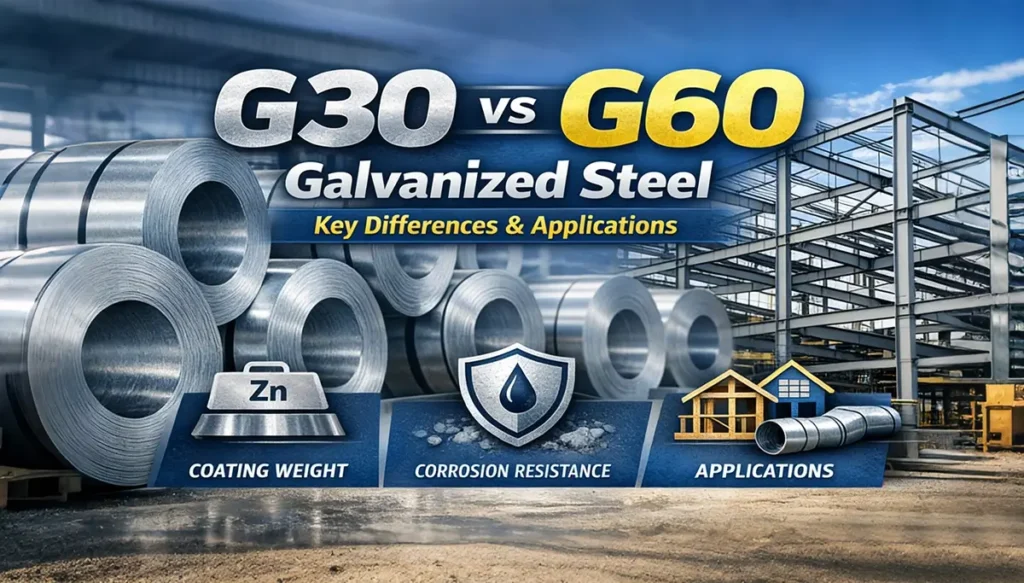
Galvanized steel is widely used in construction, manufacturing, HVAC systems, and industrial equipment due to its cost-effective corrosion protection. However, the performance of galvanized steel largely depends on the zinc coating weight, which determines how well the steel resists corrosion in different environments.
Under ASTM A653, galvanized steel is classified into coating grades such as G30 and G60, each designed for specific exposure conditions. Understanding the difference between G30 vs G60 galvanized steel is essential for engineers, contractors, and steel buyers aiming to balance durability, manufacturability, and cost.
Table of Contents
-
1️⃣ ASTM A653 Standard and Zinc Coating Weights1️⃣ ASTM A653 Standard and Zinc Coating Weights
-
2️⃣ G30 vs G60: Zinc Coating Weight and Thickness2️⃣ G30 vs G60: Zinc Coating Weight and Thickness
-
3️⃣ Performance Comparison: Corrosion Resistance and Fabrication3️⃣ Performance Comparison: Corrosion Resistance and Fabrication
-
4️⃣ Typical Applications and Service Environments4️⃣ Typical Applications and Service Environments
-
5️⃣ How to Choose Between G30 and G60 Galvanized Steel5️⃣ How to Choose Between G30 and G60 Galvanized Steel
-
6️⃣ Final Summary6️⃣ Final Summary
1️⃣ ASTM A653 Standard and Zinc Coating Weights
ASTM A653 / A653M defines hot-dip galvanized steel sheet by zinc coating weight, expressed as the total zinc mass on both sides of the steel sheet.
The coating designation system uses “G + number”, where the number represents ounces of zinc per square foot (oz/ft²). A higher number means a thicker zinc layer and stronger corrosion resistance.
This standardized system allows galvanized steel grades such as ASTM A653 G30 and G60 to be clearly specified for different service environments.
2️⃣ G30 vs G60: Zinc Coating Weight and Thickness
| Coating Grade | Coating Weight (Total) | Approx. Mass (Both Sides) | Coating Thickness (Per Side) | Typical Exposure |
|---|---|---|---|---|
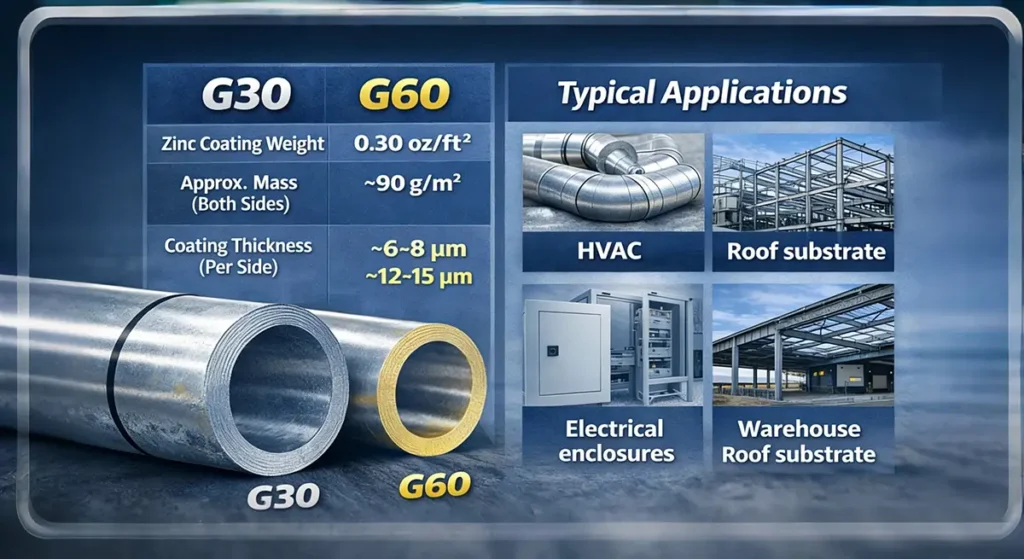
| G30 | 0.30 oz/ft² | ~90 g/m² | ~6–8 µm | Dry or low-corrosion indoor environments |
| G60 | 0.60 oz/ft² | ~180 g/m² | ~12–15 µm | Moderate indoor and light outdoor exposure |
A thicker zinc coating slows down corrosion rates and significantly extends the service life of galvanized steel, especially in humid or semi-exposed conditions.
3️⃣ Performance Comparison: Corrosion Resistance and Fabrication
Corrosion Resistance
G30 galvanized steel provides basic corrosion protection and performs well in dry, controlled indoor environments.
G60 galvanized steel offers improved resistance to moisture, condensation, and occasional outdoor exposure, making it suitable for more demanding applications.
Fabrication and Formability
G30’s thinner zinc layer makes it easier to bend, stamp, weld, and deep-draw, which is advantageous for complex fabricated parts.
G60 remains highly workable but may require slightly more controlled forming to protect the zinc coating during tight-radius bends.
In most manufacturing applications, both grades meet standard fabrication requirements, with G30 favored for intricate forming and G60 for durability-driven designs.
4️⃣ Typical Applications and Service Environments
Where G30 and G60 Are Commonly Used
| Environment / Application | Recommended Grade | Reason |
|---|---|---|
| Indoor or lightly humid environments (HVAC ducts, interior wall panels, electrical enclosures) | G30 or G60 | G30 is widely used for indoor HVAC components, appliance housings, and electrical cabinets where corrosion exposure is limited. G60 provides added safety in areas with occasional humidity. |
| Light-duty fabricated parts (furniture frames, shelving systems, brackets) | G30 | G30 galvanized steel offers sufficient corrosion protection while maintaining excellent formability and lower material cost. |
| Pre-painted galvanized steel substrates (PPGI base material) | G30 | G30 is commonly used as a base steel for pre-painted galvanized products due to its smooth surface and ease of coating adhesion. |
| Moderate outdoor exposure (warehouse walls, roof substrates, framing components) | G60 | G60 provides a balanced level of corrosion resistance for structures exposed to rain, humidity, and temperature variation. |
| Projects requiring longer service life with limited maintenance | G60 | The thicker zinc coating extends durability and reduces long-term corrosion risk. |
In practice, G30 galvanized steel is best suited for interior and low-corrosion applications, while G60 is often selected as a general-purpose grade for projects involving mixed indoor and outdoor exposure.
5️⃣ How to Choose Between G30 and G60 Galvanized Steel
When selecting the appropriate galvanized steel grade, consider the following factors:
Level of environmental exposure (dry indoor vs. humid or semi-outdoor)
Required service life and maintenance expectations
Fabrication complexity and forming requirements
Budget and overall life-cycle cost
If the application is strictly indoor and cost-sensitive, G30 galvanized steel is usually sufficient. For construction, HVAC, and structural components exposed to moisture or varying climates, G60 galvanized steel provides better long-term performance and reliability.
6️⃣ Final Summary
| Category | G30 Galvanized Steel | G60 Galvanized Steel |
|---|---|---|
| Zinc coating weight | Lower | Medium |
| Corrosion resistance | Basic | Enhanced |
| Formability | Excellent | Very good |
| Indoor applications | Ideal | Ideal |
| Light outdoor exposure | Limited | Suitable |
| Typical use | HVAC, appliances, furniture, PPGI base | Construction, framing, HVAC systems |
In summary, G30 is a cost-effective solution for low-corrosion indoor applications, while G60 galvanized steel offers broader application flexibility, improved durability, and stronger corrosion protection, making it the preferred choice for many engineering and construction projects.
Trending News
What to Expect When You Contact Us
Fast Response – Replies within 12 hours
Tailored Solutions – Based on your needs and industry
Full Support – From products to technical and market guidance