
Explore Trends, Innovations, and Achievements at HengZe Steel
How Is Galvanized Steel Coil Manufactured?
A Complete Technical Guide to the Galvanized Steel Coil Manufacturing Process
- Industry News
- May 4, 2022
- 8:47 am
Galvanized steel coil is produced through a continuous hot-dip galvanizing process that enhances corrosion resistance and durability. Starting from cold-rolled steel coils, the process includes surface cleaning, annealing, molten zinc coating, precise thickness control, and skin pass finishing. This ensures consistent coating quality, mechanical performance, and long service life. Widely used in construction, automotive, and industrial applications, galvanized steel coils from Hengze Steel meet international standards and diverse application needs.
Table of Contents
-
1️⃣ Why Steel Requires Galvanizing1️⃣ Why Steel Requires Galvanizing
-
2️⃣ The Engineering Nature of Galvanized Steel Coil2️⃣ The Engineering Nature of Galvanized Steel Coil
-
3️⃣ Overview of the Galvanized Steel Coil Manufacturing Process3️⃣ Overview of the Galvanized Steel Coil Manufacturing Process
-
4️⃣ Detailed Manufacturing Process of Galvanized Steel Coil4️⃣ Detailed Manufacturing Process of Galvanized Steel Coil
-
5️⃣ Zinc Coating Structure and Corrosion Protection Mechanism5️⃣ Zinc Coating Structure and Corrosion Protection Mechanism
-
6️⃣ Key Quality Factors in Galvanized Steel Coil Production6️⃣ Key Quality Factors in Galvanized Steel Coil Production
-
7️⃣ Typical Specifications and Technical Parameters7️⃣ Typical Specifications and Technical Parameters
-
8️⃣ Conclusion: What Defines High-Quality Galvanized Steel Coil8️⃣ Conclusion: What Defines High-Quality Galvanized Steel Coil
1. Why Steel Requires Galvanizing
Carbon steel is inherently vulnerable to corrosion when exposed to moisture, oxygen, and industrial environments. Without protective treatment, oxidation gradually reduces structural integrity and increases maintenance costs.
The galvanized steel coil manufacturing process addresses this issue by applying a zinc-based protection system that provides:
Barrier protection, isolating steel from corrosive elements
Sacrificial (cathodic) protection, where zinc corrodes preferentially to protect the steel substrate
This dual mechanism explains why galvanized steel coils are widely specified for construction, appliances, automotive panels, and infrastructure projects.
2️⃣ The Engineering Nature of Galvanized Steel Coil
From a materials engineering perspective, galvanized steel coil is not simply zinc-coated steel, but a carefully engineered multi-layer composite.
A standard galvanized steel coil structure consists of:
Low-carbon steel substrate
Zinc–iron intermetallic alloy layer
Outer pure zinc coating
Optional surface passivation or functional layer
This engineered structure is the reason why galvanized steel coil performance can vary significantly between manufacturers, even when similar coating weights and standards are claimed.
3️⃣ Overview of the Galvanized Steel Coil Manufacturing Process
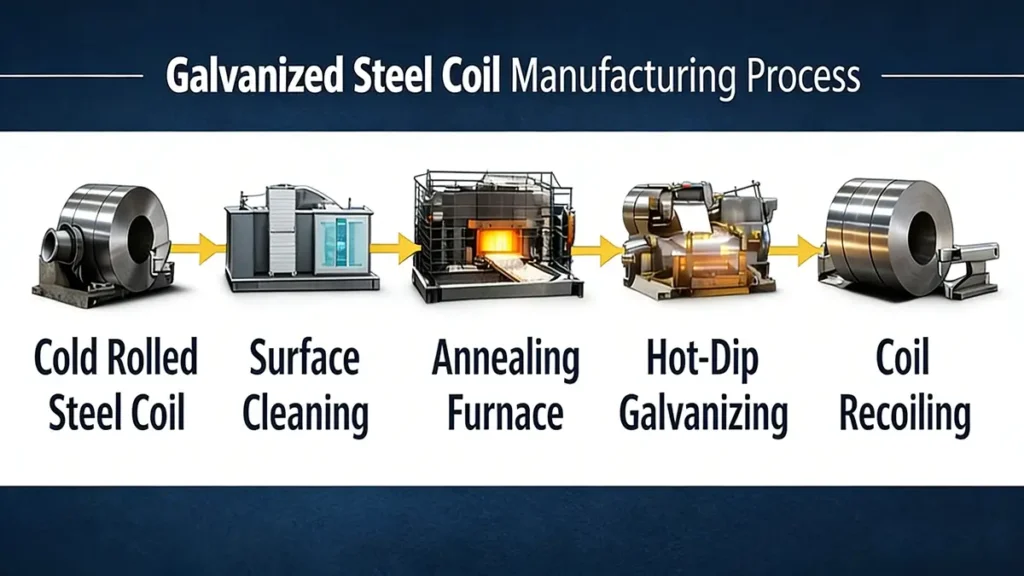
Most modern producers utilize Continuous Galvanizing Lines (CGL) to achieve stable and repeatable results in hot-dip galvanized steel coil production.
The typical galvanized steel coil manufacturing flow is:
Cold-rolled steel coil
→ Surface cleaning and activation
→ Continuous annealing
→ Hot-dip galvanizing
→ Zinc coating control
→ Surface treatment
→ Skin pass, leveling, and recoiling
Manufacturers like Hengze Steel, operating continuous galvanizing lines, rely on this integrated process to maintain uniform coating quality and mechanical consistency across full coil lengths.
4️⃣ Detailed Manufacturing Process of Galvanized Steel Coil
4.1 Base Steel Selection and Its Role
Galvanized steel coils are primarily produced from low-carbon cold-rolled steel grades, such as DX51D, SGCC, or equivalent materials.
These grades are preferred because they provide:
Stable zinc–iron reaction behavior
Uniform microstructure for dense and adherent zinc layers
Excellent formability for bending, stamping, and roll forming
The quality of the base steel establishes the foundation for the entire galvanized steel coil quality control system.
4.2 Surface Preparation: The Foundation of Coating Quality
Prior to galvanizing, the steel strip must reach a chemically clean and activated surface state.
This typically involves:
Alkaline degreasing to remove rolling oils
Acid or chemical cleaning to eliminate surface oxides
Rinsing and drying to prevent contamination
Insufficient surface preparation remains one of the primary causes of coating adhesion failure in galvanized steel coils.
4.3 Continuous Annealing Before Galvanizing
Continuous annealing is an essential step in hot-dip galvanized steel coil manufacturing.
Its functions include:
Relieving cold rolling stresses
Restoring ductility and formability
Optimizing crystal structure for zinc diffusion
Annealing is performed under controlled protective atmospheres to prevent surface oxidation prior to zinc immersion.
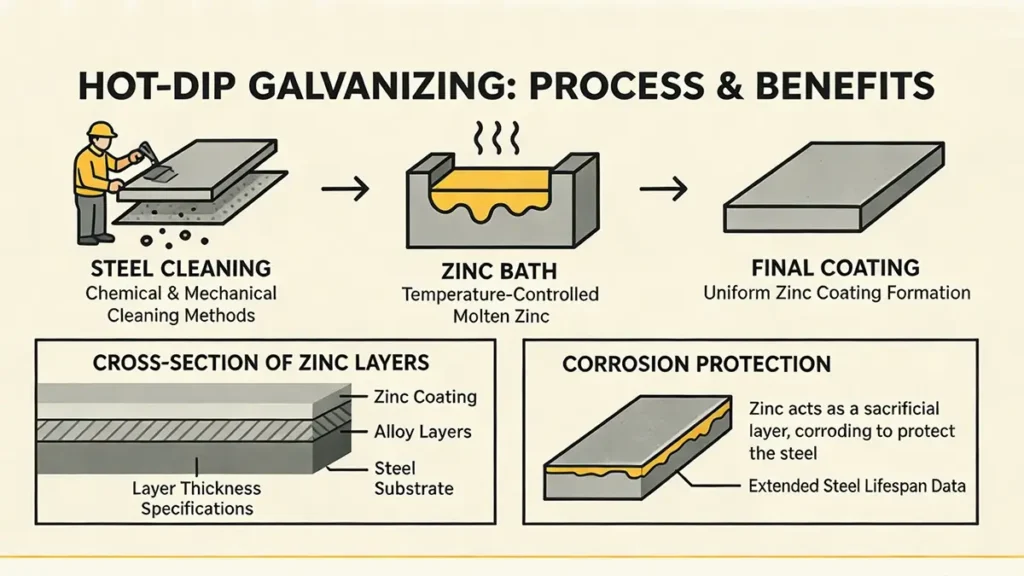
4.4 Hot-Dip Galvanizing Process Explained
During hot-dip galvanizing, the steel strip passes through molten zinc at approximately 450–470°C.
At this stage:
Zinc diffuses into the steel surface
Zinc–iron intermetallic layers are formed
A continuous outer zinc layer develops
This metallurgical bonding mechanism is the defining characteristic of hot-dip galvanized steel coil and the source of its superior corrosion resistance.
4.5 Zinc Coating Thickness and Coating Weight Control
Zinc coating thickness is precisely controlled using air knife systems, rather than immersion time alone.
Key control elements include:
High-velocity air or nitrogen jets removing excess zinc
Online coating weight measurement
Closed-loop automatic adjustment systems
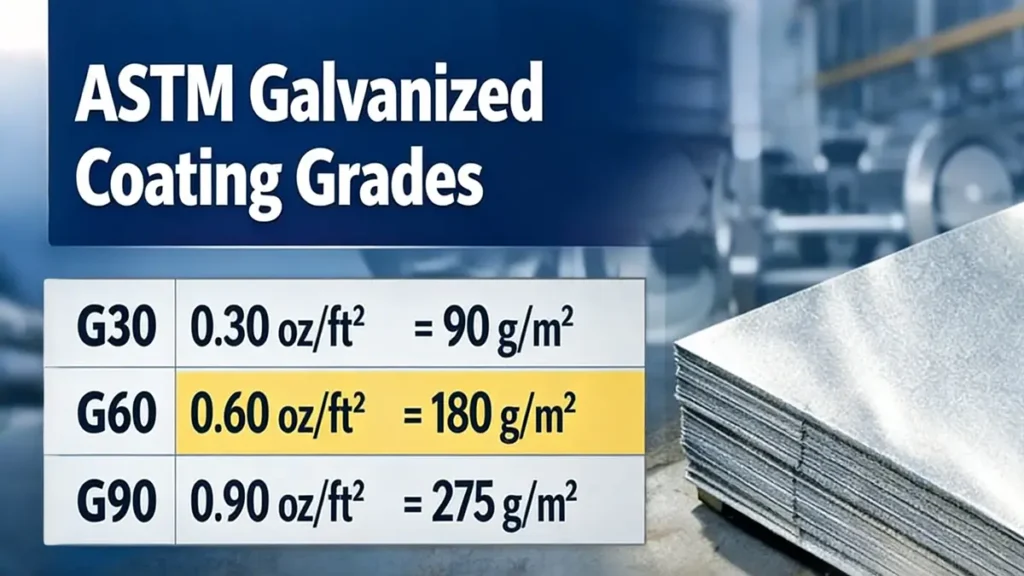
These technologies enable consistent production of common coating specifications such as Z60, Z80, Z120, and Z275.
4.6 Surface Treatment and Functional Finishing
Following galvanizing, surface treatments may be applied to enhance performance:
Passivation to reduce white rust formation
Light oiling to improve formability and handling
Specialized treatments to enhance paint adhesion
Such treatments significantly influence storage stability and downstream processing performance.
4.7 Skin Pass, Leveling, and Coil Finishing
Final finishing typically includes:
Skin pass rolling to improve surface quality
Tension leveling to ensure flatness
Precision recoiling to control internal stress and coil geometry
These steps determine the practical usability of galvanized steel coils in fabrication and installation.
5️⃣ Zinc Coating Structure and Corrosion Protection Mechanism
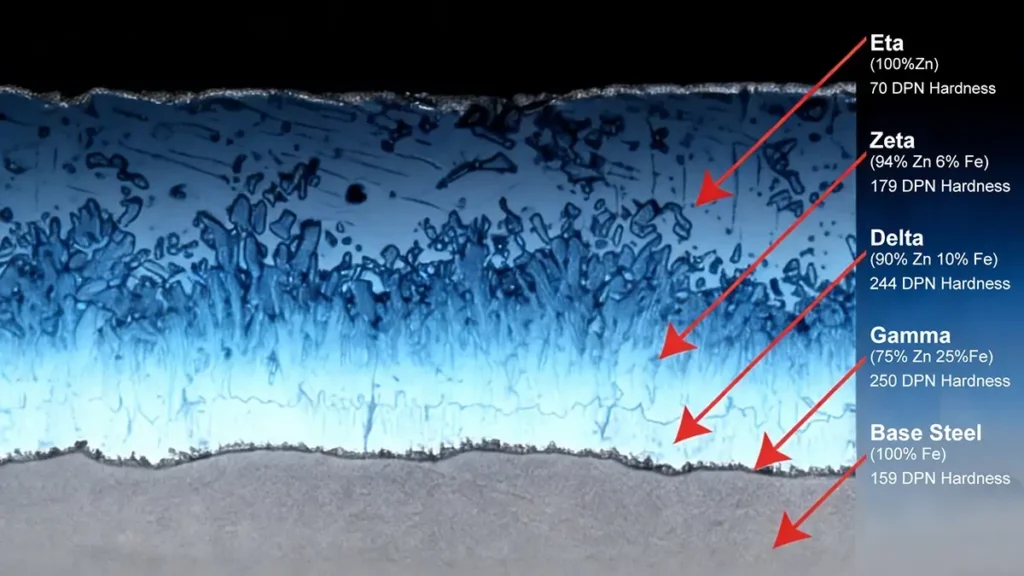
A typical hot-dip galvanized coating consists of:
Zinc–iron alloy layer providing metallurgical adhesion
Pure zinc layer serving as the primary corrosion barrier
Surface treatment layer delaying initial oxidation
This multi-layer protection system ensures long-term corrosion resistance in a wide range of service environments.
6️⃣ Key Quality Factors in Galvanized Steel Coil Production
Beyond nominal standards, actual product performance depends on:
Continuous galvanizing line stability
Precision of annealing atmosphere and temperature control
Air knife accuracy and responsiveness
Online inspection and real-time quality feedback
These factors largely explain the variation in galvanized steel coil quality between different suppliers.
7️⃣ Typical Specifications and Technical Parameters
Table 1: Common Galvanized Steel Coil Specifications
| Parameter | Typical Range |
|---|---|
| Thickness | 0.12 – 3.0 mm |
| Width | 600 – 1,500 mm |
| Coil Weight | 3 – 10 MT |
| Zinc Coating | Z60 – Z275 g/m² |
| Surface Finish | Regular / Minimized / Zero Spangle |
| Surface Treatment | Chromated / Non-chromated / Oiled |
| Standards | ASTM A653, JIS G3302, EN 10346 |
Table 2: Typical Mechanical Properties
| Property | Typical Value |
|---|---|
| Yield Strength | 140 – 350 MPa |
| Tensile Strength | 270 – 500 MPa |
| Elongation | ≥ 18% |
| Formability | Excellent |
8️⃣ Conclusion: What Defines High-Quality Galvanized Steel Coil
Galvanized steel coil manufacturing is a highly integrated industrial process combining metallurgy, heat treatment, surface engineering, and continuous automation.
Companies such as Hengze Steel, operating modern galvanizing lines, emphasize process stability, precise control, and consistent quality management rather than simply meeting minimum specification values.
Ultimately, high-quality galvanized steel coils are defined by long-term manufacturing discipline and technical control at every stage of the production process.
Trending News
What to Expect When You Contact Us
Fast Response – Replies within 12 hours
Tailored Solutions – Based on your needs and industry
Full Support – From products to technical and market guidance