
Explore Trends, Innovations, and Achievements at HengZe Steel
Galvanized Coating Designations Guide | ASTM G90, EN Z275, JIS Z27
- Industry News
- January 29, 2026
- 8:11 am
A Professional Guide to ASTM, EN, and JIS Zinc Coating Standards
Galvanized steel plays a critical role in construction, infrastructure, electrical systems, mechanical engineering, and government-funded projects. To ensure consistent corrosion resistance and compliance, international standards define specific galvanized coating designations that describe the total zinc coating weight applied to both sides of the steel.
At Hengze Steel, we regularly encounter project specifications referencing multiple coating standards. Understanding how these galvanized coating designations work—and how they compare across standards—is essential for engineers, buyers, and technical decision-makers.
This guide provides a clear, neutral, and technically accurate explanation of galvanized coating marks under ASTM, EN, and JIS standards, supported by comparison tables and practical selection guidance.
Table of Contents
-
1️⃣ What Is a Galvanized Coating?1️⃣ What Is a Galvanized Coating?
-
2️⃣ Why Galvanized Coating Designations Matter2️⃣ Why Galvanized Coating Designations Matter
-
3️⃣ ASTM Galvanized Coating Designations3️⃣ ASTM Galvanized Coating Designations
-
4️⃣ EN (European) Zinc Coating Standards4️⃣ EN (European) Zinc Coating Standards
-
5️⃣ JIS Galvanized Coating Designations5️⃣ JIS Galvanized Coating Designations
-
6️⃣ Equivalent Galvanized Coating Grades Across Standards6️⃣ Equivalent Galvanized Coating Grades Across Standards
-
7️⃣ Aluminum-Zinc Alloy Coatings (AZ Series)7️⃣ Aluminum-Zinc Alloy Coatings (AZ Series)
-
8️⃣ How to Select the Appropriate Galvanized Coating8️⃣ How to Select the Appropriate Galvanized Coating
-
ConclusionConclusion
1. What Is a Galvanized Coating?
A galvanized coating is a protective zinc layer applied to steel, most commonly through the hot-dip galvanizing process. During this process, steel is immersed in molten zinc, creating a metallurgical bond that provides long-term corrosion protection.
In nearly all international steel standards, galvanized coating designations represent the total zinc coating weight on both sides of the steel sheet, rather than coating thickness on a single surface. This approach ensures consistent performance expectations across applications.
Hot-dip galvanized steel sheets and coils are widely used in environments requiring durability, weather resistance, and predictable service life.
2️⃣ Why Galvanized Coating Designations Matter
Accurately specifying galvanized coating grades is essential for:
Meeting engineering design and government project requirements
Ensuring adequate corrosion resistance in different exposure conditions
Avoiding ambiguity in international steel procurement
Aligning material performance with expected service life
For example, specifying G90 galvanized steel under ASTM A653 or Z275 zinc coating under EN 10346 clearly defines the corrosion protection level, whereas general descriptions such as “heavy galvanized” do not.
A thicker zinc coating slows down corrosion rates and significantly extends the service life of galvanized steel, especially in humid or semi-exposed conditions.
3️⃣ ASTM Galvanized Coating Designations
3.1 ASTM A653 – Galvanized (GI) Steel
ASTM A653 / A653M is the most widely used standard for hot-dip galvanized steel in North America and many international construction projects.
ASTM galvanized coating designations follow this format:
G + Number
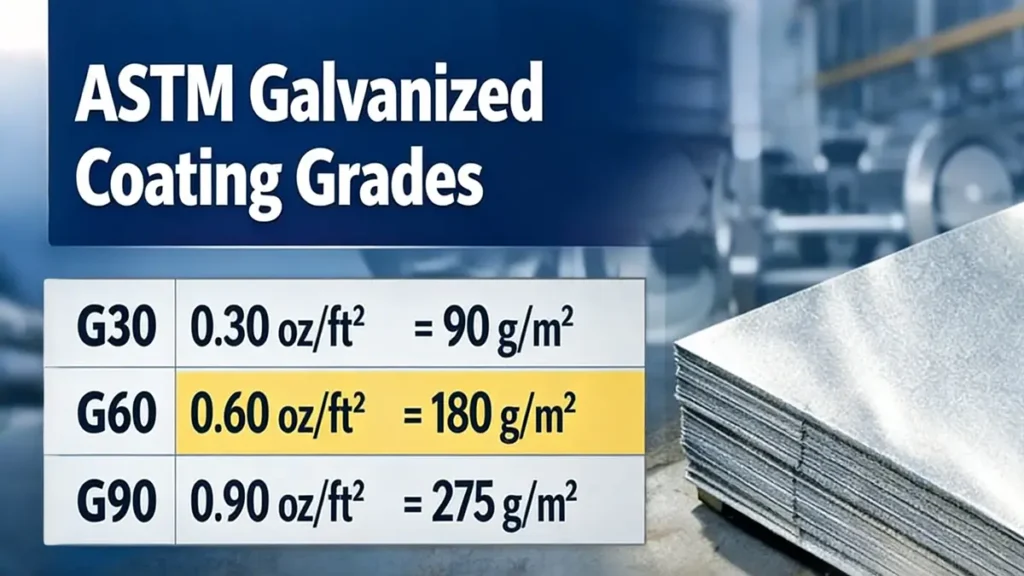
The number indicates the total zinc coating weight on both sides, measured in ounces per square foot (oz/ft²).
| Coating Designation | Zinc Coating (oz/ft²) | Approx. g/m² | Typical Applications |
|---|---|---|---|
| G30 | 0.30 | ≈ 90 | Indoor use, light corrosion |
| G40 | 0.40 | ≈ 120 | Dry environments |
| G60 | 0.60 | ≈ 180 | General outdoor use |
| G90 | 0.90 | ≈ 275 | Structural steel, buildings |
| G120 | 1.20 | ≈ 360 | Higher corrosion exposure |
| G165 | 1.65 | ≈ 500 | Industrial environments |
| G185 | 1.85 | ≈ 565 | Severe corrosion conditions |
Among these, G90 galvanized coating is the most commonly specified grade for structural and infrastructure applications.
3.2 Galvannealed Coatings (ASTM A653 – A Series)
ASTM A653 also defines galvannealed steel, which features a zinc-iron alloy coating.
| Coating Designation | Coating Type | Typical Applications |
|---|---|---|
| A40 | Zinc-iron alloy | |
| A60 | Zinc-iron alloy | |
| A90 | Zinc-iron alloy | Automotive panels, welded parts |
Galvannealed coatings provide improved paint adhesion and weldability, though their corrosion resistance is slightly lower than equivalent galvanized coatings.
4️⃣ EN (European) Zinc Coating Standards
EN 10346 – Zinc Coated Steel Sheets
European standards express zinc coating weight using:
Z + Number (g/m²)
The number represents the total zinc coating mass on both sides of the steel.
| Coating Designation | Zinc Coating (g/m²) |
|---|---|
| Z100 | 100 |
| Z140 | 140 |
| Z180 | 180 |
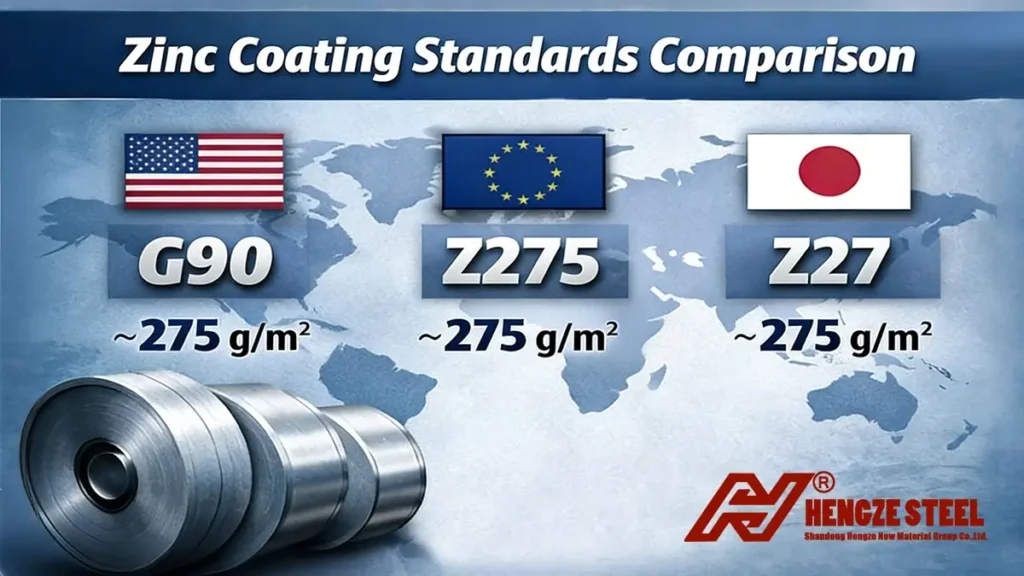
| Z275 | 275 (most widely specified) |
| Z350 | 350 |
| Z450 | 450 |
| Z600 | 600 |
In many international tenders, Z275 galvanized steel is widely accepted and often referenced alongside ASTM G90.
In practice, G30 galvanized steel is best suited for interior and low-corrosion applications, while G60 is often selected as a general-purpose grade for projects involving mixed indoor and outdoor exposure.
5️⃣ JIS Galvanized Coating Designations
JIS G3302
The Japanese Industrial Standard also uses Z-based designations, expressed in g/m².
| Coating Designation | Zinc Coating (g/m²) |
|---|---|
| Z08 | 80 |
| Z10 | 100 |
| Z18 | 180 |
| Z27 | 275 |
| Z35 | 350 |
| Z45 | 450 |
| Z60 | 600 |
JIS Z27 is commonly specified in projects across Japan, Southeast Asia, and Singapore, and is technically comparable to ASTM G90 and EN Z275.
6️⃣ Equivalent Galvanized Coating Grades Across Standards
Understanding how galvanized coating grades align across standards is essential for global sourcing and specification consistency.
| Corrosion Protection Level | ASTM A653 | EN 10346 | JIS G3302 |
|---|---|---|---|
| Light duty | G30 | Z100 | Z10 |
| Medium duty | G60 | Z180 | Z18 |
| Most commonly specified | G90 | Z275 | Z27 |
| High corrosion resistance | G120 | Z350 | Z35 |
| Very high corrosion | G165 | Z450 | Z45 |
| Extreme environments | G185+ | Z600+ | Z60+ |
These equivalencies are widely used for technical reference, although project documentation should always state the applicable standard explicitly.
7️⃣ Aluminum-Zinc Alloy Coatings (AZ Series)
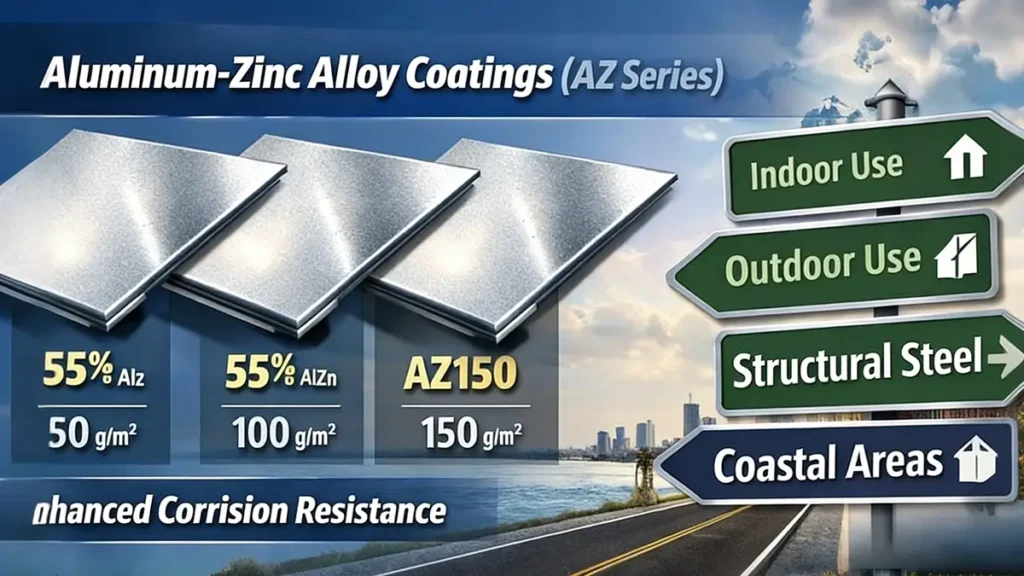
For applications requiring enhanced corrosion resistance, aluminum-zinc alloy coatings (often referred to as Galvalume®) are commonly used.
| Coating Designation | Coating Type | Total Coating (g/m²) |
|---|---|---|
| AZ50 | 55% Al-Zn alloy | 50 |
| AZ100 | 55% Al-Zn alloy | 100 |
| AZ150 | 55% Al-Zn alloy | 150 |
| AZ180 | 55% Al-Zn alloy | 180 |
Compared to traditional galvanized steel, aluminum-zinc coated steel offers superior corrosion resistance, particularly in marine and industrial environments.
8️⃣ How to Select the Appropriate Galvanized Coating
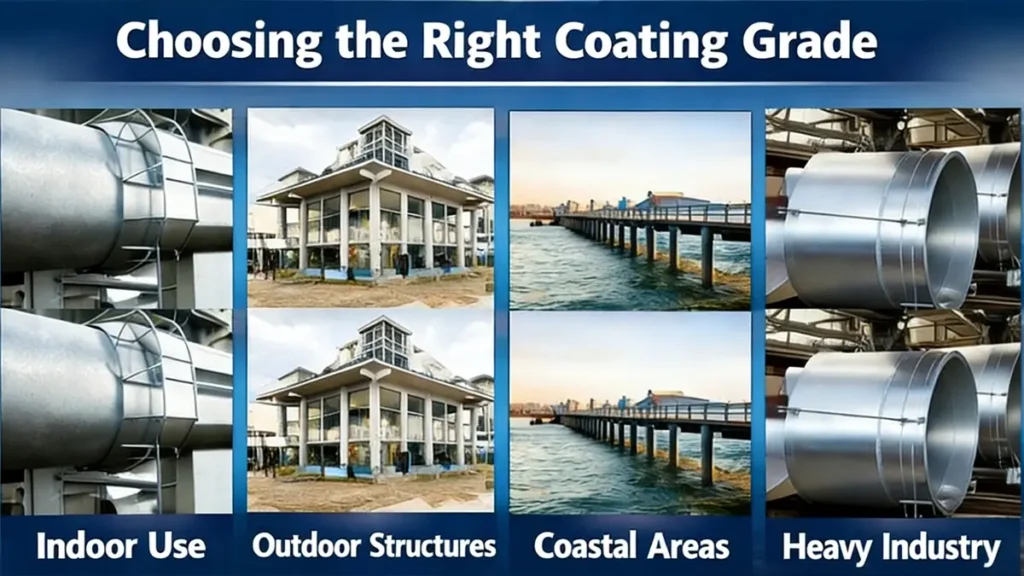
Selecting the correct galvanized coating grade depends on environmental exposure, service life expectations, and regulatory requirements.
| Application Environment | Recommended Coating Grade |
|---|---|
| Indoor, dry conditions | G30 / Z100 |
| General outdoor use | G60 / Z180 |
| Buildings and infrastructure | G90 / Z275 / Z27 |
| Coastal or industrial areas | G120+ / Z350+ |
| Highly corrosive environments | AZ150 or higher |
In practice, many engineers and buyers consult experienced steel suppliers—such as Hengze Steel—to ensure the selected coating grade aligns with both project specifications and long-term performance requirements.
Conclusion
Although galvanized coating designations differ across ASTM, EN, and JIS standards, they all serve the same purpose: defining the total zinc coating weight and expected corrosion protection level.
Across global construction and infrastructure projects, G90, Z275, and Z27 remain the most widely recognized and accepted galvanized coating grades. A clear understanding of these designations supports accurate specification, smoother international trade, and predictable material performance.
For projects requiring technical clarification or material comparison, Hengze Steel continues to support engineers and procurement teams with standards-based guidance and consistent galvanized steel solutions.
Trending News
-
G30 vs G60 Galvanized Steel: Key Differences & Applications - [Cloned #13365]
-
G30 vs G60 Galvanized Steel: Key Differences & Applications
-
How Coating Technologies Improve PPGI Steel Coil Performance
-
Steel Coil Uses & Applications Across Industries | Hengze Steel
-
How to Choose Zinc Coating Thickness for Galvanized Steel Coils
What to Expect When You Contact Us
Fast Response – Replies within 12 hours
Tailored Solutions – Based on your needs and industry
Full Support – From products to technical and market guidance