
Explore Trends, Innovations, and Achievements at HengZe Steel
What Is Zn-Al-Mg Coated Steel? Properties & Applications
- Industry News
- October 16, 2026
- 2:48 am
Zn-Al-Mg coated steel is carbon steel protected by a zinc-aluminum-magnesium alloy coating designed to improve corrosion resistance. Compared with conventional hot-dip galvanized steel, it can provide better corrosion performance under many atmospheric conditions, particularly at cut edges, punched holes, and formed sections.
The coating combines zinc’s sacrificial protection with the beneficial effects of aluminum and magnesium in the formation of protective corrosion products. Actual performance depends on alloy composition, coating mass, steel grade, fabrication methods, and environmental exposure.
For construction, solar mounting systems, cable trays, agricultural buildings, and infrastructure projects, Zn-Al-Mg coated steel offers a practical option when corrosion resistance and fabrication efficiency are important.
Hengze Steel focuses on steel products for industrial and construction applications. When evaluating Zn-Al-Mg coated steel for a project, buyers should compare the coating specification, base steel grade, dimensional requirements, and verified corrosion-performance data rather than relying on the coating name alone.
Table of Contents
-
1️⃣ What Is Zn-Al-Mg Coated Steel?1️⃣ What Is Zn-Al-Mg Coated Steel?
-
2️⃣ Chemical Composition and Corrosion Protection2️⃣ Chemical Composition and Corrosion Protection
-
3️⃣ Key Properties of Zn-Al-Mg Coated Steel3️⃣ Key Properties of Zn-Al-Mg Coated Steel
-
4️⃣ Zn-Al-Mg vs. Galvanized Steel vs. Galvalume4️⃣ Zn-Al-Mg vs. Galvanized Steel vs. Galvalume
-
5️⃣ Main Applications of Zn-Al-Mg Coated Steel5️⃣ Main Applications of Zn-Al-Mg Coated Steel
-
6️⃣ Coating Mass and Technical Specifications6️⃣ Coating Mass and Technical Specifications
-
7️⃣ Fabrication and Storage Considerations7️⃣ Fabrication and Storage Considerations
-
8️⃣ How to Choose Zn-Al-Mg Coated Steel8️⃣ How to Choose Zn-Al-Mg Coated Steel
-
9️⃣ Frequently Asked Questions9️⃣ Frequently Asked Questions
-
ConclusionConclusion
1️⃣ What Is Zn-Al-Mg Coated Steel?
Zn-Al-Mg coated steel is steel sheet or strip coated with an alloy consisting primarily of zinc, aluminum, and magnesium, typically through a continuous hot-dip process.
The coating protects the underlying carbon steel by providing a physical barrier and sacrificial corrosion protection. Its alloy chemistry also influences the corrosion products that develop during exposure, helping slow coating degradation under suitable conditions.
Common product forms include steel coils, sheets, and slit strips for subsequent cutting, punching, bending, and roll forming.
Relevant standards
Three important standards for this product category are:
ASTM A1046/A1046M: Covers hot-dip zinc-aluminum-magnesium alloy-coated steel sheet.
EN 10346: Covers continuously hot-dip coated steel flat products, including Zn-Al-Mg coatings designated ZM.
JIS G 3323: Covers hot-dip zinc-aluminum-magnesium alloy-coated steel sheet and strip.
The applicable standard, steel grade, coating mass, and mechanical properties should be confirmed in the purchase specification.
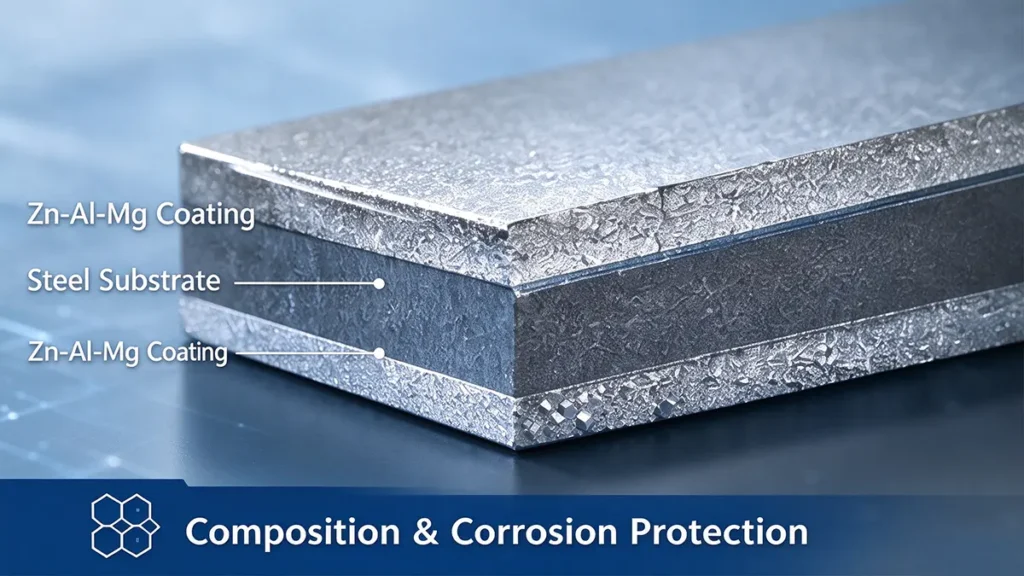
2️⃣ Chemical Composition and Corrosion Protection
Zn-Al-Mg coating performance depends on the interaction of its three principal elements.
Element | Main contribution |
|---|---|
Zinc (Zn) | Provides sacrificial protection and contributes to the protective coating layer. |
Aluminum (Al) | Influences coating microstructure and the formation of protective surface films. |
Magnesium (Mg) | Helps form corrosion products that can reduce further coating degradation. |
Commercial formulations are not identical. For example, ArcelorMittal’s Magnelis coating contains approximately 3.5% aluminum and 3% magnesium, while Nippon Steel’s ZAM product is associated with a formulation containing approximately 6% aluminum and 3% magnesium. These are manufacturer-specific examples, not universal compositions.
How does Zn-Al-Mg coating work?
The coating protects steel through three complementary mechanisms:
-
Barrier protection: The metallic layer separates the steel substrate from moisture and corrosive substances.
-
Sacrificial protection: Zinc preferentially corrodes under suitable electrochemical conditions, helping protect small areas of exposed steel.
-
Protective corrosion products: Zinc-, aluminum-, and magnesium-containing compounds can form a relatively stable surface layer that slows further corrosion.
3️⃣ Key Properties of Zn-Al-Mg Coated Steel
3.1 Enhanced corrosion resistance
Zn-Al-Mg coated steel can outperform conventional galvanized steel in many atmospheric environments. The improvement depends on alloy chemistry, coating mass, humidity, chloride deposition, pollution, and exposure duration.
3.2 Improved cut-edge protection
Cut edges and punched holes are common corrosion-sensitive areas in roll-formed profiles, solar mounting rails, and cable trays.
Zn-Al-Mg coatings can provide improved protection around these locations through sacrificial action and the formation of protective corrosion products. This may delay red rust formation, although it does not eliminate corrosion risk.
3.3 Potential for lower coating mass
In suitable applications, Zn-Al-Mg coated steel may achieve the required corrosion performance with less coating mass than conventional galvanized steel.
Any substitution should be supported by relevant technical data or qualification testing. Lower coating mass does not automatically mean equivalent service life in every environment.
3.4 Formability and fabrication
Depending on the base steel grade and coating specification, Zn-Al-Mg coated steel can be processed by:
Roll forming and bending
Shearing and punching
Stamping and profiling
Welding and mechanical fastening
The substrate grade determines key mechanical properties, including yield strength, tensile strength, and elongation. The selected material must meet both structural and fabrication requirements.
3.5 Life-cycle cost
A suitable Zn-Al-Mg coating may reduce maintenance or replacement requirements in certain applications. However, the economic benefit depends on material price, coating mass, fabrication losses, installation, inspection, and expected service conditions.
The total cost over the intended service life is more informative than the initial price per tonne alone.
4️⃣ Zn-Al-Mg vs. Galvanized Steel vs. Galvalume
These three coating systems are used to protect steel from corrosion, but their compositions and performance characteristics differ.
Feature | |||
|---|---|---|---|
Main coating composition | Primarily zinc | Zinc, aluminum, magnesium | Primarily aluminum and zinc, typically with silicon |
Protection mechanism | Barrier and sacrificial protection | Barrier, sacrificial protection, and protective corrosion products | Strong barrier protection with alloy-dependent sacrificial behavior |
Cut-edge performance | Zinc provides sacrificial protection | Often improved edge protection under comparable conditions | Different edge behavior; depends on coating and exposure |
Typical applications | General construction and fabrication | Solar supports, profiles, cable trays, infrastructure | Roofing, cladding, and building envelopes |
Main selection factor | Established specifications and cost | Corrosion performance, coating mass, and edge exposure | Atmospheric performance and application requirements |
Galvalume generally refers to a zinc-aluminum-silicon coating based on approximately 55% aluminum, 43.4% zinc, and 1.6% silicon. Actual commercial specifications may vary.
Which coating should you choose?
Choose galvanized steel when conventional zinc protection meets the project’s requirements.
Consider Zn-Al-Mg coated steel when enhanced corrosion resistance, especially around fabricated edges, is important.
Consider Galvalume for applications such as roofing and cladding where its specific coating characteristics suit the design.
No coating is universally superior in every environment. Comparisons should use equivalent exposure conditions, appropriate test methods, and clearly defined coating specifications.
5️⃣ Main Applications of Zn-Al-Mg Coated Steel
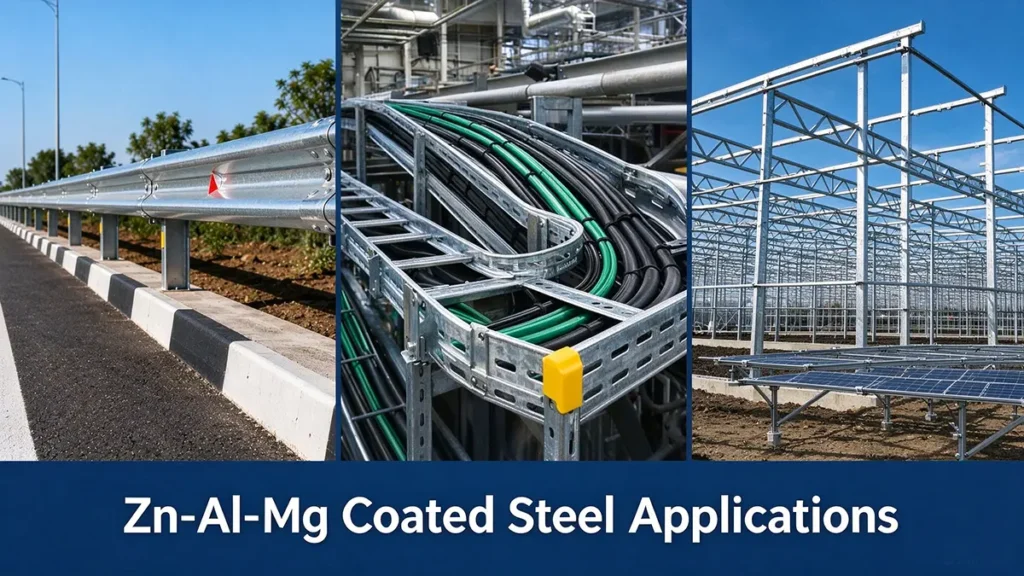
Zn-Al-Mg coated steel is used in applications that require corrosion protection alongside the strength and formability of steel.
5.1 Solar photovoltaic mounting systems
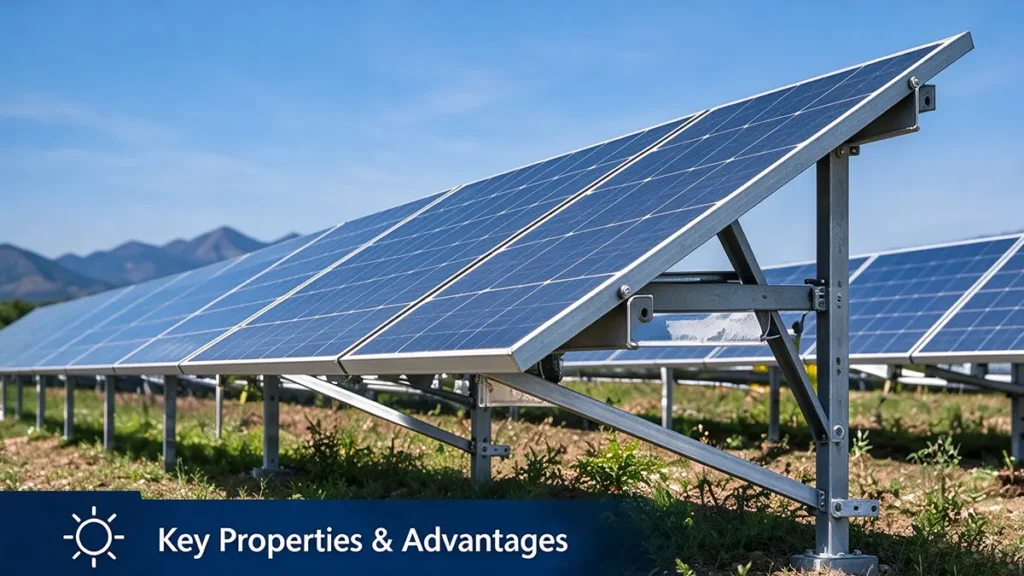
Solar mounting rails, purlins, brackets, posts, and support profiles are exposed to rain, condensation, temperature changes, and sometimes airborne salts. Zn-Al-Mg coated steel can offer improved protection for perforated and cold-formed components. Coating selection should account for site conditions, structural loads, connection details, and the project’s design life.
5.2 Construction and building components
Common applications include C- and Z-purlins, roof and wall supports, metal profiles, cable trays, and other formed components. The coating can be useful where cutting and punching expose steel edges during manufacturing.
5.3 Agricultural buildings and greenhouse structures
Greenhouse frames, farm buildings, fencing, and selected agricultural equipment may benefit from improved atmospheric corrosion resistance. Enclosed livestock facilities and areas exposed to manure, fertilizers, or frequent washdown require additional assessment because chemical exposure can accelerate corrosion.
5.4 Cable trays and electrical infrastructure
Cable trays, brackets, and electrical support systems contain numerous punched holes, joints, and cut edges. Zn-Al-Mg coated steel can be suitable for outdoor and industrial installations when the coating specification matches the environmental conditions.
5.5 Transportation and general infrastructure
Potential applications include roadside barriers, fencing, utility supports, poles, and selected railway or industrial components. Road salt, soil contact, standing water, and mechanical abrasion must be considered when determining the appropriate protection system.
These are potential applications rather than blanket approvals. Each project requires an assessment of coating requirements, structural performance, fabrication methods, and actual exposure conditions.
6️⃣ Coating Mass and Technical Specifications
Coating mass is a key purchasing parameter because it indicates the quantity of metallic coating applied to the steel.
Under EN 10346, the ZM designation identifies a zinc-aluminum-magnesium coating family. In the referenced commercial product range, the numerical value indicates the nominal total coating mass across both sides.
The following values are illustrative published specifications for one commercial product family.
| Coating designation | Total coating mass, both sides | Approx. thickness per side |
|---|---|---|
| ZM70 | 70 g/m² | 5 µm |
| ZM120 | 120 g/m² | 10 µm |
| ZM200 | 200 g/m² | 16 µm |
| ZM250 | 250 g/m² | 20 µm |
| ZM310 | 310 g/m² | 25 µm |
| ZM430 | 430 g/m² | 35 µm |
Source: ArcelorMittal Magnelis product specifications. Thickness values are approximate and depend on the coating density and measurement method.
A higher coating mass generally provides a greater reserve of protective material, but the appropriate grade depends on the application. The highest available coating mass is not necessarily the most cost-effective choice.
What should a technical specification include?
Parameter | Requirement to confirm |
|---|---|
Product standard | ASTM A1046/A1046M, EN 10346, JIS G 3323, or the specified equivalent |
Base steel grade | Strength, formability, and applicable mechanical properties |
Steel thickness | Nominal thickness and tolerances |
Coating specification | ZM designation or equivalent, coating mass, and applicable acceptance criteria |
Surface treatment | Passivation, oiling, or other specified treatment |
Dimensions | Width, length, coil dimensions, and dimensional tolerances |
Quality documentation | Inspection results, test reports, and required certificates |
Buyers should confirm that the specified steel grade and coating are available together in the required dimensions and that the supplied product meets the relevant standard.
For project-based procurement, Hengze Steel can be considered as a potential supplier to discuss Zn-Al-Mg coated steel requirements. Buyers should confirm the available coating grades, base steel specifications, dimensions, production capabilities, and supporting quality documentation before placing an order.
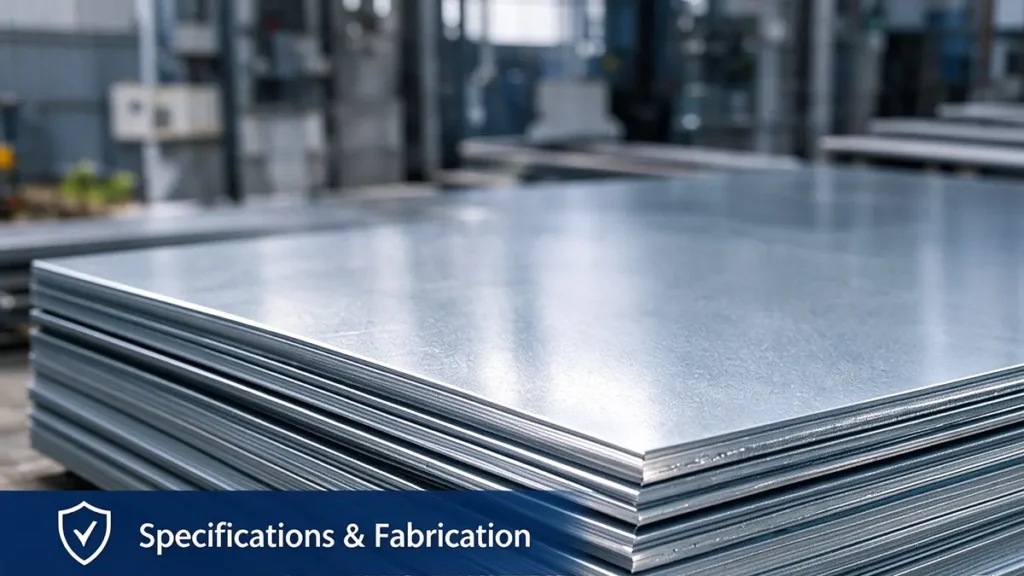
7️⃣ Fabrication and Storage Considerations
Zn-Al-Mg coated steel can be processed using conventional coated-steel fabrication methods, but cutting, forming, welding, and storage practices influence the condition of the finished coating.
Cutting and punching
Cutting and punching expose the steel substrate at edges and holes. Although Zn-Al-Mg coatings can improve cut-edge corrosion resistance, the result depends on cutting quality, defect size, coating specification, and exposure conditions.
Thermal cutting may damage the coating near the edge. Where required, evaluate edge protection and post-fabrication treatment according to the intended service environment.
Bending and roll forming
The minimum bend radius depends on steel grade, thickness, coating specification, and forming conditions. Tight bends or unsuitable tooling can damage the coating.
Use the supplier’s technical recommendations for the selected product rather than applying a universal bend-radius value.
Welding and joining
Welding can damage the coating in the heat-affected area. Appropriate welding parameters, ventilation, fume extraction, and post-weld corrosion protection should be established for the application.
Bolted connections should also be designed to minimize water retention, crevices, and potential galvanic corrosion between dissimilar metals.
Storage and transportation
Keep coils and sheets dry, well ventilated, and protected from rain and condensation. Water trapped between stacked sheets can cause white corrosion products or surface staining.
For long-distance transportation, follow the supplier’s packaging, handling, and storage recommendations.
Environmental limitations
Zn-Al-Mg coated steel is not immune to corrosion. Continuous immersion, aggressive chemicals, severe chloride exposure, soil contact, and persistent standing water may require a different coating system or additional protection.
8️⃣ How to Choose Zn-Al-Mg Coated Steel
A practical selection process should address five key questions.
Where will the steel be used? Identify whether the environment is rural, urban, industrial, coastal, agricultural, or subject to chemical exposure.
What coating specification is required? Confirm the applicable standard, coating designation, coating mass, and surface treatment.
What mechanical properties are needed? Select the base steel grade, thickness, strength, and formability to suit the component design.
How will the steel be fabricated? Consider cutting, punching, bending, welding, fastening, and post-fabrication protection.
What evidence supports the expected durability? Review technical datasheets, inspection certificates, corrosion-test results, and relevant exposure data.
Salt-spray testing can help compare products tested under the same protocol, but test hours should not be directly converted into years of outdoor service life.
For procurement teams, it is also worth comparing total cost, including material, fabrication, installation, inspection, maintenance, and potential replacement.
9️⃣ Frequently Asked Questions
It often provides better corrosion resistance under comparable atmospheric conditions, particularly around cut edges. The degree of improvement depends on alloy composition, coating mass, and exposure conditions.
There is no universal service-life figure. Durability depends on the coating specification, environment, fabrication quality, installation details, and maintenance requirements. Project-specific exposure data are preferable to generalized lifetime claims.
For the referenced EN-style commercial product designation, ZM310 represents a nominal total coating mass of 310 g/m² across both sides. Always verify the exact requirements against the applicable standard and supplier datasheet.
Yes. Suitable products can be painted if the surface preparation, pretreatment, and paint system are compatible with the metallic coating and intended exposure.
Yes. It is used for solar mounting rails, purlins, brackets, and other structural components. The required coating mass and steel grade should be selected according to site corrosivity, structural design, and project requirements.
No. Zn-Al-Mg is a general coating category. Magnelis and ZAM are commercial product names associated with specific manufacturers. Their formulations, available grades, and product specifications may differ.
Conclusion
Zn-Al-Mg coated steel combines the structural versatility of carbon steel with a metallic coating designed to improve corrosion resistance. Its principal advantages include enhanced atmospheric corrosion performance, improved protection at certain cut edges, and suitability for a wide range of formed steel components.
It is particularly relevant to solar mounting systems, construction profiles, cable trays, agricultural structures, and selected infrastructure applications.
However, material selection should be based on the complete specification—not simply the Zn-Al-Mg designation. Coating mass, substrate grade, fabrication methods, exposure conditions, and quality documentation all influence the finished product’s performance.
Hengze Steel can be contacted to discuss steel requirements for construction and industrial projects. When evaluating a potential supply, specify the intended application, steel grade, dimensions, coating mass, applicable standard, and required certificates to help establish whether the proposed material meets your project requirements.
Trending News
What to Expect When You Contact Us
Fast Response – Replies within 12 hours
Tailored Solutions – Based on your needs and industry
Full Support – From products to technical and market guidance