
Explore Trends, Innovations, and Achievements at HengZe Steel
PPGL Steel Coil Specifications: Thickness, Width & Coating
- Industry News
- August 14, 2026
- 6:33 am
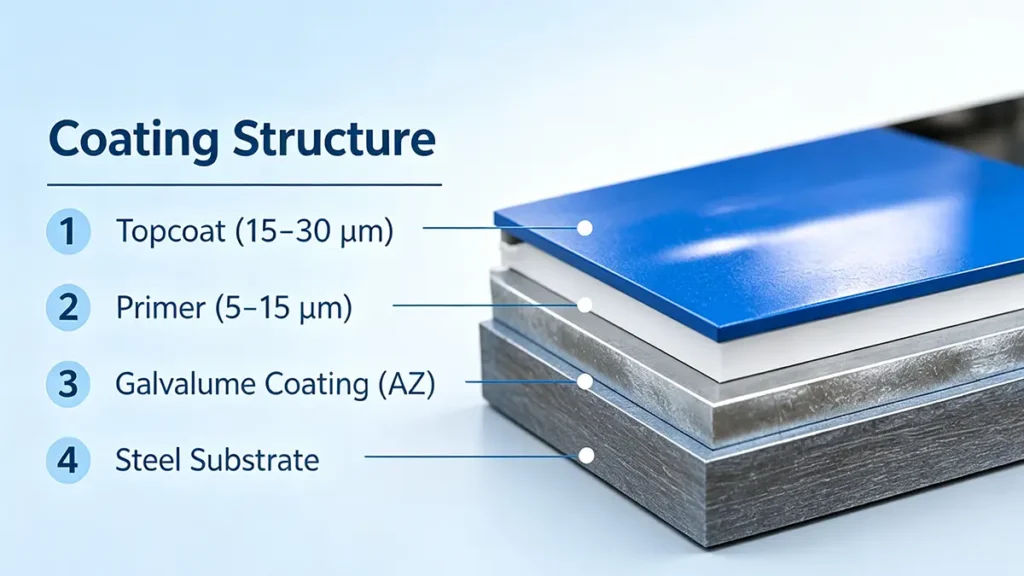
PPGL steel coil is prepainted Galvalume steel coil, consisting of a steel substrate, aluminum-zinc alloy coating, pretreatment, primer, and topcoat. For buyers, the most important specifications are thickness, width, AZ coating mass, steel grade, paint system, and mechanical properties.
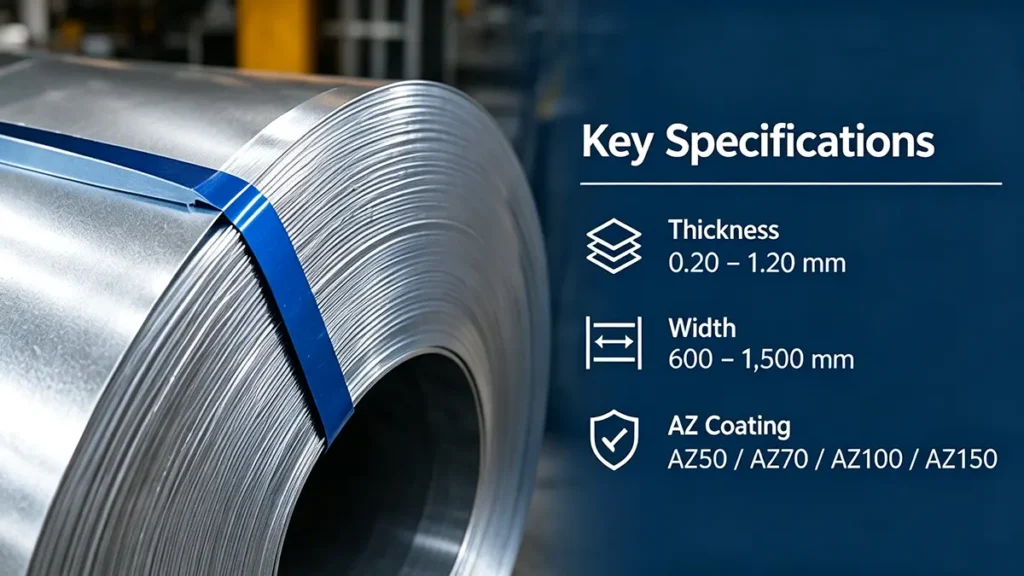
Typical commercial PPGL products are available in thicknesses around 0.20–1.20 mm, widths of approximately 600–1,500 mm, and AZ coating designations such as AZ50, AZ70, AZ100, and AZ150. Actual ranges depend on the applicable standard, production line, steel grade, and project requirements.
For buyers comparing specifications from different manufacturers, Hengze Steel can be considered as one supplier option, with the final selection based on technical specifications, testing requirements, production capability, and total delivered cost rather than brand name alone.
Table of Contents
-
1️⃣ What Is PPGL Steel Coil?1️⃣ What Is PPGL Steel Coil?
-
2️⃣ PPGL Steel Coil Specifications at a Glance2️⃣ PPGL Steel Coil Specifications at a Glance
-
3️⃣ PPGL Steel Coil Thickness3️⃣ PPGL Steel Coil Thickness
-
4️⃣ PPGL Steel Coil Width4️⃣ PPGL Steel Coil Width
-
5️⃣ AZ Coating: AZ50, AZ70, AZ100 and AZ1505️⃣ AZ Coating: AZ50, AZ70, AZ100 and AZ150
-
6️⃣ PPGL Paint Coating and Paint Types6️⃣ PPGL Paint Coating and Paint Types
-
7️⃣ Steel Grades and Mechanical Properties7️⃣ Steel Grades and Mechanical Properties
-
8️⃣ PPGL Standards and Specifications8️⃣ PPGL Standards and Specifications
-
9️⃣ Surface Finish, Color and Protective Film9️⃣ Surface Finish, Color and Protective Film
-
10. How to Choose PPGL Specifications10. How to Choose PPGL Specifications
-
11. Typical PPGL Specifications by Application11. Typical PPGL Specifications by Application
-
12. PPGL Quality Inspection and Testing12. PPGL Quality Inspection and Testing
-
13. PPGL Steel Coil Specification Checklist13. PPGL Steel Coil Specification Checklist
-
Frequently Asked QuestionsFrequently Asked Questions
-
ConclusionConclusion
1️⃣ What Is PPGL Steel Coil?
PPGL stands for Prepainted Galvalume Steel Coil. It uses steel coated with an aluminum-zinc alloy before the organic coating system is applied.
A typical PPGL structure is:
Steel substrate → Galvalume coating → Pretreatment → Primer → Topcoat
The metallic coating provides corrosion protection, while the paint system provides additional weather resistance, color, surface protection, and appearance.
ASTM A755/A755M covers prepainted steel sheet products using metallic-coated steel substrates, including aluminum-zinc alloy-coated steel.
The final specification should therefore be treated as a complete system rather than simply a “painted steel coil.”
2️⃣ PPGL Steel Coil Specifications at a Glance
| Specification | Typical Commercial Range / Option |
|---|---|
| Product | Prepainted Galvalume Steel Coil |
| Thickness | 0.20–1.20 mm |
| Width | 600–1,500 mm |
| AZ Coating | AZ50, AZ70, AZ100, AZ120, AZ150 |
| Steel Grades | DX51D, DX52D, S250GD, S280GD, S350GD, etc. |
| Topcoat | PE, SMP, HDP, PVDF |
| Topcoat Thickness | Typically 15–30 μm |
| Back Coat | Typically 5–15 μm |
| Coil ID | Commonly 508 mm or 610 mm |
| Coil Weight | Project and equipment dependent |
| Color | RAL, NCS, or customer specified |
These are representative commercial ranges, not universal limits. The actual specification should always be confirmed against the applicable standard and purchase contract. Commercial supplier ranges commonly vary in thickness, width, AZ coating, paint thickness, and coil weight.
3️⃣ PPGL Steel Coil Thickness
Thickness is one of the first specifications buyers should define because it affects structural capacity, forming behavior, weight, and cost.
Common PPGL thicknesses include:
- 0.20 mm
- 0.25 mm
- 0.30 mm
- 0.35 mm
- 0.40 mm
- 0.45 mm
- 0.50 mm
- 0.60 mm
- 0.70 mm
- 0.80 mm
- 1.00 mm
- 1.20 mm
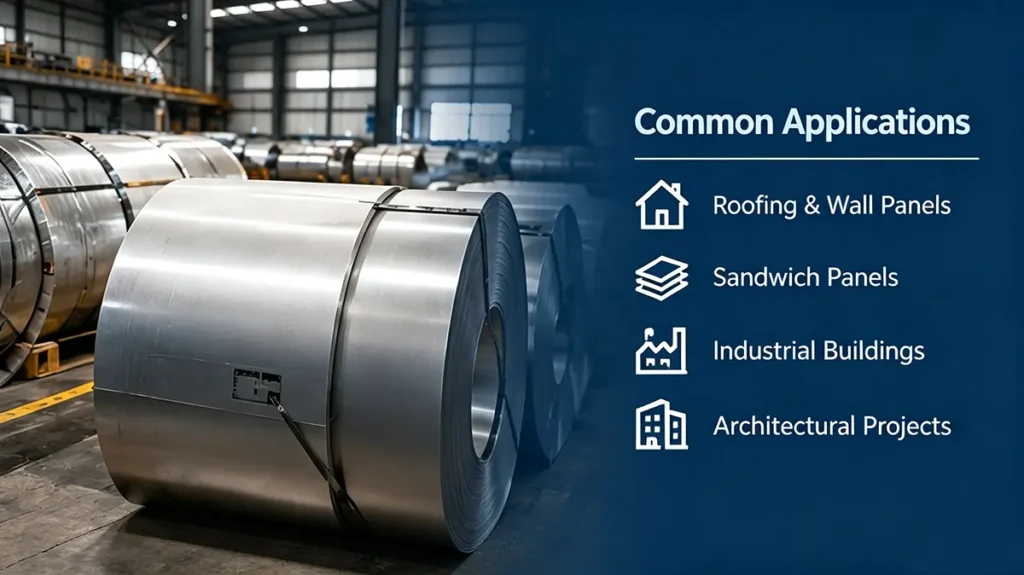
For roofing and wall applications, 0.40–0.60 mm is common. Heavier structural or industrial applications may require thicker material.
Thickness should not be selected only according to price. The buyer should consider:
- Span and support spacing
- Wind and snow loads
- Profile geometry
- Forming requirements
- Required service life
- Structural grade
- Local building regulations
When ordering, also clarify whether the specified thickness refers to the steel substrate, metallic-coated product, or finished prepainted product, because different specifications can define measurement differently.
4️⃣ PPGL Steel Coil Width
PPGL coils are available in various widths according to the customer’s application and the manufacturer’s production capability.
A common commercial range is approximately 600–1,500 mm.
Typical requirements include:
| Application | Width Consideration |
|---|---|
| Roofing sheets | Based on roll-forming equipment |
| Wall panels | Based on panel width and profile |
| Sandwich panels | Matched to panel production line |
| Corrugated sheets | Determined by profile and effective coverage |
| Custom fabrication | Based on cutting/forming requirements |
Width should be specified together with thickness, coil ID, coil weight, and tolerance.
For roofing products, buyers should also distinguish between coil width and effective cover width. After profiling, the usable width is normally smaller than the original flat coil width.
5️⃣ AZ Coating: AZ50, AZ70, AZ100 and AZ150
The Galvalume coating is primarily an aluminum-zinc alloy coating. ASTM A792/A792M covers 55% aluminum-zinc alloy-coated steel sheet and includes requirements for coating mass, mechanical properties, chemical composition, and testing.
Common designations include:
- AZ50
- AZ70
- AZ100
- AZ120
- AZ150
The number generally represents the specified coating mass in g/m², normally referring to the total coating mass on both sides where the relevant designation is defined that way.
For example, AZ150 indicates a higher coating mass than AZ50.
Higher AZ coating can provide greater metallic-coating protection, but it does not automatically make a PPGL product suitable for every environment. Service life also depends on:
- Paint system
- Steel grade
- Edge exposure
- Forming damage
- UV exposure
- Atmospheric conditions
- Salt and industrial pollutants
ASTM A792 currently covers aluminum-zinc alloy-coated steel in several grades and requires coating-mass and mechanical testing.
6️⃣ PPGL Paint Coating and Paint Types
The organic coating is another major part of PPGL performance.
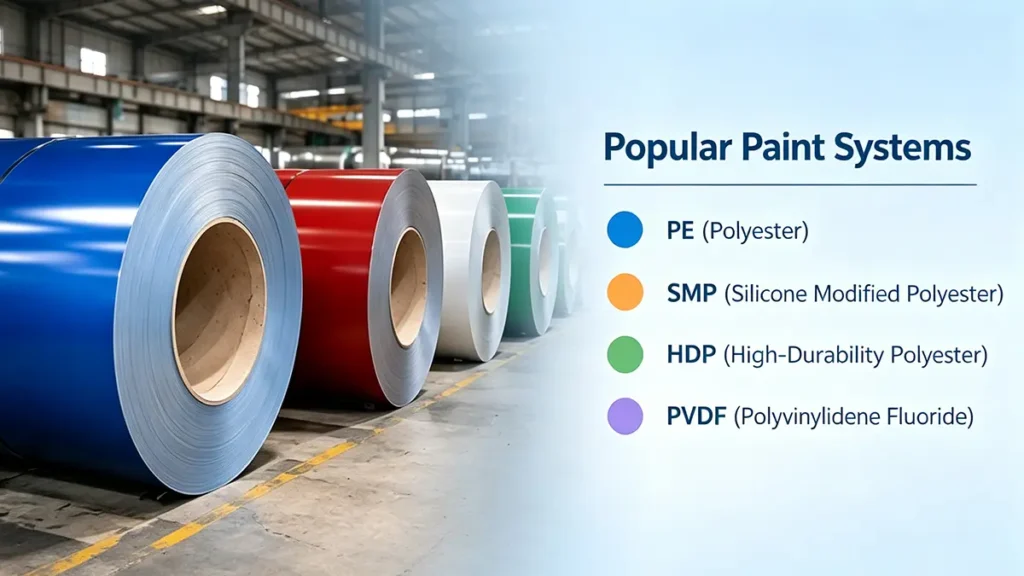
Common commercial paint systems include:
PE — Polyester
PE is widely used for general roofing, wall panels, and other applications where moderate weather resistance is sufficient.
SMP — Silicone Modified Polyester
SMP generally provides improved durability and weather resistance compared with standard polyester.
HDP — High-Durability Polyester
HDP is commonly selected where better weathering performance is required while maintaining a balance between performance and cost.
PVDF — Polyvinylidene Fluoride
PVDF is generally selected for demanding exterior applications, particularly where long-term color and weathering performance are important.
Typical commercial topcoat thicknesses may be around 15–30 μm, while back-coating thickness is commonly around 5–15 μm. These are typical market values rather than fixed requirements.
The correct paint system should be selected according to UV exposure, corrosion environment, expected service life, forming requirements, and budget.
7️⃣ Steel Grades and Mechanical Properties
PPGL specifications should include both the metallic coating and the underlying steel grade.
Common grades include:
- DX51D+AZ
- DX52D+AZ
- S250GD+AZ
- S280GD+AZ
- S350GD+AZ
- S420GD+AZ
- S550GD+AZ
DX grades are commonly used for forming applications, while structural grades are selected according to required mechanical strength.
The required properties may include:
- Yield strength
- Tensile strength
- Elongation
- Formability
- Bend performance
EN 10346 includes continuously hot-dip coated steel flat products and covers both forming grades such as DX51D–DX57D and structural grades such as S220GD through S550GD.
The steel grade should therefore be selected according to the forming process and structural requirements, not simply according to coating thickness.
8️⃣ PPGL Standards and Specifications
Different markets may use different standards. The most important step is to identify which standard governs the purchase order.
ASTM A792/A792M
Used for 55% aluminum-zinc alloy-coated steel sheet. It covers coating mass, chemical composition, mechanical properties, and related testing.
ASTM A755/A755M
Relevant to prepainted steel sheet products using metallic-coated steel substrates for exterior building applications.
EN 10346
Covers continuously hot-dip coated steel flat products, including aluminum-zinc coated products designated with +AZ.
For international procurement, the specification should clearly state the standard, steel grade, coating designation, paint system, dimensions, tolerances, and inspection requirements.
A quotation simply stating “PPGL coil” is not technically sufficient.
For buyers evaluating suppliers, Hengze Steel can be assessed against these same technical criteria, with attention to standard compliance, production consistency, testing documentation, and delivery requirements.
9️⃣ Surface Finish, Color and Protective Film
PPGL can be supplied in different surface finishes and colors depending on the application.
Common color systems include:
- RAL
- NCS
- Customer-defined color samples
Important surface specifications may include:
- Gloss
- Color difference
- Surface appearance
- Paint adhesion
- Scratch resistance
- Protective film requirements
Protective film can be useful for products requiring additional surface protection during transportation, forming, or installation. However, film type and removal requirements should be agreed before production.
10. How to Choose PPGL Specifications
A practical selection process is:
Step 1: Define the application
Determine whether the material is intended for:
- Roofing
- Wall panels
- Sandwich panels
- Industrial buildings
- Agricultural buildings
- Commercial buildings
- Architectural applications
Step 2: Select steel grade
Choose the grade according to forming and structural requirements.
Step 3: Select thickness
Consider structural loading, span, profile, forming process, and local requirements.
Step 4: Select AZ coating
Use the expected corrosion environment and required service life to determine whether AZ50, AZ70, AZ100, AZ120, AZ150, or another specified coating is appropriate.
Step 5: Select paint system
PE may be adequate for standard applications, while SMP, HDP, or PVDF may be more appropriate for demanding outdoor exposure.
Step 6: Confirm dimensions
Specify:
Thickness + Width + Coil ID + Coil Weight + Tolerances
Step 7: Define testing
Specify required tests and documentation before production rather than after delivery.
11. Typical PPGL Specifications by Application
| Application | Typical Thickness | AZ Coating | Common Paint |
|---|---|---|---|
| General roofing | 0.40–0.60 mm | AZ70–AZ100 | PE / SMP |
| Industrial roofing | 0.45–0.70 mm | AZ100–AZ150 | SMP / HDP |
| Wall panels | 0.40–0.60 mm | AZ70–AZ100 | PE / SMP |
| Commercial buildings | 0.50–0.80 mm | AZ100–AZ150 | HDP / PVDF |
| Architectural applications | Project-specific | Project-specific | PVDF |
These values should be used as starting points rather than fixed specifications. Actual requirements depend on structural design, environmental exposure, forming equipment, and local standards.
12. PPGL Quality Inspection and Testing
A reliable PPGL inspection program normally covers several parameters rather than only checking thickness.
Dimensional Inspection
- Thickness
- Width
- Length, where applicable
- Flatness
- Coil dimensions
Metallic Coating
- AZ coating mass
- Coating uniformity
- Surface condition
Mechanical Properties
- Yield strength
- Tensile strength
- Elongation
- Bend performance
Paint Performance
Depending on the project:
- Paint thickness
- Adhesion
- Impact resistance
- Pencil hardness
- T-bend performance
- Color
- Gloss
- Weathering resistance
For export orders, buyers should also request the relevant mill test certificate, inspection report, coating test results, and paint documentation where required.
13. PPGL Steel Coil Specification Checklist
Before placing an order, confirm the following:
Material
- Steel grade
- Applicable standard
- Galvalume coating designation
Dimensions
- Thickness
- Width
- Thickness tolerance
- Width tolerance
- Coil ID
- Coil weight
Coating
- AZ50 / AZ70 / AZ100 / AZ150 or specified value
- Primer type and thickness
- Topcoat type
- Topcoat thickness
- Back-coat type and thickness
Appearance
- Color
- Gloss
- Surface finish
- Protective film
Quality
- Mechanical properties
- Coating test
- Paint adhesion
- Bend test
- Inspection certificate
Logistics
- Packaging
- Loading method
- Container requirements
- Delivery terms
- Destination port
A detailed specification sheet reduces misunderstandings between buyer, manufacturer, inspection agency, and end customer.
Frequently Asked Questions
There is no single standard thickness for all PPGL products. Commercial products commonly range from approximately 0.20 to 1.20 mm, depending on grade, standard, application, and production capability.
AZ150 generally indicates a specified 150 g/m² aluminum-zinc coating mass, normally based on the applicable standard's coating-mass definition. It represents a higher coating level than AZ50.
Not necessarily for every application. AZ150 provides a higher metallic coating level, but the correct choice depends on corrosion exposure, expected service life, paint system, forming, and project requirements.
There is no universal “best” paint. PE is common for general applications, while SMP and HDP offer higher durability, and PVDF is commonly selected for demanding architectural and exterior applications.
PPGL uses an aluminum-zinc alloy metallic coating, while PPGI uses a zinc coating. PPGL is often selected when higher corrosion and heat resistance are required, while PPGI remains widely used for general construction applications.
A complete quotation should identify at least the steel grade, standard, thickness, width, AZ coating, paint system, paint thickness, color, coil ID, coil weight, packaging, inspection requirements, quantity, and delivery terms.
Conclusion
PPGL steel coil selection should be based on the complete specification rather than one parameter. Thickness, width, steel grade, AZ coating, paint system, mechanical properties, and testing requirements all affect the final performance and cost of the material.
For most purchasing projects, the best approach is to define the application first and then establish the required steel grade, dimensions, coating level, paint system, and inspection standard.
When comparing international suppliers, Hengze Steel can be considered alongside other qualified manufacturers by evaluating technical compliance, production consistency, quality documentation, delivery capability, and total procurement cost.
A well-defined PPGL specification not only makes quotations easier to compare but also reduces the risk of receiving material that does not match the requirements of the roofing, wall-panel, construction, or architectural project.
Trending News
What to Expect When You Contact Us
Fast Response – Replies within 12 hours
Tailored Solutions – Based on your needs and industry
Full Support – From products to technical and market guidance