
Explore Trends, Innovations, and Achievements at HengZe Steel
PPGI Paint Systems: PE, SMP, HDP & PVDF Explained
- Industry News
- September 24, 2026
- 7:53 am
PPGI, or prepainted galvanized steel, is widely used for roofing, wall cladding, sandwich panels, industrial buildings, commercial facilities, and architectural applications.
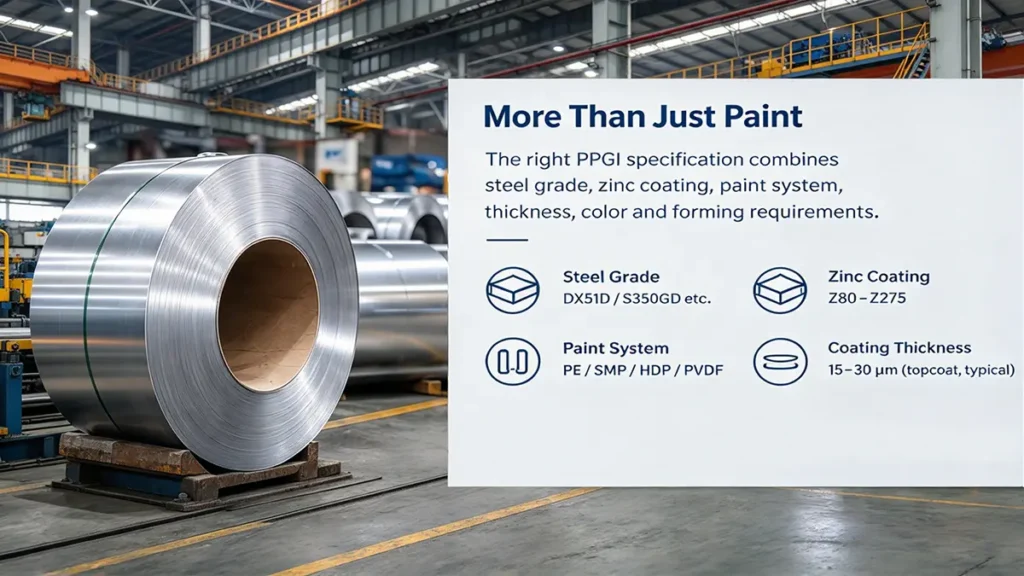
When purchasing PPGI steel coils, buyers often focus on steel thickness, zinc coating, and color. However, the paint system is equally important because it affects UV resistance, color retention, weatherability, surface hardness, formability, and long-term appearance.
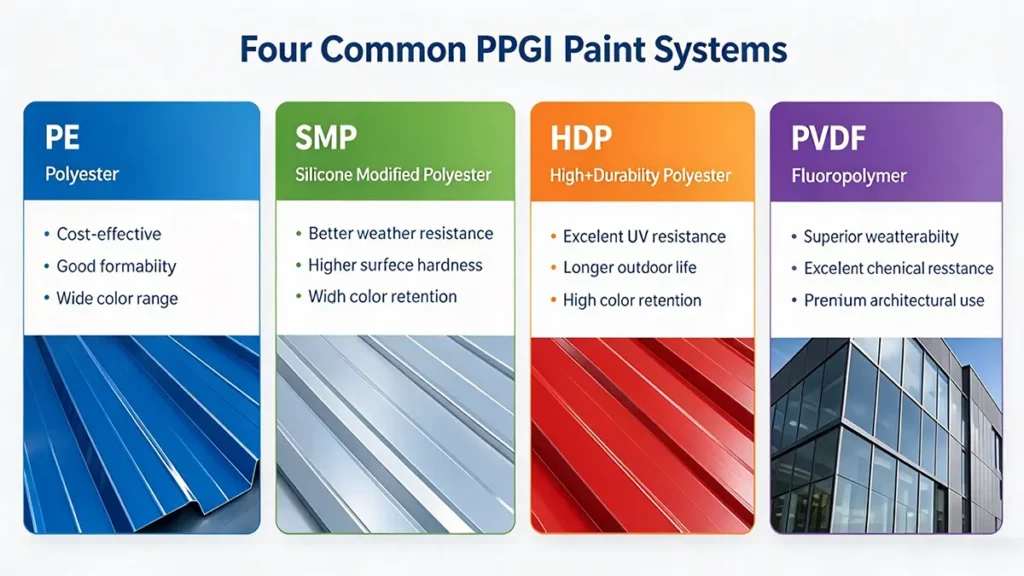
The four common PPGI coating systems are PE, SMP, HDP, and PVDF. Each uses a different resin technology and is intended for different performance requirements.
For buyers, the key question is not simply which coating is “best,” but which paint system matches the environment, service requirements, forming process, and project budget.
For projects requiring different combinations of steel grade, zinc coating, paint system, color, and coating thickness, Hengze Steel supplies PPGI and PPGL steel coils with configurable coating and substrate specifications for different construction and industrial applications.
Table of Contents
-
1️⃣ What Is a PPGI Paint System?1️⃣ What Is a PPGI Paint System?
-
2️⃣ How the PPGI Coating Structure Works2️⃣ How the PPGI Coating Structure Works
-
3️⃣ PE Polyester Coating3️⃣ PE Polyester Coating
-
4️⃣ SMP Silicone Modified Polyester Coating4️⃣ SMP Silicone Modified Polyester Coating
-
5️⃣ HDP High-Durability Polyester Coating5️⃣ HDP High-Durability Polyester Coating
-
6️⃣ PVDF Fluoropolymer Coating6️⃣ PVDF Fluoropolymer Coating
-
7️⃣ PE vs. SMP vs. HDP vs. PVDF Comparison7️⃣ PE vs. SMP vs. HDP vs. PVDF Comparison
-
8️⃣ Paint Thickness: Why DFT Matters8️⃣ Paint Thickness: Why DFT Matters
-
9️⃣ Paint System vs. Zinc Coating9️⃣ Paint System vs. Zinc Coating
-
10. How Climate Affects Paint Selection10. How Climate Affects Paint Selection
-
11. How Forming Requirements Affect Coating Selection11. How Forming Requirements Affect Coating Selection
-
12. Which PPGI Paint System Should You Specify?12. Which PPGI Paint System Should You Specify?
-
13. Common PPGI Coating Specification Mistakes13. Common PPGI Coating Specification Mistakes
-
14. PPGI Paint System Testing and Standards14. PPGI Paint System Testing and Standards
-
15. PPGI Paint System Selection: A Practical Procurement Checklist15. PPGI Paint System Selection: A Practical Procurement Checklist
-
Frequently Asked QuestionsFrequently Asked Questions
-
ConclusionConclusion
1️⃣ What Is a PPGI Paint System?
PPGI stands for Pre-Painted Galvanized Iron/Steel, commonly referring to galvanized steel that is continuously coated with an organic paint system before being supplied as a coil or sheet.
A typical PPGI structure consists of:
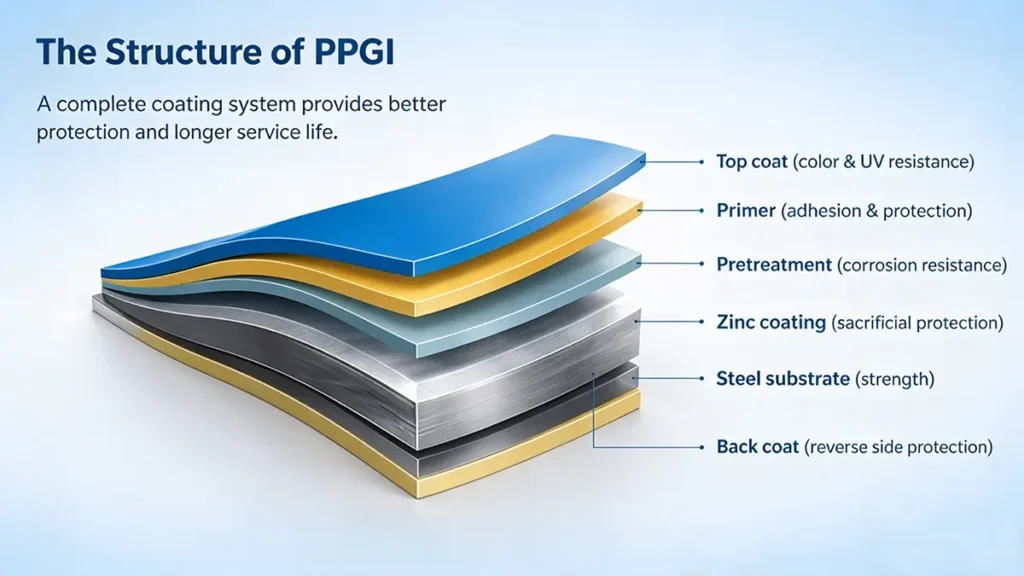
Steel substrate → Zinc coating → Pretreatment → Primer → Topcoat → Back coat
Each layer has a different function.
| Layer | Main Function |
|---|---|
| Steel substrate | Provides structural strength |
| Zinc coating | Provides metallic corrosion protection |
| Pretreatment | Improves paint adhesion and corrosion resistance |
| Primer | Provides adhesion and additional barrier protection |
| Topcoat | Provides color, UV resistance, weatherability and surface protection |
| Back coat | Protects the reverse side and supports fabrication |
ASTM A755/A755M specifically covers metallic-coated steel sheet that is subsequently prepainted by the coil-coating process for exterior building products. The standard recognizes coating systems using materials such as polyester, silicone polyester and fluoropolymer, and emphasizes that substrate, organic coating system and forming method all influence service life and appearance.
This is important because PPGI performance cannot be determined from the topcoat resin alone.
A 25 μm PVDF topcoat on an inappropriate substrate or with inadequate pretreatment is not automatically a better engineering solution than a properly specified SMP system.
2️⃣ How the PPGI Coating Structure Works
The paint system works together with the metallic coating.
For conventional PPGI, the zinc layer provides sacrificial or cathodic protection, while the organic coating creates a barrier against moisture, oxygen, UV radiation and contaminants.
The paint therefore performs several functions:
- Protects the metallic coating from direct environmental exposure
- Reduces moisture penetration
- Provides UV resistance
- Controls color fading and chalking
- Protects the surface from abrasion
- Provides the required appearance
- Improves resistance to atmospheric pollutants
- Supports the required forming and fabrication process
The complete coating system is therefore more important than simply specifying “PPGI with PE paint.”
A purchasing specification should ideally identify:
- Steel grade
- Steel thickness
- Zinc coating mass
- Paint system
- Topcoat thickness
- Back-coat thickness
- Color/RAL number
- Gloss level
- Surface finish
- Applicable standard
- Forming requirements
- Inspection and testing requirements
For example:
DX51D + Z275 + PE 20/5 μm + RAL 9002
is considerably more useful than simply stating:
“PPGI, white.”
3️⃣ PE Polyester Coating
What Is PE Coating?
PE, or Polyester, is one of the most widely used paint systems for prepainted steel.
It is based on polyester resin technology and is commonly selected when the application requires a balance between:
- Cost
- Color availability
- Formability
- Adhesion
- General weather resistance
PE coatings generally provide good flexibility and formability, which makes them suitable for roll forming and many conventional roofing and cladding applications.
ASTM A755 identifies polyester as one of the typical topcoat materials used for prepainted metallic-coated building products.
Typical Applications
PE PPGI is commonly used for:
- General industrial roofing
- Warehouse roofing
- Wall cladding
- Interior panels
- Sandwich panels
- Agricultural buildings
- Commercial buildings in moderate environments
- Applications where repainting or replacement cycles are relatively short
Advantages of PE
1. Good formability
PE is generally suitable for roll forming and bending operations, particularly when the correct grade and coating thickness are selected.
2. Broad color selection
Polyester systems can be formulated in a wide range of colors and gloss levels.
3. Cost efficiency
PE is normally positioned below SMP, HDP and PVDF in initial material cost.
4. Good general-purpose performance
For moderate climates and ordinary building applications, PE can provide an appropriate balance between performance and cost.
Limitations
PE is not normally the first choice where long-term color retention and extreme weather resistance are major priorities.
Strong UV exposure can eventually cause:
- Color fading
- Gloss reduction
- Chalking
- Surface aging
This does not mean PE is unsuitable for outdoor applications. It means that the expected exposure should be considered when specifying the system.
4️⃣ SMP Silicone Modified Polyester Coating
What Is SMP?
SMP stands for Silicone Modified Polyester.
SMP modifies conventional polyester chemistry with silicone components to improve selected surface and weathering characteristics.
Compared with standard PE, SMP is generally designed for improved:
- Weather resistance
- Surface hardness
- Scratch resistance
- Gloss retention
- UV resistance
- Resistance to chalking
PPG describes SMP as a commonly used coil-coating system for residential, agricultural, industrial and commercial metal roofing and sidewall panels, with emphasis on film integrity, adhesion, color durability and scratch/mar resistance.
Typical Applications
SMP is frequently specified for:
- Exterior roofing
- Wall cladding
- Industrial buildings
- Agricultural buildings
- Commercial warehouses
- Residential roofing
- Buildings exposed to stronger sunlight
- Applications requiring improved surface durability over conventional PE
SMP vs. PE
The practical difference can be summarized as:
PE → general-purpose polyester
SMP → polyester with enhanced weathering and surface performance
SMP is therefore often considered when standard PE does not provide enough outdoor durability, but a premium fluoropolymer system is not necessary.
An Important Consideration
SMP should not be selected simply because it contains the word “silicone.”
The actual performance depends on:
- Resin formulation
- Silicone modification level
- Pigment system
- Primer
- Film thickness
- Pretreatment
- Substrate
- Curing conditions
- Manufacturing quality
Therefore, the resin name alone does not provide a complete specification.
5️⃣ HDP High-Durability Polyester Coating
What Is HDP?
HDP generally refers to High-Durability Polyester.
HDP is an advanced polyester-based coating technology designed to improve outdoor weatherability compared with conventional polyester systems.
It is often positioned between conventional PE/SMP and premium PVDF in terms of performance and cost.
Depending on the formulation, HDP can provide improved:
- UV resistance
- Color retention
- Gloss retention
- Chalking resistance
- Weathering performance
Typical Applications
HDP is commonly considered for:
- Long-life roofing
- Industrial buildings
- Commercial buildings
- Exterior wall systems
- High-UV regions
- Large warehouse projects
- Buildings where long-term appearance is important but PVDF may not be required
Some industry sources describe HDP as a cost-effective alternative for demanding outdoor applications, with performance approaching higher-end coating systems depending on formulation and test requirements.
HDP Is Not Simply “Thicker PE”
This distinction is important.
Increasing paint thickness does not automatically transform PE into HDP.
Paint thickness and resin technology are different variables.
For example:
- PE 25 μm
- HDP 20 μm
cannot be compared only by thickness.
The resin chemistry, pigment selection, curing process and formulation determine much of the coating’s weathering behavior.
6️⃣ PVDF Fluoropolymer Coating
What Is PVDF?
PVDF stands for Polyvinylidene Fluoride.
It is a fluoropolymer-based coating system widely used for demanding architectural and exterior applications where long-term color stability, gloss retention, chemical resistance and weatherability are important.
PVDF coatings have a long-established position in premium metal building products. PPG notes their resistance to chalking, fading and severe weather exposure and identifies them as particularly suitable for demanding exterior architectural applications.
Typical Applications
PVDF-coated steel is commonly considered for:
- Architectural façades
- Landmark buildings
- High-end commercial buildings
- Airports
- Coastal structures
- High-UV environments
- Premium roofing
- Long-life exterior cladding
- Projects with strict appearance requirements
Why PVDF Performs Differently
PVDF’s fluoropolymer chemistry provides strong resistance to environmental degradation.
The main benefits include:
- Excellent UV resistance
- Excellent color retention
- High chalking resistance
- Strong chemical resistance
- Good resistance to atmospheric pollutants
- Long-term gloss retention
- High weatherability
PVDF and 70% Resin Systems
In architectural coil coatings, 70% PVDF resin systems are widely recognized as a premium specification.
However, buyers should avoid treating “PVDF” as a complete technical specification.
The quotation should identify the actual resin system, coating thickness, primer system and applicable performance requirements.
A supplier stating only:
“PVDF coating”
has not yet provided enough information for a technical comparison.
7️⃣ PE vs. SMP vs. HDP vs. PVDF Comparison
The four systems can be compared broadly as follows:
| Property | PE | SMP | HDP | PVDF |
|---|---|---|---|---|
| Resin type | Polyester | Silicone-modified polyester | High-durability polyester | Fluoropolymer |
| General durability | Standard | Improved | High | Very high |
| UV resistance | Moderate | Good | Very good | Excellent |
| Color retention | Moderate | Good | Very good | Excellent |
| Chalking resistance | Moderate | Good | Very good | Excellent |
| Surface hardness | Good | Higher | High | High |
| Formability | Very good | Good | Good | Good, formulation-dependent |
| Chemical resistance | Moderate | Good | Good | Excellent |
| Typical cost | Low | Medium | Medium-high | High |
| Typical application | General construction | Exterior roofing/cladding | Long-life exterior | Premium architecture |
| Typical priority | Cost + forming | Durability + cost | Weatherability | Maximum long-term appearance |
These categories should be treated as general engineering guidance rather than universal performance guarantees. Actual results depend on resin formulation, pigment package, coating thickness, substrate, pretreatment, curing, fabrication and environmental exposure.
Published supplier data commonly places typical topcoat thickness around 15–30 μm, although the actual specification varies by paint system and manufacturer.
8️⃣ Paint Thickness: Why DFT Matters
DFT, or dry film thickness, is an important parameter when purchasing PPGI.
Typical commercial systems may use approximately:
- Topcoat: 15–30 μm
- Primer: 5–10 μm
- Back coat: 5–15 μm
Actual values depend on the coating system and supplier specification. ASTM A755 recognizes both thin-film and thicker-film multi-coat systems.
For example, a specification may be written as:
20/5 μm
meaning approximately:
- 20 μm topcoat
- 5 μm back coating
Another specification might use:
25/10 μm
depending on the required performance.
Does Thicker Paint Always Mean Better?
No.
A thicker coating can improve certain barrier properties, but excessive thickness may affect:
- Formability
- Adhesion
- Surface appearance
- Cracking during bending
- Curing
- Cost
The resin system and film thickness must therefore be considered together.
A properly formulated 20 μm HDP system should not automatically be considered inferior to a 25 μm PE system.
9️⃣ Paint System vs. Zinc Coating
One of the most common PPGI specification mistakes is treating the paint coating and zinc coating as the same thing.
They perform different functions.
Zinc Coating
The zinc layer provides metallic corrosion protection to the steel substrate.
Common designations include:
- Z80
- Z100
- Z120
- Z180
- Z275
The number generally indicates coating mass in g/m² for both sides under the relevant specification.
Paint System
The organic coating provides:
- Color
- UV protection
- Weather resistance
- Surface protection
- Additional barrier protection
Therefore:
Zinc coating ≠ paint coating
A PPGI coil specification such as:
DX51D + Z275 + PE 20/5 μm
contains substantially more information than:
PPGI PE white
The first describes the substrate grade, metallic coating and paint structure.
10. How Climate Affects Paint Selection
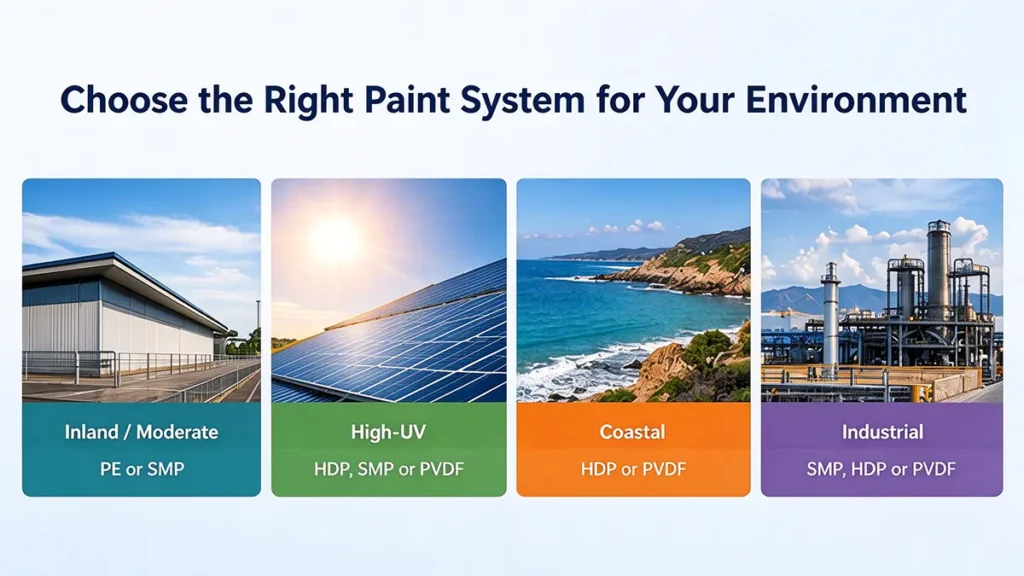
The same PPGI paint system does not necessarily perform equally well in every location.
Environmental exposure should be considered before selecting the resin.
Mild Inland Climate
For ordinary inland buildings with moderate UV exposure and limited pollution:
PE or SMP
may be technically appropriate depending on the required service period.
Typical applications include:
- Warehouses
- Agricultural buildings
- Industrial workshops
- General roofing
High-UV Climate
In regions with strong solar radiation, the coating is exposed to higher UV loading.
For these conditions:
HDP or SMP
may be considered where improved weatherability is required.
For premium architectural projects:
PVDF
may be specified where long-term appearance is a major requirement.
Coastal Environment
Coastal buildings face:
- Salt-laden air
- High humidity
- Chlorides
- Strong UV
- Wet-dry cycles
In these environments, paint selection should not be considered independently from the metallic coating.
The complete system may require:
appropriate zinc or Al-Zn coating + suitable primer + high-performance topcoat
For demanding architectural applications, PVDF is commonly considered because of its weathering and chemical resistance.
Industrial Environment
Industrial buildings can experience exposure to:
- Acidic pollutants
- Alkaline pollutants
- Solvents
- Dust
- High humidity
- Temperature fluctuations
The chemical environment should be identified before selecting the coating.
PVDF may be appropriate for particularly demanding applications, while HDP or SMP can provide a practical balance where exposure is less severe.
11. How Forming Requirements Affect Coating Selection
Paint selection should also consider what happens after the coil leaves the coating line.
PPGI is often:
- Slit
- Roll formed
- Bent
- Corrugated
- Press formed
- Cut
- Fabricated into roofing panels
During forming, the coating can experience:
- Tensile stress
- Compression
- Bending
- Abrasion
- Impact
If the coating is too brittle for the selected forming operation, defects can appear at bends.
Possible problems include:
- Cracking
- Delamination
- Loss of adhesion
- Surface whitening
- Damage to the coating film
This is why paint system + steel grade + thickness + forming radius should be evaluated together.
For example, a roofing profile requiring tight bends may have different requirements from a relatively flat architectural façade panel.
12. Which PPGI Paint System Should You Specify?
Instead of selecting a coating solely according to price, buyers can use a simple decision process.
Step 1: Identify the environment
Ask:
- Inland or coastal?
- Mild or tropical?
- High UV?
- Industrial pollution?
- High humidity?
- Salt exposure?
Step 2: Define the required service period
A temporary agricultural building and a landmark commercial façade do not have the same coating requirements.
Step 3: Define the forming process
Determine:
- Roll-forming profile
- Minimum bend radius
- Stamping requirements
- Fabrication method
- Expected handling
Step 4: Define appearance requirements
Consider:
- Color
- Gloss
- Color retention
- Surface finish
- Pattern
- Long-term appearance
Step 5: Define the metallic coating
For PPGI, specify the required zinc coating mass.
For PPGL, specify the required Al-Zn coating mass such as AZ100 or AZ150.
Step 6: Define the paint system
Then select:
PE → SMP → HDP → PVDF
according to the actual performance requirements.
A Practical Selection Framework
| Project Condition | Common Paint-System Consideration |
|---|---|
| Indoor / sheltered | PE |
| General inland roofing | PE / SMP |
| Outdoor commercial roofing | SMP / HDP |
| Strong UV exposure | HDP / PVDF |
| Long-life exterior cladding | HDP / PVDF |
| Premium architectural façade | PVDF |
| Coastal architectural application | PVDF, with appropriate metallic coating |
| Tight forming requirements | PE or suitable SMP/HDP formulation |
| Cost-sensitive general construction | PE |
| Long-term color retention priority | PVDF |
13. Common PPGI Coating Specification Mistakes
Mistake 1: Choosing only by paint name
“PVDF” does not provide enough information.
The specification should also define:
- Resin system
- Topcoat DFT
- Primer
- Back coat
- Substrate
- Metallic coating
- Color
- Performance requirements
Mistake 2: Assuming thicker paint is always better
A thicker coating does not automatically provide better overall performance.
Coating chemistry and manufacturing quality remain critical.
Mistake 3: Ignoring the substrate
A high-performance paint cannot compensate indefinitely for an incorrectly selected substrate or inadequate metallic coating.
The steel, metallic coating, pretreatment, primer and topcoat should be treated as a complete system.
Mistake 4: Using laboratory salt-spray hours as a service-life guarantee
Salt-spray testing is useful for comparative evaluation, but laboratory hours should not be converted directly into years of outdoor service.
Real-world performance depends on:
- Climate
- Pollutants
- UV
- Humidity
- Salt concentration
- Surface damage
- Edge exposure
- Forming
- Maintenance
This is one reason why technical specifications should not promise a fixed outdoor lifetime based only on ASTM B117 or ISO 9227 results.
Mistake 5: Selecting PVDF for every project
PVDF provides high performance, but not every building needs a premium fluoropolymer coating.
For many warehouses and standard industrial buildings, PE, SMP or HDP may provide an appropriate balance between performance and cost.
The objective is not to maximize coating cost. It is to match the coating system to the project’s actual exposure and design requirements.
14. PPGI Paint System Testing and Standards
A professional PPGI specification may involve several different test categories.
Coating Adhesion
Common methods include:
- ASTM D3359
- ISO 2409
These tests evaluate coating adhesion after controlled cutting and removal procedures.
Pencil Hardness
ASTM D3363 can be used to evaluate surface hardness.
Bend/Formability
Bend testing evaluates coating integrity after deformation.
ASTM E290 is one commonly referenced method for metallic materials, while product-specific standards may define the actual acceptance criteria.
Salt Spray
Common references include:
- ASTM B117
- ISO 9227
These tests evaluate corrosion behavior under accelerated laboratory conditions.
Weathering
Accelerated weathering and outdoor exposure testing can be used to evaluate:
- Color change
- Gloss retention
- Chalking
- Cracking
- Delamination
The exact testing program should correspond to the intended application and applicable product standard.
15. PPGI Paint System Selection: A Practical Procurement Checklist
When requesting a PPGI quotation, buyers should provide as much of the following information as possible:
Basic Material
- PPGI or PPGL
- Steel grade
- Applicable standard
- Thickness
- Width
Metallic Coating
- Zinc coating mass, such as Z120 or Z275
- Or Al-Zn coating mass, such as AZ100 or AZ150
Paint System
- PE
- SMP
- HDP
- PVDF
Paint Structure
- Topcoat thickness
- Primer thickness
- Back-coat thickness
- Total coating structure
Appearance
- RAL color
- Gloss
- Matt or textured finish
- Pattern requirements
Processing
- Roll forming
- Bending
- Stamping
- Slitting
- Cut-to-length
Quality Requirements
- Adhesion
- Bend performance
- Hardness
- Weathering
- Salt-spray testing where applicable
- Third-party inspection if required
For international procurement, it is also useful to specify packaging, coil ID, coil weight, tolerances, loading requirements and inspection documentation.
Frequently Asked Questions
PE is a conventional polyester coating, while SMP is a silicone-modified polyester system. SMP is generally formulated for improved weathering, surface hardness and resistance to chalking compared with standard PE.
They are different coating technologies rather than a universal “better” and “worse” hierarchy. HDP is generally designed for higher weather durability, while SMP can provide a strong combination of durability, adhesion, formability and cost efficiency. The actual formulation and test data should be compared.
PVDF generally provides higher long-term weatherability, UV resistance, color retention and chemical resistance, particularly for demanding architectural applications. However, HDP can be a more economical solution where the required performance does not justify a premium fluoropolymer system.
Typical commercial topcoat thickness is approximately 15–30 μm, with primer and back-coat thickness specified separately. Actual values depend on the paint system, manufacturer and project specification.
PE polyester is widely used because it offers a practical combination of cost, color availability and formability. SMP, HDP and PVDF are selected when higher weathering performance is required.
Yes. PVDF-coated steel is used for roofing, wall cladding and architectural metal systems, particularly where long-term color and weather resistance are important.
Yes, but the paint is only one part of the corrosion-protection system. The metallic zinc coating, pretreatment, primer, topcoat, edge condition and fabrication quality all influence corrosion performance.
No.
PPGI uses a galvanized steel substrate with a zinc coating.
PPGL uses a Galvalume or aluminum-zinc-coated steel substrate.
Both can use paint systems such as PE, SMP, HDP and PVDF.
Conclusion
The choice between PE, SMP, HDP and PVDF should be based on the actual performance requirements of the PPGI application rather than on coating names alone.
In general:
- PE is a practical choice for general-purpose and cost-sensitive applications.
- SMP provides improved weatherability and surface durability over standard polyester.
- HDP is designed for higher outdoor durability and improved color and UV performance.
- PVDF is commonly selected for premium architectural applications and demanding environments where long-term appearance and weather resistance are important.
The most important point is that paint system selection is only one part of PPGI specification. Steel grade, zinc coating mass, pretreatment, primer, topcoat thickness, forming requirements and environmental exposure all contribute to final performance. ASTM A755/A755M likewise treats the metallic-coated substrate and organic coating system as an integrated product rather than an isolated paint layer.
For projects requiring different combinations of steel grade, zinc coating, paint system, color and coating thickness, Hengze Steel provides PPGI and PPGL options using PE, SMP, HDP and PVDF systems, with specifications configurable according to project requirements. Its published PPGI range includes multiple substrate thicknesses, zinc coating levels, paint thicknesses and international standards.
For buyers, the most useful approach is therefore not to ask simply “PE or PVDF?”, but to define the complete requirement:
substrate + metallic coating + pretreatment + primer + paint system + DFT + color + forming + environment.
That specification provides a much more reliable basis for comparing PPGI suppliers, quotations and long-term performance.
Trending News
What to Expect When You Contact Us
Fast Response – Replies within 12 hours
Tailored Solutions – Based on your needs and industry
Full Support – From products to technical and market guidance