
Explore Trends, Innovations, and Achievements at HengZe Steel
How to Choose a Steel Coil Manufacturer in China
- Industry News
- October 14, 2026
- 2:36 am
Choosing a steel coil manufacturer in China involves more than comparing prices. Buyers need to verify product specifications, manufacturing capability, quality control, traceability, export experience, and delivery reliability before placing an order.
A qualified supplier should be able to produce or procure the specified steel coil consistently, provide verifiable inspection records, and meet the requirements of the destination market. The evaluation process is similar for galvanized steel coil (GI), Galvalume steel coil (GL), prepainted galvanized steel coil (PPGI), prepainted Galvalume steel coil (PPGL), and other coated steel products, although the technical checks differ by product.
For international buyers considering Hengze Steel, the same due-diligence principles apply as they do to any steel supplier: verify the actual production capabilities, compare technical specifications, check quality documentation, and assess the supplier’s ability to fulfill the contract.
This guide explains how to evaluate Chinese steel coil manufacturers, identify common purchasing risks, and make a more informed sourcing decision.
Table of Contents
-
1️⃣ Identify the Right Type of Steel Coil Supplier1️⃣ Identify the Right Type of Steel Coil Supplier
-
2️⃣ Check Manufacturing Capability and Production Equipment2️⃣ Check Manufacturing Capability and Production Equipment
-
3️⃣ Verify Product Specifications and Technical St3️⃣ Verify Product Specifications and Technical St
-
4️⃣ Evaluate Quality Control and Traceability4️⃣ Evaluate Quality Control and Traceability
-
5️⃣ Verify Certifications and Quality Documents5️⃣ Verify Certifications and Quality Documents
-
6️⃣ Compare Product Range and Customization Capability6️⃣ Compare Product Range and Customization Capability
-
7️⃣ Evaluate Export Experience and Delivery Reliability7️⃣ Evaluate Export Experience and Delivery Reliability
-
8️⃣ Compare Quotations Beyond Price per Ton8️⃣ Compare Quotations Beyond Price per Ton
-
9️⃣ Check Packaging and Shipping Arrangements9️⃣ Check Packaging and Shipping Arrangements
-
10. Identify Common Supplier Red Flags10. Identify Common Supplier Red Flags
-
11. Steel Coil Manufacturer Evaluation Checklist11. Steel Coil Manufacturer Evaluation Checklist
-
Frequently Asked QuestionsFrequently Asked Questions
-
ConclusionConclusion
1️⃣ Identify the Right Type of Steel Coil Supplier
Not every company advertising itself as a steel coil manufacturer operates the same type of facility. Understanding the supplier’s actual business model is the first step.
| Supplier Type | Main Activities | What Buyers Should Verify |
|---|---|---|
| Integrated steel producer | Steelmaking, hot rolling, cold rolling, and potentially coating | Production scope, mill capacity, quality systems |
| Coating or processing manufacturer | Galvanizing, Galvalume coating, painting, slitting, or other processing | Actual production lines, substrate sourcing, process control |
| Steel service center | Slitting, cutting, leveling, and distribution | Processing accuracy, inventory, traceability |
| Trading company | Sources products from mills or processors | Factory relationships, order control, document reliability |
A trading company is not necessarily an unsuitable supplier. It may offer access to multiple mills, smaller quantities, or a broader product range. However, buyers should know who actually manufactures the material, who controls production, and who is responsible for product conformity.
For products such as PPGI and PPGL, the supplier may purchase galvanized or Galvalume substrate from another mill and then paint it on its own line. That arrangement can be commercially reasonable, provided the responsibilities and quality controls are transparent.
The key question is not simply whether a company calls itself a factory, but whether its actual production and supply arrangements can meet your requirements.
2️⃣ Check Manufacturing Capability and Production Equipment
A supplier’s claimed annual capacity is less useful than evidence that its equipment can produce the exact specification required by your project.
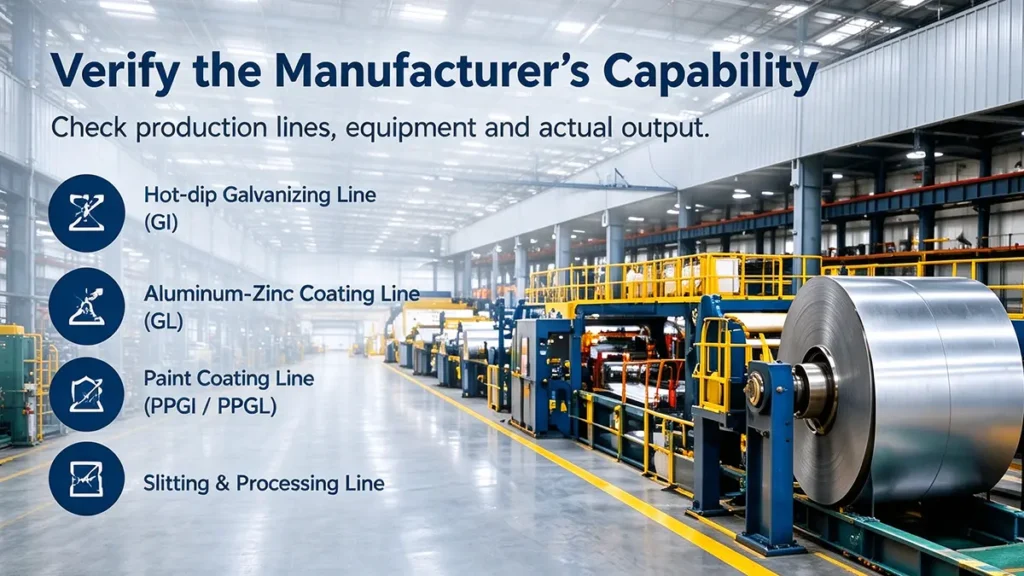
Verify the Relevant Production Lines
Different products require different manufacturing processes.
| Product | Manufacturing or Processing Capability to Check |
|---|---|
| Galvanized steel coil (GI) | Hot-dip galvanizing line, zinc coating control, surface finishing |
| Galvalume steel coil (GL) | Aluminum-zinc coating line, coating-mass control, surface quality |
| PPGI / PPGL | Substrate preparation, pretreatment, primer and topcoat application, curing |
| Zn-Al-Mg coated steel | Appropriate alloy-coating production line and coating inspection |
| Tinplate coil (ETP / SPTE) | Electrolytic tinning process and relevant surface and coating tests |
| Corrugated roofing sheets | Profile forming, dimensional inspection, cut-length accuracy |
A company may supply all these products without manufacturing every one of them in-house. The important distinction is between equipment it operates directly and processes performed by external partners.
Questions to Ask During a Factory Audit
Request specific information rather than relying only on promotional photographs:
- Which production lines are operated by the company itself?
- What are the available thickness and width ranges?
- Which steel grades and coating designations can be produced?
- What is the normal monthly output for your required specification?
- Which processes are subcontracted?
- How are production schedules coordinated when several orders are running simultaneously?
For PPGI and PPGL, ask about paint thickness control, curing conditions, color changes, and coating consistency. For GI and GL, focus on metallic coating mass, mechanical properties, surface condition, and dimensional tolerances.
A live factory visit is useful, but a structured video inspection with current equipment footage and production records can also provide meaningful evidence.
3️⃣ Verify Product Specifications and Technical St
Product specifications should be confirmed before discussing price. A quotation for “0.5 mm galvanized steel coil” is incomplete if it does not identify the grade, zinc coating, thickness measurement basis, applicable standard, and tolerances.
Confirm the Applicable Standard
Common standards include:
- ASTM A653/A653M: Hot-dip galvanized or galvannealed steel sheet.
- ASTM A792/A792M: 55% aluminum-zinc alloy-coated steel sheet.
- ASTM A755/A755M: Metallic-coated steel sheet prepainted by coil coating for exterior building products.
- EN 10346: Continuously hot-dip coated steel flat products, where required by the project.
The applicable standard and edition should be stated in the purchase order. Similar-looking coating designations are not always directly interchangeable across standards or unit systems.
Define the Complete Product Specification
For galvanized and Galvalume coils, specify:
- Steel grade and mechanical properties
- Nominal thickness and thickness tolerance
- Width and width tolerance
- Zinc or aluminum-zinc coating designation
- Surface finish and treatment
- Coil inner diameter and weight range
- Applicable standard and edition
For PPGI and PPGL, also define:
- Paint system, such as PE, SMP, HDP, or PVDF
- Primer and topcoat requirements
- Paint film thickness
- Color reference and gloss level
- Surface appearance and protective film, if required
One detail deserves particular attention: base metal thickness (BMT) and total coated thickness (TCT) are not the same. BMT excludes the coating, while TCT includes it. The order should state which measurement basis applies so that quotations and inspection results can be compared correctly.
4️⃣ Evaluate Quality Control and Traceability
Reliable manufacturing requires repeatable quality control, not just a satisfactory sample.
A sample coil may demonstrate that a supplier can produce an acceptable product, but the buyer also needs evidence that routine production follows the same specification.
Review the Inspection Process
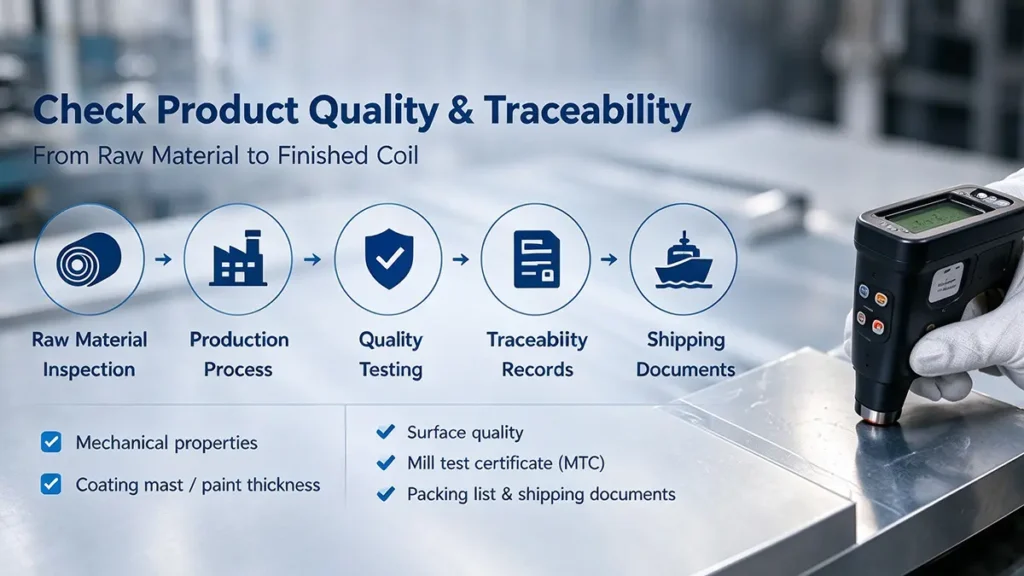
For steel coils, quality checks may include:
| Inspection Item | What It Confirms |
|---|---|
| Thickness and width | Dimensional conformity |
| Yield strength and tensile strength | Mechanical performance |
| Elongation and bend testing | Formability, where specified |
| Metallic coating mass | Compliance with coating requirements |
| Paint film thickness | Organic coating conformity for PPGI / PPGL |
| Adhesion and T-bend testing | Paint performance during forming |
| Surface inspection | Scratches, dents, uneven coating, or visible defects |
| Coil weight and dimensions | Order and shipping conformity |
The applicable test methods and acceptance limits depend on the product standard and purchase specification. ASTM A653 and A792, for example, include requirements relating to mechanical properties, coating requirements, and bend testing.
Check Traceability from
A useful test is to select a finished coil and ask the supplier to trace it back to the incoming material and its inspection records.
The records should connect, where applicable:
Incoming substrate → Production batch → Finished coil number → Inspection report → Packing list → Shipping documents
If certificates cannot be matched to specific coil numbers, the buyer may have difficulty proving which material was delivered if a quality dispute arises.
For larger or technically demanding orders, consider an agreed pre-shipment inspection by the buyer or a qualified third-party inspection company. The inspection scope should define sampling, measuring methods, acceptance criteria, an
5️⃣ Verify Certifications and Quality Documents
A quality certificate is useful, but it should be verified rather than accepted at face value.
ISO 9001 and Other Management-System Certifications
ISO 9001 establishes requirements for a quality management system. It provides a framework for controlling processes and improving consistency, but it does not automatically guarantee that every steel coil meets the purchase specification.
When a supplier claims ISO certification, check:
- The exact legal entity named on the certificate
- The certified site or production location
- The scope of certification
- The certification body’s identity and accreditation
- The certificate’s current status and validity
The IAF CertSearch database provides a way to verify accredited management-system certifications by organization name or certificate number.
Review Product-Specific Documents
Depending on the order, useful documents may include:
- Mill Test Certificate (MTC)
- Chemical composition and mechanical test results
- Coating-mass inspection records
- Paint test reports for prepainted products
- Third-party inspection reports, when contractually required
- Packing list and coil identification records
- Certificate of origin, where applicable
Check that the grade, dimensions, coating, coil numbers, and test results correspond to the material being supplied—not merely to a generic sample or a previous production run.
6️⃣ Compare Product Range and Customization Capability
A broad catalog can simplify sourcing, but the number of products listed on a website does not necessarily prove manufacturing capability.
Buyers should ask whether the supplier can meet the particular combination of steel grade, thickness, width, coating, finish, and packaging required.
For example, a PPGI order may require a specific color, paint system, topcoat thickness, coil ID, and forming performance. Another project may require a defined galvanized coating mass and structural steel grade. These combinations can create different production constraints and lead times.
When assessing suppliers, Hengze Steel should be evaluated by the same product-specific criteria: the relevant production or processing capability, available specifications, supporting inspection records, and ability to fulfill the order consistently.
Questions to Ask
- Can the supplier produce the specified dimensions and grade?
- Are custom coating levels or paint systems available?
- Are color samples or production samples available for approval?
- What is the minimum order quantity for the exact specification?
- Can the supplier maintain the same requirements across repeat orders?
- Are customized packaging and shipping marks available?
A technically suitable supplier is more valuable than one with a large product catalog but limited capability for your actual order.
7️⃣ Evaluate Export Experience and Delivery Reliability
Export experience involves more than having shipped steel before. The supplier must coordinate production, documentation, packing, container loading, and shipping schedules.
Assess Lead Time Realistically
Ask the supplier to separate the main stages of delivery:
- Raw-material availability
- Production scheduling
- Manufacturing and inspection
- Packing and document preparation
- Port delivery and vessel booking
Lead time can change according to steel availability, specification complexity, order quantity, seasonal demand, and shipping arrangements. A realistic schedule with clearly stated assumptions is more useful than an unusually short promise without production details.
Confirm Document Responsibilities
Before placing the order, agree on who prepares and checks each document, including the commercial invoice, packing list, mill certificate, certificate of origin if required, and shipping documents.
Also confirm how coil IDs, product descriptions, quantities, and weights will be recorded. Errors between the purchase order, packing list, and shipping documents can create avoidable customs clearance and receiving problems.
Agree on Incoterms
The contract should identify the selected Incoterms® rule, its named place or port, and the applicable edition. Incoterms® 2020 defines the respective responsibilities for delivery, costs, and transfer of risk between seller and buyer; it does not replace the technical product specification.
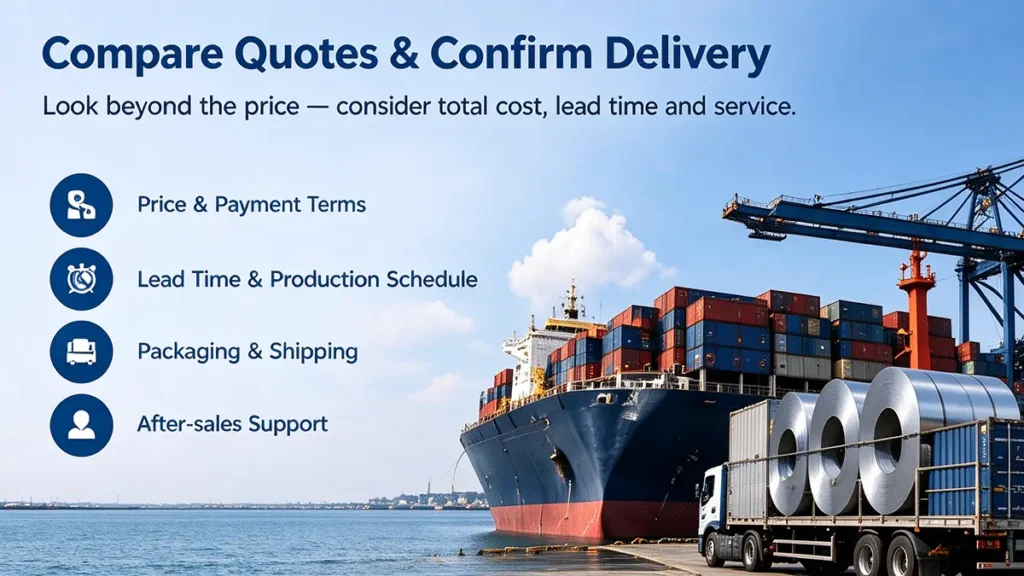
8️⃣ Compare Quotations Beyond Price per Ton
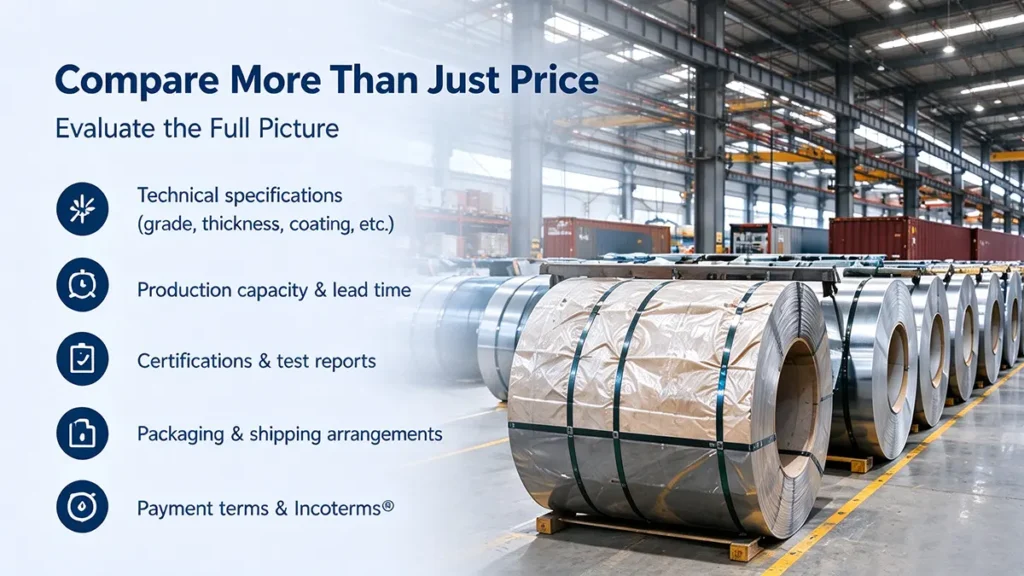
Steel coil prices can vary with the substrate, grade, dimensions, coating, paint system, order quantity, production timing, and delivery terms.
A lower quotation is not necessarily more economical if it uses a different specification or excludes important costs.
Normalize the Technical Specification First
Before comparing prices, confirm that every quotation uses the same:
- Steel grade and applicable standard
- Thickness basis and tolerance
- Width and dimensions
- Metallic coating requirement
- Paint system and film thickness, where applicable
- Coil weight and packaging
- Quantity and order schedule
- Inspection and documentation requirements
Then compare the commercial terms.
| Cost or Risk Factor | What to Check |
|---|---|
| Product price | Same grade, dimensions and coating |
| Packing | Included requirements and extra charges |
| Inspection | Supplier inspection versus third-party inspection |
| Freight and insurance | Included scope under the agreed trade term |
| Port and local charges | Who bears each stated cost |
| Payment terms | Deposit, balance, documents and payment milestones |
| Quality risk | Inspection rights and remedies for nonconformity |
| Delivery schedule | Production lead time and shipment assumptions |
The final comparison should be based on the cost of receiving conforming material at the required destination, not simply the quoted price per ton.
For large orders, a trial order can help evaluate product quality, packaging, documentation, communication, and delivery performance before a longer-term supply agreement is established.
9️⃣ Check Packaging and Shipping Arrangements
Steel coils are heavy, compact loads that can be damaged by poor handling, moisture, impact, or inadequate restraint during transport.
Ask for a packaging specification covering:
- Waterproof or moisture-resistant wrapping, as appropriate
- Inner and outer protection
- Edge protection
- Strapping and restraint
- Coil identification and shipping marks
- Handling and loading orientation
- Loading photographs and container condition records
The correct packaging depends on the product, transport route, storage conditions, and destination requirements.
For coated steel, scratches and damaged edges can affect appearance and, in some cases, corrosion performance. Prepainted products may require additional surface protection to reduce handling damage.
The purchase contract should also define how visible damage, missing identification, or packaging defects will be recorded and reported at receipt.
10. Identify Common Supplier Red Flags
Some warning signs are more significant than a low price.
Unclear manufacturing responsibility. The supplier cannot identify which company operates the relevant production line or where the material will be processed.
Incomplete specifications. The quotation states only “GI coil,” “GL coil,” or “PPGI” without sufficient technical detail.
Unverifiable documents. Certificates do not identify the relevant product, production batch, or coil numbers.
Unrealistic delivery promises. The supplier promises immediate shipment without confirming raw material, production capacity, or inspection arrangements.
Inconsistent commercial information. The legal entity, contract party, invoice issuer, and payment beneficiary differ without a clear and verifiable explanation.
Resistance to inspection. The supplier will not agree on reasonable, contractually defined inspection procedures.
Unclear corrective-action process. There is no agreed method for handling rejected material, shortages, dimensional deviations, or transport damage.
One warning sign does not necessarily mean that a supplier is unsuitable. However, several unresolved issues should be addressed before payment or production release.
11. Steel Coil Manufacturer Evaluation Checklist
Use the following checklist when shortlisting potential suppliers.
| Evaluation Area | Evidence to Request | Priority |
|---|---|---|
| Business identity | Business license and contract entity details | Essential |
| Manufacturing capability | Relevant line details and production evidence | Essential |
| Technical specifications | Written product specification and tolerances | Essential |
| Quality control | Inspection procedures and actual test records | Essential |
| Traceability | Link between coil ID, certificate and packing list | Essential |
| Certifications | Valid certificates with appropriate scope | Important |
| Export capability | Sample export documents and shipping process | Important |
| Production schedule | Capacity for the exact order and confirmed lead time | Essential |
| Packaging | Written packing specification and loading method | Important |
| Commercial terms | Comparable quotation, payment terms and Incoterms | Essential |
| After-sales process | Written complaint and corrective-action procedure | Important |
For an initial evaluation, request a complete quotation, a technical data sheet, a sample MTC or inspection report, current certification details, and photographs or video of the relevant production process.
The purpose is not to collect the largest number of documents. It is to determine whether the evidence is consistent, relevant, and traceable to the product you intend to buy.
Frequently Asked Questions
PE is a conventional polyester coating, while SMP is a silicone-modified polyester system. SMP is generally formulated for improved weathering, surface hardness and resistance to chalking compared with standard PE.
They are different coating technologies rather than a universal “better” and “worse” hierarchy. HDP is generally designed for higher weather durability, while SMP can provide a strong combination of durability, adhesion, formability and cost efficiency. The actual formulation and test data should be compared.
PVDF generally provides higher long-term weatherability, UV resistance, color retention and chemical resistance, particularly for demanding architectural applications. However, HDP can be a more economical solution where the required performance does not justify a premium fluoropolymer system.
Typical commercial topcoat thickness is approximately 15–30 μm, with primer and back-coat thickness specified separately. Actual values depend on the paint system, manufacturer and project specification.
PE polyester is widely used because it offers a practical combination of cost, color availability and formability. SMP, HDP and PVDF are selected when higher weathering performance is required.
Yes. PVDF-coated steel is used for roofing, wall cladding and architectural metal systems, particularly where long-term color and weather resistance are important.
Yes, but the paint is only one part of the corrosion-protection system. The metallic zinc coating, pretreatment, primer, topcoat, edge condition and fabrication quality all influence corrosion performance.
No.
PPGI uses a galvanized steel substrate with a zinc coating.
PPGL uses a Galvalume or aluminum-zinc-coated steel substrate.
Both can use paint systems such as PE, SMP, HDP and PVDF.
Conclusion
The choice between PE, SMP, HDP and PVDF should be based on the actual performance requirements of the PPGI application rather than on coating names alone.
In general:
- PE is a practical choice for general-purpose and cost-sensitive applications.
- SMP provides improved weatherability and surface durability over standard polyester.
- HDP is designed for higher outdoor durability and improved color and UV performance.
- PVDF is commonly selected for premium architectural applications and demanding environments where long-term appearance and weather resistance are important.
The most important point is that paint system selection is only one part of PPGI specification. Steel grade, zinc coating mass, pretreatment, primer, topcoat thickness, forming requirements and environmental exposure all contribute to final performance. ASTM A755/A755M likewise treats the metallic-coated substrate and organic coating system as an integrated product rather than an isolated paint layer.
For projects requiring different combinations of steel grade, zinc coating, paint system, color and coating thickness, Hengze Steel provides PPGI and PPGL options using PE, SMP, HDP and PVDF systems, with specifications configurable according to project requirements. Its published PPGI range includes multiple substrate thicknesses, zinc coating levels, paint thicknesses and international standards.
For buyers, the most useful approach is therefore not to ask simply “PE or PVDF?”, but to define the complete requirement:
substrate + metallic coating + pretreatment + primer + paint system + DFT + color + forming + environment.
That specification provides a much more reliable basis for comparing PPGI suppliers, quotations and long-term performance.
Trending News
What to Expect When You Contact Us
Fast Response – Replies within 12 hours
Tailored Solutions – Based on your needs and industry
Full Support – From products to technical and market guidance