
Explore Trends, Innovations, and Achievements at HengZe Steel
What Is Galvalume Steel Coil? AZ Coating Explained
- Industry News
- October 15, 2026
- 9:04 am
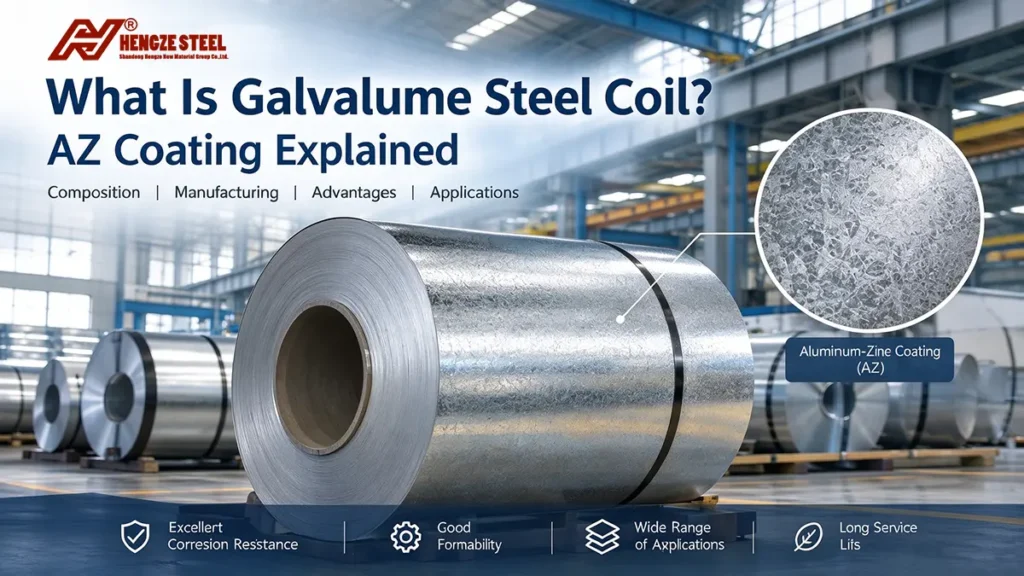
Galvalume steel coil is a hot-dip aluminum-zinc alloy-coated steel product designed to provide corrosion resistance, formability, and long-term performance in a wide range of applications. It is commonly used in metal roofing, wall cladding, industrial buildings, agricultural structures, and prepainted steel products.
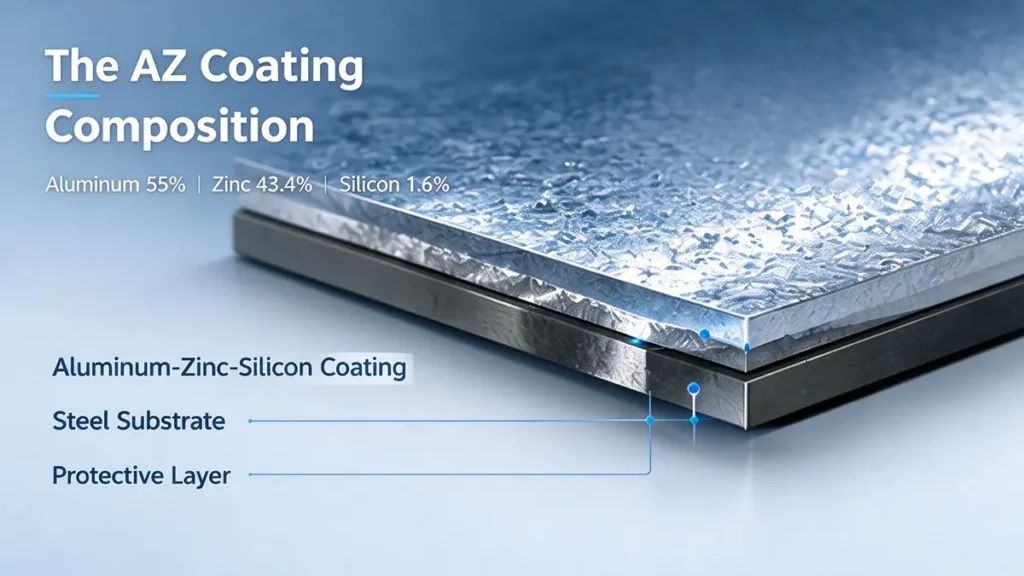
The defining feature of conventional Galvalume coating is its nominal composition of 55% aluminum, 43.4% zinc, and 1.6% silicon by weight. Aluminum provides barrier protection, while zinc contributes sacrificial corrosion protection in localized areas. Together, these elements create a coating system that performs differently from conventional galvanized steel.
For buyers evaluating material specifications, Hengze Steel’s Galvalume steel coil range provides a starting point for reviewing available coating options, steel grades, dimensions, and surface treatments. The final specification should always reflect the intended application, fabrication process, and service environment.
Understanding Galvalume requires more than knowing its alloy composition. The AZ coating designation, coating mass, base steel grade, surface treatment, and exposure conditions all influence material selection and product performance.
This guide explains how Galvalume steel coil works, what AZ coating designations mean, how it compares with galvanized steel, and which technical details buyers should confirm before ordering.
Table of Contents
-
1️⃣ What Is Galvalume Steel Coil?1️⃣ What Is Galvalume Steel Coil?
-
2️⃣ What Does AZ Coating Mean?2️⃣ What Does AZ Coating Mean?
-
3️⃣ How Is Galvalume Steel Coil Manufactured?3️⃣ How Is Galvalume Steel Coil Manufactured?
-
4️⃣ AZ50, AZ55, AZ60, and AZ150 Explained4️⃣ AZ50, AZ55, AZ60, and AZ150 Explained
-
5️⃣ Galvalume vs. Galvanized Steel Coil5️⃣ Galvalume vs. Galvanized Steel Coil
-
6️⃣ Common Applications of Galvalume Steel6️⃣ Common Applications of Galvalume Steel
-
7️⃣ Advantages and Limitations of Galvalume Steel Coil7️⃣ Advantages and Limitations of Galvalume Steel Coil
-
8️⃣ How to Choose the Right Galvalume Steel Coil8️⃣ How to Choose the Right Galvalume Steel Coil
-
9️⃣ Frequently Asked Questions9️⃣ Frequently Asked Questions
-
ConclusionConclusion
1️⃣ What Is Galvalume Steel Coil?
Galvalume steel coil is cold-rolled or otherwise suitably prepared steel sheet coated with an aluminum-zinc alloy through a continuous hot-dip process. After coating, the strip is cooled, inspected, and recoiled for delivery to downstream manufacturers.
The steel substrate provides the product’s mechanical strength, while the metallic coating protects the surface against atmospheric corrosion.
The material is supplied in coil form so that it can be further processed into roofing sheets, corrugated panels, standing-seam roofing, wall cladding, formed structural components, and other sheet-metal products.
Several terms are commonly used in the market:
-
Galvalume steel coil: The familiar commercial term for steel protected by a conventional 55% aluminum-zinc coating.
-
AZ-coated steel coil: An industry term referring to aluminum-zinc alloy-coated steel.
-
Aluzinc or aluminum-zinc steel coil: Alternative commercial descriptions frequently encountered in international steel trading.
-
55% Al-Zn coated steel: A more technical description of the conventional coating composition.
Galvalume is also a trademark used for a particular commercial coating technology. Not every aluminum-zinc-coated steel product sold under the broader AZ or Aluzinc descriptions is necessarily identical in composition, manufacturing process, or specification.
For standardized procurement, buyers should identify the coating type, governing product standard, coating mass, and steel grade rather than relying on the commercial product name alone. ASTM A792/A792M is a principal specification covering 55% aluminum-zinc alloy-coated steel sheet supplied in coils and cut lengths.
2️⃣ What Does AZ Coating Mean?
AZ refers to the aluminum-zinc alloy coating applied to the steel surface. In commercial specifications, the AZ designation helps identify the required coating class or mass, depending on the standard and unit system being used.
The coating is not a separate sheet of aluminum placed over zinc-coated steel. It is a metallic alloy layer formed directly on the steel through hot-dip coating.
2.1 Chemical composition of Galvalume coating
The conventional aluminum-zinc coating has the following nominal composition:
|
Element |
Approximate weight percentage |
Primary function |
|---|---|---|
|
Aluminum (Al) |
55% |
Forms a protective surface layer that slows atmospheric corrosion |
|
Zinc (Zn) |
43.4% |
Provides sacrificial protection in localized damaged areas |
|
Silicon (Si) |
1.6% |
Helps control interfacial alloy formation during hot-dip coating |
These percentages describe the conventional Al-Zn-Si coating. Actual production tolerances and the applicable coating type are determined by the relevant material specification. ASTM A792/A792M also covers a second coating type based on an aluminum-zinc-magnesium-silicon alloy, so buyers should confirm the exact coating type when the distinction matters.
2.2 How does AZ coating protect steel?
Galvalume’s corrosion resistance comes from the combined behavior of its coating constituents.<
Aluminum: barrier protectionAluminum forms a relatively stable oxide layer when exposed to the atmosphere. This layer helps limit further reactions between the coating and its environment, providing important protection across the exposed surface.Zinc: sacrificial protection
Zinc is electrochemically more active than steel. When a small area of the underlying steel becomes exposed, zinc can preferentially corrode and provide a degree of sacrificial protection. The effectiveness of this mechanism depends on the geometry of the damaged area and the surrounding environment.Silicon: coating-interface control
Silicon helps control the formation of iron-aluminum intermetallic compounds at the steel-coating interface during production. This supports the coating’s ability to adhere to the substrate during subsequent forming operations.
The resulting coating combines barrier protection with a degree of sacrificial protection. This balance makes Galvalume suitable for many building applications involving prolonged atmospheric exposure. However, its behavior at cut edges, deep scratches, and damaged areas is not identical to that of galvanized steel.
2.3 Why does coating composition matter?
Two steel coils may have similar thicknesses and metallic appearances but different corrosion performance if their coating compositions or coating masses differ.
Composition alone is also insufficient to determine service life. Coating mass, substrate condition, manufacturing quality, chemical exposure, moisture retention, and installation details must be considered together.
For this reason, a material specification should identify both the coating system and the required coating mass.
3️⃣ How Is Galvalume Steel Coil Manufactured?
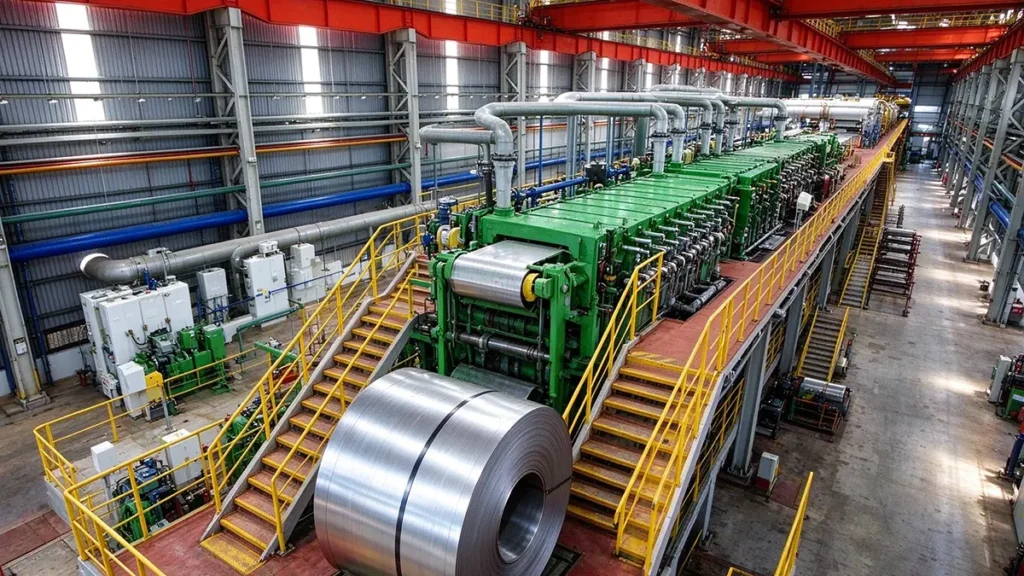
Galvalume steel coil is typically produced on a continuous hot-dip coating line. The process must maintain consistent surface cleanliness, coating composition, strip temperature, and coating mass to achieve the specified properties.
Step 1: Steel strip preparation
The steel strip passes through cleaning operations to remove rolling oil and other surface contaminants.
Effective cleaning is essential because contamination can prevent uniform wetting of the steel by the molten coating alloy.
Step 2: Annealing and thermal control
The strip is heated under controlled conditions. Depending on the steel grade and production route, annealing develops the mechanical properties required for subsequent forming or structural use.
Temperature control is particularly important when the finished product must meet specified yield strength, tensile strength, elongation, or forming requirements.
Step 3: Hot-dip alloy coating
The prepared strip passes through a bath of molten aluminum-zinc alloy. The coating forms through a combination of wetting and metallurgical interaction at the steel surface.
Bath chemistry, strip speed, temperature, and surface condition all influence the finished coating.
Step 4: Coating-mass adjustment and cooling
Gas knives remove excess molten metal and help regulate the coating mass. The coated strip is then cooled under controlled conditions to solidify the alloy layer.
Uneven coating distribution or process instability can affect coating uniformity, surface appearance, and subsequent processing performance.
Step 5: Surface treatment, inspection, and recoiling
Depending on the intended application, the strip may receive passivation or another chemical treatment, an oil coating, or an optional protective surface treatment.
The finished coil is inspected against the applicable specification and order requirements. Relevant inspection items may include thickness, width, coating mass, mechanical properties, surface quality, and coating adhesion during bending.
For buyers, the important distinction is that the product’s performance is determined by the complete manufacturing and quality-control process, not simply by the nominal alloy composition.
4️⃣ AZ50, AZ55, AZ60, and AZ150 Explained
The AZ coating designation is one of the most important specifications when purchasing aluminum-zinc-coated steel coil.
However, AZ50, AZ55, and AZ60 should not be interpreted as 50, 55, and 60 g/m². Under ASTM terminology, these inch-pound designations refer to coating-mass classes expressed in ounces per square foot. Metric designations use a separate system.
4.1 Common AZ coating designations
The following table shows commonly paired designations used when comparing the two unit systems.
|
Inch-pound designation |
Metric designation commonly paired with it |
Approximate coating mass class |
|---|---|---|
|
AZ50 |
AZM150 |
150 g/m² |
|
AZ55 |
AZM165 |
165 g/m² |
|
AZ60 |
AZM180 |
180 g/m² |
Important: These are standard coating designations, not exact mathematical conversions. The corresponding classes are defined under their respective unit systems. The applicable edition of ASTM A792/A792M and the order specification should govern acceptance.
4.2 What does AZ150 mean?
AZ150 is commonly used to identify aluminum-zinc-coated steel with a specified coating mass of 150 g/m² under the relevant metric coating designation.
The stated coating mass generally represents the combined coating on both sides of the steel sheet, not 150 g/m² on each side.
If the coating were distributed evenly, 150 g/m² total would correspond to approximately 75 g/m² per side. Actual distribution may differ, so the total coating designation should not be treated as a guarantee of identical coating mass on both surfaces.
Coating mass also should not be confused with coating thickness. Converting g/m² into micrometers requires assumptions about coating density, composition, and distribution.
4.3 Is a higher AZ coating designation always better?
A higher coating mass generally means that more metallic coating is present, which can increase the available corrosion-protection reserve under otherwise comparable conditions.
However, the highest available coating class is not automatically the best choice for every application.
A roofing manufacturer, for example, may need to balance corrosion resistance against forming requirements, product cost, steel grade, and the design life of the finished building.
The appropriate coating class depends on the exposure environment, expected service conditions, fabrication process, and project specification.
4.4 AZ150 vs. AZ180: What should buyers consider?
AZ150 and AZ180 are metric coating-mass classes commonly encountered in purchasing discussions. AZ180 specifies a higher coating-mass class than AZ150, but that difference alone does not establish how many additional years a finished product will last.
Buyers should consider:
-
The corrosiveness of the installation environment.
-
Whether the product will be used as bare metallic-coated sheet or as a prepainted system.
-
The frequency and severity of moisture exposure.
-
The presence of salt deposits, industrial pollutants, or aggressive chemicals.
-
Cut-edge geometry, drainage, and maintenance requirements.
For international orders, always state the applicable standard and unit system. This prevents confusion between ASTM AZ designations and metric coating designations used by other standards.
5️⃣ Galvalume vs. Galvanized Steel Coil
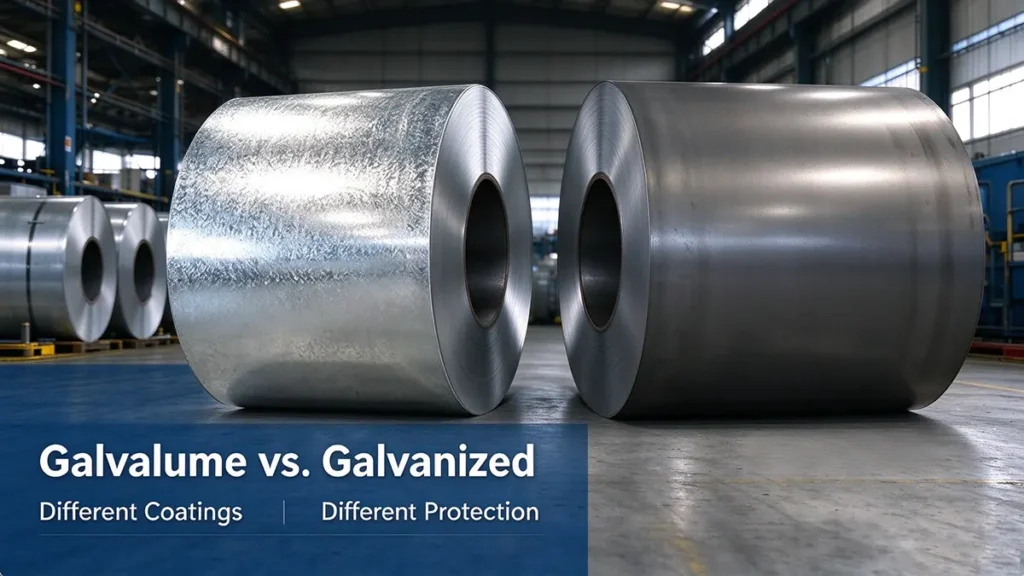
Galvalume and galvanized steel coil are both hot-dip metallic-coated steel products, but their coatings have different compositions and corrosion-protection characteristics.
Galvalume uses an aluminum-zinc alloy coating, while conventional galvanized steel uses a predominantly zinc coating. The main ASTM product specifications are ASTM A792/A792M for 55% aluminum-zinc alloy-coated steel and ASTM A653/A653M for zinc-coated or zinc-iron alloy-coated steel sheet.
5.1 Technical comparison
Property | ||
|---|---|---|
Coating composition | Conventional 55% Al-Zn-Si alloy | Predominantly zinc |
Principal ASTM specification | ASTM A792/A792M | ASTM A653/A653M |
Primary protection mechanism | Strong barrier protection with localized sacrificial protection | Zinc barrier protection and sacrificial protection |
Typical applications | Roofing, wall cladding, building panels, and selected industrial components | Roofing, framing, ducts, general fabrication, and structural components |
Cut-edge behavior | Depends on edge geometry, exposure, and coating condition | Zinc can provide sacrificial protection around exposed steel |
Key purchasing factors | Coating mass, steel grade, surface treatment, exposure, and forming requirements | Zinc coating designation, steel grade, surface treatment, exposure, and forming requirements |
5.2 Which offers better corrosion resistance?
Galvalume often performs very well in atmospheric building applications, particularly on exposed roof and wall surfaces. Under comparable and suitable service conditions, conventional 55% aluminum-zinc coatings can offer longer corrosion life than conventional galvanized coatings.
Nevertheless, the result is not universal. Performance depends on coating mass, coating condition, local climate, pollutants, salt exposure, and the design of the installed system.
Galvanized steel may be preferable in certain applications where zinc’s sacrificial protection around exposed edges is especially valuable. Neither product should be selected solely on a general statement that one is always more corrosion-resistant than the other.
5.3 Can Galvalume be used in coastal environments?
The answer depends on the severity of exposure and the specific product system.
Marine atmospheres, persistent salt deposits, and direct seawater splash can create demanding corrosion conditions. A standard metallic coating designation does not by itself establish suitability for these environments.
For coastal projects, buyers should obtain exposure-specific recommendations and evaluate the complete system, including paint or other protective finishes, panel design, fasteners, cut edges, and maintenance requirements.
The same principle applies to buildings exposed to agricultural chemicals or industrial pollution.
6️⃣ Common Applications of Galvalume Steel
Galvalume steel coil is used where corrosion-resistant sheet steel can provide a practical balance of durability, strength, appearance, and formability.
6.1 Metal roofing and wall cladding
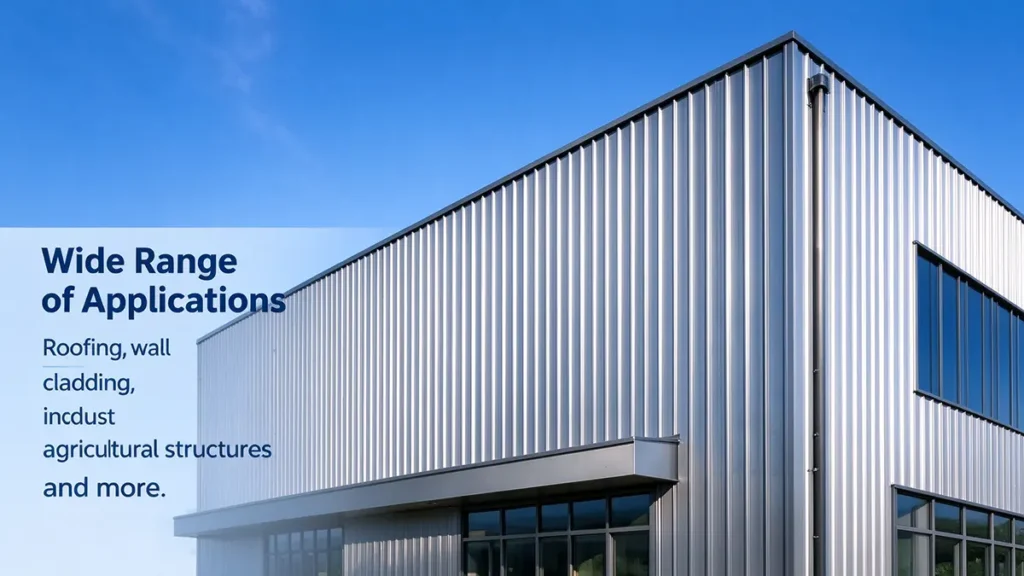
Roofing and wall cladding are among the most established applications for Galvalume steel coil.
The material can be roll-formed into corrugated sheets, trapezoidal panels, standing-seam roofing, and other profiles. These products are widely used in warehouses, factories, commercial buildings, workshops, and agricultural structures.
Coating selection should reflect local exposure and expected maintenance requirements. Roof slope, drainage, fastener design, and the prevention of trapped moisture also influence the long-term performance of the finished roof.
6.2 Prepainted steel coil
Galvalume can serve as the metallic-coated substrate for prepainted steel coil.
In this system, the metallic coating provides an initial layer of corrosion protection, while the pretreatment, primer, and topcoat contribute additional protection and the required surface appearance.
The overall performance depends on the entire coating system. A well-selected metallic coating cannot compensate for an incompatible pretreatment or an unsuitable paint system.
6.3 Industrial and commercial buildings
Galvalume is used in exterior wall panels, formed building components, roof decking, and other fabricated sheet-metal products.
For load-bearing components, the steel grade and mechanical properties must meet the structural design requirements. Coating mass addresses a different requirement and should not be used as a substitute for strength specifications.
6.4 Agricultural buildings and storage facilities
Farm buildings, equipment shelters, and selected storage structures may use Galvalume roofing and wall panels.
The operating environment is especially important in agricultural applications. Fertilizer dust, animal waste, ammonia, persistent condensation, and other chemical exposures can accelerate corrosion if the material and installation system are unsuitable.
Where these conditions are expected, material selection should be based on the actual exposure rather than general assumptions about outdoor corrosion resistance.
6.5 Other industrial applications
Depending on the specific grade and coating requirements, aluminum-zinc-coated steel may also be considered for selected equipment housings, formed sheet-metal components, and applications involving elevated temperatures.
Suitability must be confirmed against the product standard, operating temperature, forming requirements, and any relevant industry-specific requirements.
7️⃣ Advantages and Limitations of Galvalume Steel Coil
A proper material assessment considers both the benefits of the coating and its limitations under actual operating conditions.
7.1 Main advantages
Effective atmospheric corrosion resistance
The aluminum-zinc alloy coating provides strong barrier protection on exposed surfaces. This is an important reason for its use in metal roofing and building cladding.
Aluminum contributes barrier protection, while zinc provides a degree of sacrificial protection in localized damaged areas. The combined behavior differs from that of a conventional zinc-only coating.Suitable for continuous coil processing
When the correct steel grade and coating are selected, Galvalume coil can be slit, leveled, corrugated, roll-formed, and processed into numerous building products.Compatibility with prepainting
Galvalume can be used as a metallic-coated substrate for suitable factory-applied paint systems, providing additional protection and decorative flexibility.Availability in different steel grades and coating classes
The product can be specified for different forming and structural requirements. ASTM A792/A792M identifies multiple steel categories and coating types, allowing purchasers to define requirements according to the intended use.
7.2 Limitations buyers should understand
Cut edges and coating damage require proper design.
Exposed edges, deep scratches, and coating damage behave differently from intact coated surfaces. Cutting quality, panel detailing, moisture retention, and the extent of exposed steel can influence corrosion development.
Severe marine conditions, direct chemical exposure, and persistent contamination may require a specialized coating or protective system. The nominal AZ designation alone cannot guarantee performance.Formability depends on the base steel grade.
A coating specification does not determine whether a coil is suitable for tight-radius bending, deep drawing, or other demanding forming operations. The substrate grade, coating adhesion, bend radius, and processing conditions must all be considered.Incompatible material contact can create corrosion risks.
Dissimilar metals, water traps, and certain construction materials can contribute to corrosion under particular conditions. The installation design should address material compatibility and drainage.Coating mass is not a complete service-life prediction.
Increasing coating mass may improve the corrosion-protection reserve, but service life also depends on the environment, fabrication quality, protective finishes, and maintenance.
These considerations are not reasons to avoid Galvalume. They are reasons to specify the material according to its intended operating conditions.
8️⃣ How to Choose the Right Galvalume Steel Coil
Selecting the right Galvalume steel coil starts with the finished product, not simply the coating designation.
Buyers should establish the mechanical, dimensional, surface, and corrosion-resistance requirements before requesting quotations.
8.1 Specify the steel thickness
Nominal thickness affects product weight, stiffness, structural capacity, and forming behavior.
The purchasing specification should clarify whether the required thickness refers to the base metal or the total coated sheet, as well as the permitted thickness tolerance.
This is important when comparing offers that may use different measurement conventions.
8.2 Confirm the AZ coating mass
Specify the required coating designation under the applicable standard, such as an appropriate AZ or AZM coating class.
Avoid descriptions such as “heavy coating” or “high corrosion resistance” without a defined technical requirement.
When comparing ASTM and metric designations, verify that the two products meet the intended standard requirements rather than relying on similar-looking numbers.
8.3 Select the appropriate steel grade
The base steel grade should reflect the required formability and mechanical performance.
For example, a coil intended for routine roofing-panel roll forming may have different requirements from a coil intended for a structural component with a specified yield strength.
Buyers should confirm the applicable mechanical requirements, including yield strength, tensile strength, elongation, and coating-bend performance where required by the governing specification.
8.4 Confirm width, coil weight, and inner diameter
For downstream processing, specify:
|
Parameter |
Why it matters |
|---|---|
|
Coil width |
Must match the slitting or forming line requirements |
|
Coil weight |
Affects handling, loading, and equipment capacity |
|
Inner diameter (ID) |
Must be compatible with the uncoiler mandrel |
|
Outer diameter (OD) |
Affects storage, transportation, and handling |
|
Dimensional tolerances |
Influence production yield and finished-product consistency |
For slit coils, the order should also define the required slit width, width tolerance, and edge quality.
8.5 Define the surface condition
Surface treatment should be specified according to the intended processing route.
Possible requirements include bare metallic coating, passivation, oiling, anti-fingerprint treatment, or a surface suitable for subsequent painting. Not every treatment is compatible with every downstream process, so the required finish should be confirmed before ordering.
For procurement teams comparing available configurations, Hengze Steel’s Galvalume steel coil specifications can serve as a reference when preparing an inquiry. Actual thickness ranges, coating options, tolerances, and delivery conditions should be confirmed against the current quotation and mill documentation.
8.6 Verify standards and inspection documents
ASTM A792/A792M covers 55% aluminum-zinc alloy-coated steel sheet supplied in coils and cut lengths. ASTM A924/A924M provides general requirements for hot-dip metallic-coated steel sheet when applicable under the product specification.
A purchasing specification should identify the governing standard and required inspection documentation. Depending on the order, this may include a mill test certificate, coating-mass results, dimensional inspection records, and mechanical test results.
Do not assume that a product meets every cited international standard merely because several standards appear on a general product page. The actual ordered material, test requirements, and documentation should be checked.
Galvalume steel coil purchasing checklist
Before confirming an order, make sure the following items are clearly defined:
-
Product: aluminum-zinc alloy-coated steel coil.
-
Standard: ASTM A792/A792M or another agreed product standard.
-
Thickness: nominal value and tolerance.
-
Coating: alloy type and required AZ/AZM coating class.
-
Steel grade: selected for the application and fabrication process.
-
Width and coil dimensions: including ID, OD, and coil weight where applicable.
-
Surface treatment: as supplied or suitable for the next processing stage.
-
Quality documents: agreed mill certificates and inspection requirements.
-
End use: roofing, cladding, structural components, prepainting, or other specified application.
A complete specification reduces ambiguity during quotation, production, inspection, and delivery.
9️⃣ Frequently Asked Questions
Galvalume steel coil is steel sheet coated with an aluminum-zinc alloy through a hot-dip process. Conventional Galvalume coating contains approximately 55% aluminum, 43.4% zinc, and 1.6% silicon by weight. It is widely used for roofing, wall cladding, and other applications requiring atmospheric corrosion resistance.
AZ identifies an aluminum-zinc alloy coating system. The numbers that follow identify a coating designation under the applicable standard and unit system. They should not be interpreted as grams per square meter unless the specification explicitly defines them that way.
AZ50 is an inch-pound coating designation, while AZ150 is a metric coating-mass designation commonly associated with a 150 g/m² class. The numbers are not expressed in the same units. For international purchasing, the applicable standard and required coating mass should be stated explicitly.
AZ150 is used for many roofing and building-panel applications. Its suitability depends on the local exposure conditions, base steel grade, panel design, fabrication requirements, and expected service life. The required coating class should be determined from the project specification rather than from a universal rule.
Galvalume can provide excellent atmospheric corrosion resistance and may outperform conventional galvanized coatings in many exposed building applications. Galvanized steel may be preferable in certain situations where zinc's sacrificial protection is especially valuable. The choice depends on coating mass, environment, fabrication, and installation requirements.
Yes. Galvalume can be used as the metallic-coated substrate for suitable prepainted steel products. The surface condition, pretreatment, primer, and topcoat must be selected as a compatible system for the intended service environment.
A higher coating mass generally provides more metallic coating, but it does not guarantee a proportionate increase in service life. Corrosion depends on the exposure environment, coating composition, surface treatment, cut-edge details, installation quality, and maintenance.
ASTM A792/A792M is a principal ASTM specification for 55% aluminum-zinc alloy-coated steel sheet supplied in coils and cut lengths. Buyers should confirm the required edition, coating type, steel grade, and coating-mass designation in the purchase order.
Conclusion
Galvalume steel coil combines the mechanical properties of steel with the atmospheric corrosion protection provided by an aluminum-zinc alloy coating. Its conventional 55% aluminum coating system is widely used in roofing, wall cladding, industrial buildings, and selected fabricated steel products.
The most important purchasing considerations are not limited to the AZ coating designation. Steel thickness, substrate grade, coating mass, surface treatment, fabrication requirements, and actual exposure conditions all contribute to the finished product’s performance.
A technically complete purchase specification helps ensure that the selected material matches the application and that its properties can be verified through the appropriate inspection documents.
For project-specific sourcing, Hengze Steel can be approached with the required steel grade, thickness, coating designation, dimensions, surface condition, and applicable standard to support a more precise product inquiry and quotation.
Trending News
What to Expect When You Contact Us
Fast Response – Replies within 12 hours
Tailored Solutions – Based on your needs and industry
Full Support – From products to technical and market guidance