
Explore Trends, Innovations, and Achievements at HengZe Steel
What Is Prepainted Aluminum Coil? Properties & Applications
- Industry News
- October 22, 2026
- 8:48 am
Prepainted aluminum coil is a factory-coated aluminum strip widely used in architectural roofing, exterior wall cladding, aluminum composite panels, rainwater systems, signage, and industrial components. By applying an organic coating to aluminum in a continuous coil-coating line before fabrication, manufacturers can achieve consistent color, controlled coating thickness, and a finished surface suitable for a wide range of forming processes.
However, prepainted aluminum coil is not a single standardized material with uniform performance. Its suitability for a particular application depends on several interrelated factors, including aluminum alloy and temper, surface pretreatment, coating resin, dry-film thickness, curing conditions, and downstream fabrication requirements.
For buyers and project engineers, understanding these variables is essential when comparing suppliers, evaluating technical specifications, and selecting materials for long-term service.
As a steel and metal materials supplier, Hengze Steel recognizes the importance of matching coated metal products to their intended applications. When evaluating prepainted aluminum coil alongside other coated metal materials, buyers should consider substrate properties, coating performance, fabrication requirements, and the environmental conditions of the finished product.
This guide examines how prepainted aluminum coil is manufactured, its key properties, common coating systems, technical specifications, major applications, and the quality standards buyers should understand before placing an order.
Table of Contents
-
1️⃣ What Is Prepainted Aluminum Coil?1️⃣ What Is Prepainted Aluminum Coil?
-
2️⃣ How Is Prepainted Aluminum Coil Manufactured?2️⃣ How Is Prepainted Aluminum Coil Manufactured?
-
3️⃣ Key Properties of Prepainted Aluminum Coil3️⃣ Key Properties of Prepainted Aluminum Coil
-
4️⃣ PE vs. SMP vs. PVDF vs. FEVE Coatings4️⃣ PE vs. SMP vs. PVDF vs. FEVE Coatings
-
5️⃣ Common Aluminum Alloys and Tempers5️⃣ Common Aluminum Alloys and Tempers
-
6️⃣ Prepainted Aluminum Coil Specifications6️⃣ Prepainted Aluminum Coil Specifications
-
7️⃣ Applications of Prepainted Aluminum Coil7️⃣ Applications of Prepainted Aluminum Coil
-
8️⃣ How to Choose the Right Prepainted Aluminum Coil8️⃣ How to Choose the Right Prepainted Aluminum Coil
-
9️⃣ Quality Testing and Industry Standards9️⃣ Quality Testing and Industry Standards
-
10. Limitations and Common Quality Issues10. Limitations and Common Quality Issues
-
Frequently Asked QuestionsFrequently Asked Questions
-
ConclusionConclusion
1️⃣ What Is Prepainted Aluminum Coil?
Prepainted aluminum coil, also called color-coated aluminum coil or coil-coated aluminum, is aluminum strip that has received an organic coating through an industrial coating process before being slit, bent, roll-formed, stamped, or otherwise fabricated into its final shape.
Unlike post-painted aluminum components, which are coated after fabrication, prepainted aluminum is coated while the metal remains in a continuous strip. The process typically involves surface cleaning, chemical pretreatment, primer application, topcoat application, thermal curing, cooling, and rewinding.
This approach enables manufacturers to control the coating process under relatively consistent production conditions and supply material with a specified surface finish.
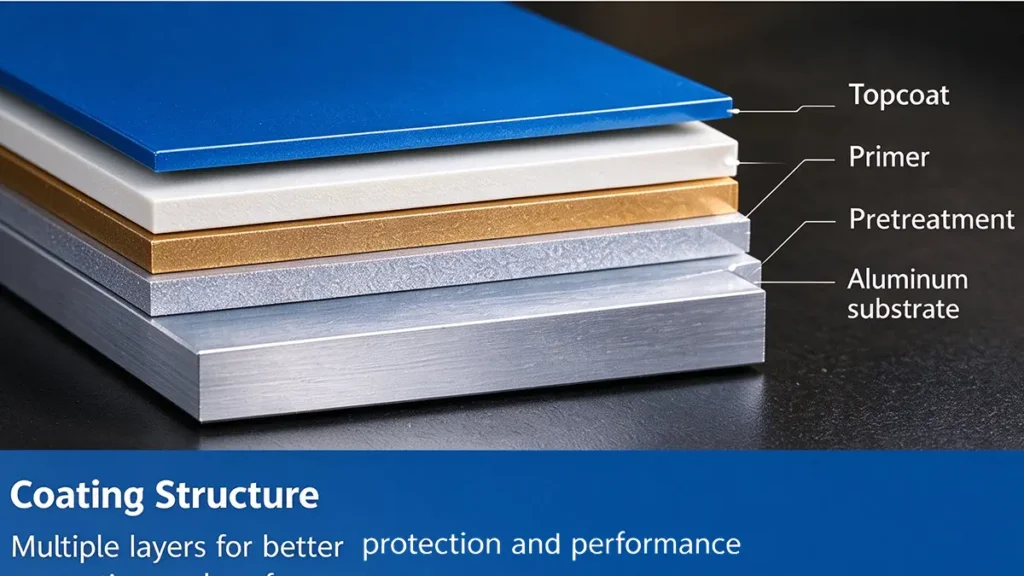
Main Components of Prepainted Aluminum Coil
A typical prepainted aluminum coil consists of several functional layers.
-
Aluminum substrate: Provides the base material’s weight, mechanical strength, formability, and inherent corrosion resistance.
-
Surface pretreatment: Improves the interface between the aluminum and the coating system.
-
Primer: Supports adhesion and contributes to the overall protective performance.
-
Topcoat: Determines the finished color, gloss, texture, weatherability, and other surface characteristics.
-
Backside coating: Protects the reverse surface or provides a compatible surface for subsequent bonding, depending on the application.
Prepainted Aluminum Coil vs. Mill-Finish Aluminum
Mill-finish aluminum is supplied without the decorative organic coating characteristic of prepainted aluminum. Depending on its intended use, it may subsequently be painted, anodized, or treated through another surface-finishing process.
Prepainted aluminum coil arrives with its specified coating already applied. Fabricators can therefore manufacture finished components without having to paint each component separately.
The distinction is particularly relevant to high-volume production, where consistent appearance, process efficiency, and reduced dependence on post-fabrication painting are important.
However, prepainted aluminum is not automatically suitable for every forming operation. Its coating must be compatible with the intended deformation, and its surface can still be damaged by improper handling or fabrication.
2️⃣ How Is Prepainted Aluminum Coil Manufactured?
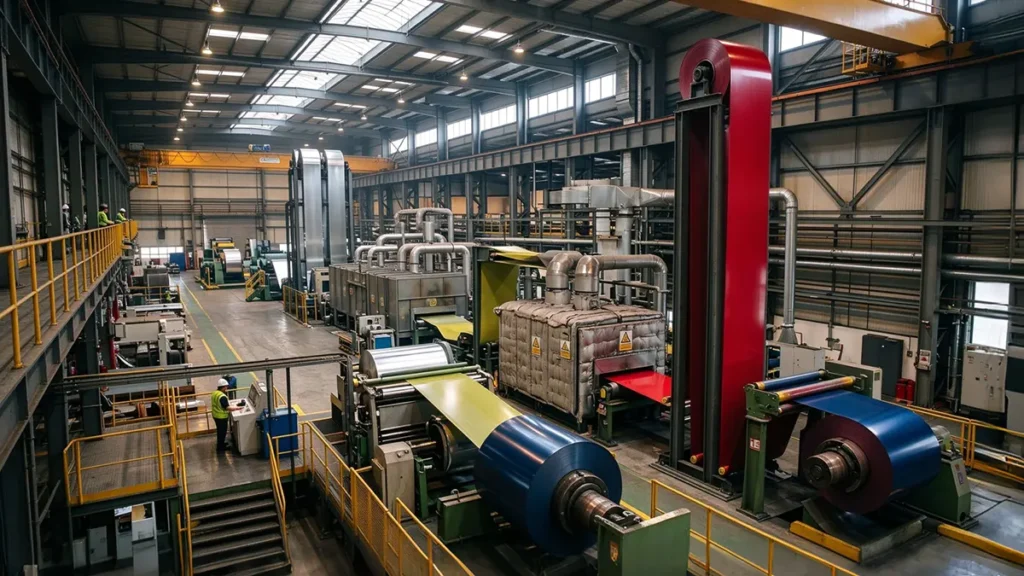
The quality of prepainted aluminum coil depends on both the incoming aluminum substrate and the control of each stage in the coating line.
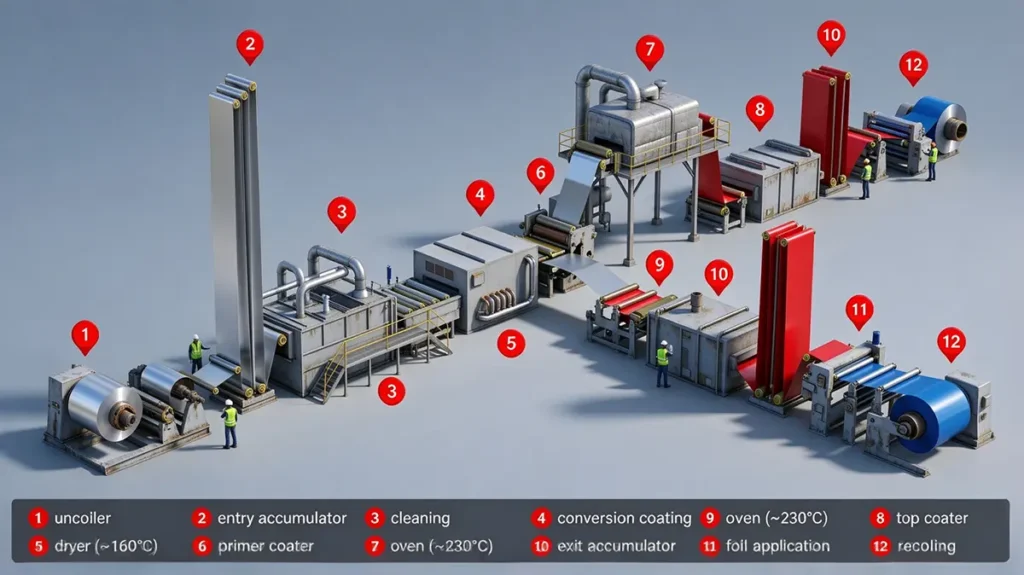
Step 1: Uncoiling and Substrate Inspection
The aluminum strip is unwound and fed into the continuous coating line. Before processing, the substrate is checked against the required alloy, temper, thickness, width, and surface-quality specifications.
Oil residues, surface contamination, rolling defects, or inconsistent material properties can compromise the finished coating if not identified and controlled.
Step 2: Cleaning and Surface Pretreatment
The aluminum surface is cleaned to remove oil, dirt, and other contaminants. Chemical pretreatment is then applied according to the coating system and the required performance.
This stage is fundamental to coating adhesion and corrosion protection. A high-quality topcoat cannot reliably compensate for inadequate surface preparation.
Step 3: Primer Application
A primer is applied to the prepared aluminum surface when required by the specified coating system.
The primer creates a functional interface between the substrate and the topcoat. Its formulation must be compatible with the pretreatment, topcoat, and intended service environment.
Step 4: Topcoat Application and Curing
The topcoat is applied using precision coating equipment, typically roller coating, to achieve the required dry-film thickness, color, gloss, and surface finish.
The coated strip then passes through a controlled curing oven. Temperature and residence time must be appropriate for the coating formulation and production speed.
Insufficient curing can adversely affect adhesion, hardness, solvent resistance, and forming performance. Excessive or poorly controlled heating may also affect coating appearance and properties.
Step 5: Cooling, Inspection, and Rewinding
After curing, the strip is cooled, inspected, and rewound into finished coils.
Inspection may include coating thickness, color difference, gloss, adhesion, flexibility, surface defects, and dimensional tolerances. The finished material is packaged to protect its surface and edges during transportation and storage.
The continuous process supports consistent production, but final quality still depends on process control, inspection frequency, and clearly defined acceptance criteria.
3️⃣ Key Properties of Prepainted Aluminum Coil
Prepainted aluminum coil combines the characteristics of aluminum with the performance of an applied coating. These properties should be evaluated together rather than treating the coating as the sole determinant of product quality.
3.1 Corrosion Resistance
Aluminum naturally develops a thin, adherent oxide layer that helps protect the underlying metal. The applied coating adds a further barrier against moisture, airborne contaminants, and other environmental exposure.
This combination makes prepainted aluminum suitable for many roofing, cladding, gutter, and architectural applications.
Nevertheless, corrosion performance varies with the aluminum alloy, pretreatment, coating integrity, edge condition, and installation environment. Coastal salt exposure, industrial pollution, trapped moisture, and contact with dissimilar metals can increase the risk of deterioration.
For aggressive environments, material selection should be supported by relevant corrosion-test requirements and appropriate installation details.
3.2 Weatherability and UV Resistance
Outdoor coatings are exposed to ultraviolet radiation, rain, humidity, temperature fluctuations, and airborne pollutants. Over time, these conditions may cause color change, gloss loss, chalking, or deterioration of the coating film.
The resin system has a major influence on weathering performance.
Standard polyester may be suitable for general-purpose applications, while appropriately formulated PVDF and FEVE systems are commonly selected for architectural projects with demanding appearance-retention requirements.
Actual durability depends on the full coating formulation, pretreatment, film thickness, curing quality, exposure conditions, and applicable performance specification.
3.3 Formability and Coating Flexibility
Prepainted aluminum coil can be formed after coating, making it useful for roll-formed roofing, gutters, trims, and other fabricated products.
The aluminum substrate must provide the required ductility, while the coating must tolerate the intended deformation without unacceptable cracking, peeling, or loss of adhesion.
For example, a roofing profile with relatively gentle bends may have different requirements from a component involving tight folds or complex geometries.
Buyers should confirm the alloy and temper, minimum bend radius, forming direction where relevant, and coating flexibility requirements before approving the material.
3.4 Lightweight Construction
Aluminum has a density of approximately 2.70 g/cm³, compared with approximately 7.85 g/cm³ for carbon steel.
This difference can reduce material weight in roofing, cladding, and fabricated components. However, the weight advantage of a finished system depends on thickness, geometry, structural requirements, supporting components, and installation design.
Aluminum and steel should therefore be compared on the basis of the complete engineered application, not density alone.
3.5 Color Consistency and Surface Finish
Prepainted aluminum coil is available in solid colors, metallic finishes, matte surfaces, gloss finishes, and selected textured patterns.
Coating a continuous strip allows manufacturers to maintain consistent processing conditions across substantial production lengths.
For projects requiring repeat orders or replacement panels, buyers should establish an approved physical sample or an instrumental color reference. A common color code does not necessarily guarantee identical appearance across different resin systems, gloss levels, or suppliers.
3.6 Recyclability
Aluminum is recyclable and can be recovered through appropriate collection and processing systems. Prepainted aluminum can therefore contribute to material recovery at the end of its useful life.
Its overall environmental impact depends on the complete life cycle, including primary aluminum production, recycled content, coating manufacture, transportation, service life, and end-of-life processing.
4️⃣ PE vs. SMP vs. PVDF vs. FEVE Coatings
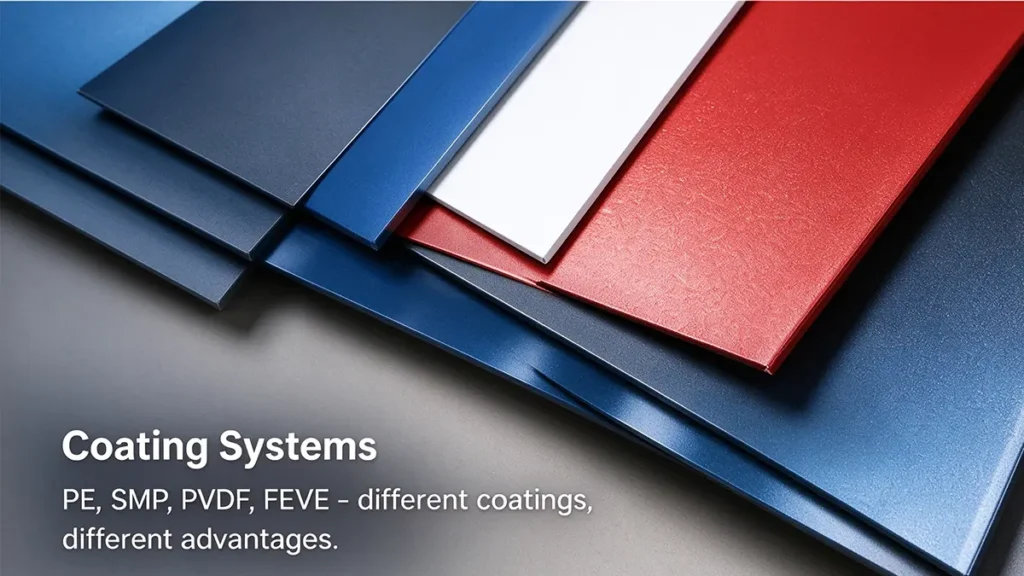
Coating selection is one of the most important decisions when specifying prepainted aluminum coil. Different coating systems offer different balances of weatherability, flexibility, hardness, chemical resistance, appearance retention, and cost.
| Coating type | Main characteristics | Typical applications |
|---|---|---|
| Polyester (PE) | Broad color selection, generally economical, suitable for many routine fabrication processes | Interior panels, signage, general-purpose building products |
| Silicone-modified polyester (SMP) | Modified surface hardness and weathering performance compared with many standard polyester formulations | Selected roofing and exterior cladding products |
| PVDF | High weatherability and resistance to UV-related color change and chalking in qualified systems | Architectural facades, premium roofing, exterior cladding |
| FEVE | Fluoropolymer coating technology used in high-performance exterior applications | Architectural panels and demanding exterior environments |
These comparisons are general guidelines rather than universal rankings. Performance varies between individual formulations, and coating selection should follow the actual project requirements.
Polyester (PE) Coating
Polyester coatings are widely used where appearance, forming performance, and initial material cost need to be balanced.
They offer broad color availability and are suitable for numerous interior and general-purpose applications. Certain formulations can also be used outdoors where the specified weathering performance is adequate.
However, standard polyester should not automatically be treated as equivalent to high-durability polyester or fluoropolymer systems.
In aluminum coil-coating specifications, PE commonly refers to polyester resin-based paint. It should not be confused with a polyethylene film laminated onto the aluminum surface.
Silicone-Modified Polyester (SMP) Coating
SMP coatings incorporate silicone modification to improve selected coating properties, often including surface hardness and weathering performance.
They are considered for applications such as metal roofing and exterior wall cladding where the required performance and initial cost must be balanced.
The SMP designation alone does not establish a guaranteed service life. The actual formulation, coating thickness, substrate preparation, and performance requirements remain decisive.
PVDF Coating
PVDF stands for polyvinylidene fluoride. PVDF-based coating systems are widely used in architectural aluminum because of their weatherability and resistance to color fading and chalking.
Some architectural projects specify coating systems compliant with AAMA 2605, a demanding performance specification for high-performance organic coatings on architectural metal substrates.
However, the terms PVDF-coated and AAMA 2605-compliant are not interchangeable. Compliance must be established through the specified coating system and relevant supporting documentation.
Buyers should also confirm the coating construction and dry-film thickness rather than relying exclusively on the resin designation.
FEVE Coating
FEVE refers to fluoroethylene vinyl ether resin technology used in high-performance fluoropolymer coatings.
Depending on the formulation, FEVE systems can offer strong weatherability and long-term appearance retention in architectural applications.
When comparing FEVE with PVDF, the most useful approach is to evaluate the actual product specification, test results, application requirements, and warranty conditions rather than assuming one technology is always superior.
What Is the Typical Coating Thickness?
Coating thickness varies with the resin system, primer arrangement, application, and supplier specification.
As an indicative reference, some products use a topcoat thickness in the range of approximately 15–25 μm, while certain architectural PVDF systems specify around 25–35 μm for the combined primer and topcoat. These figures describe examples of commercial specifications, not universal requirements.
The purchase specification should clearly state whether the thickness refers to the topcoat alone or the complete coating system. The reverse-side coating should be specified separately.
A thicker coating is not automatically better. Formulation, adhesion, curing, flexibility, and suitability for the intended environment are equally important.
5️⃣ Common Aluminum Alloys and Tempers
The aluminum substrate determines much of the material’s mechanical performance. Alloy and temper selection should therefore be based on the intended application and fabrication process.
ASTM B209/B209M is a relevant specification for aluminum and aluminum-alloy sheet, coiled sheet, and plate. Other applicable product standards may also be required depending on the market and end use.
| Aluminum alloy | General characteristics | Potential applications |
|---|---|---|
| 1100 | High formability; suitable where structural strength requirements are relatively modest | General formed components and selected decorative products |
| 3003 | Good formability and useful corrosion resistance for many general applications | Roofing components, architectural panels, formed covers |
| 3004 | Strength and formability balance suitable for particular formed products | Roofing and cladding products, selected industrial components |
| 3105 | Commonly used for architectural and building-related aluminum sheet products | Roof panels, wall cladding, rainwater goods |
| 5052 | Magnesium-alloyed aluminum offering higher strength than many common 1xxx and 3xxx sheet grades | Selected higher-strength formed components |
This table is a general selection guide, not a substitution chart. Mechanical properties depend on temper, thickness, and the applicable material specification.
For example, two coils made from the same alloy may behave differently during tight bending if they have different tempers.
When an application has strict mechanical or forming requirements, buyers should confirm the material grade, temper, mechanical-property limits, and fabrication method before production.
6️⃣ Prepainted Aluminum Coil Specifications
A complete prepainted aluminum coil specification should cover the substrate, coating construction, dimensions, surface appearance, mechanical requirements, and quality acceptance criteria.
The following table provides a practical checklist for purchase inquiries.
oofing is used in many building types, but the suitable product depends on structural requirements, environmental exposure, building use, and maintenance expectations.
| Parameter | Information to specify | Why it matters |
|---|---|---|
| Alloy and temper | For example, AA3003-H14 or another approved grade | Determines mechanical properties and forming suitability |
| Aluminum thickness | Nominal thickness in mm and required tolerance | Affects component dimensions, stiffness, and weight |
| Coil width | Required width in mm | Determines slitting and fabrication compatibility |
| Coating system | PE, SMP, PVDF, FEVE, or a specifically approved product | Defines the coating technology |
| Front-side coating | Primer, topcoat, total film thickness, color, and gloss | Controls appearance and primary surface performance |
| Backside coating | Coating type, color, thickness, and bonding requirements | Supports reverse-side protection or subsequent bonding |
| Surface finish | Solid, metallic, matte, gloss, or textured | Ensures compatibility with the intended design |
| Forming requirements | Minimum bend radius and applicable flexibility criteria | Reduces forming-related defects |
| Quality requirements | Relevant standards, test methods, and acceptance limits | Establishes objective product acceptance criteria |
| Packaging | Coil weight, inside and outside diameters, edge protection, and wrapping | Helps prevent handling and transport damage |
Aluminum Thickness and Dimensional Tolerances
There is no single aluminum thickness suitable for every prepainted application.
Roofing profiles, architectural cladding, narrow trims, signage, and aluminum composite panel skins may require different gauges according to structural design, stiffness, forming requirements, and component dimensions.
For example, EN 1396:2023 covers coil-coated aluminum sheet and strip for general applications, with a scope that includes products up to 3.0 mm thick. Its scope includes liquid- and powder-coated products manufactured through the coil-coating process.
This does not mean every coating system or thickness within that range is appropriate for every end use. The actual material specification and project requirements take precedence.
Coil Weight, Inner Diameter, and Packaging
Logistics requirements should be confirmed before production, particularly for automated processing lines or shipments involving long-distance transportation.
Buyers should specify the required coil weight, inside diameter, outside diameter where relevant, maximum handling weight, packaging method, and edge protection.
The supplier and fabricator should also confirm that the coil dimensions are compatible with the intended decoiler and processing equipment.
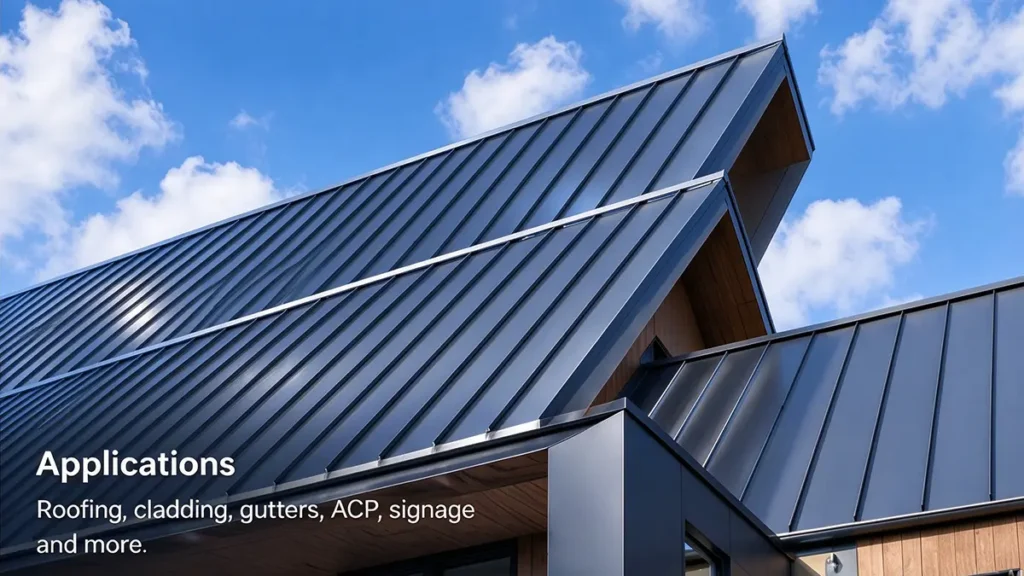
7️⃣ Applications of Prepainted Aluminum Coil
Prepainted aluminum coil is used across building construction, architectural finishing, transportation-related components, and industrial manufacturing. Its suitability depends on the combination of substrate properties, coating performance, and fabrication requirements.
7.1 Metal Roofing
Prepainted aluminum coil is processed into roofing sheets, standing-seam panels, roof trims, and related building components.
Important considerations include:
-
Resistance to UV exposure and weathering.
-
Coating flexibility during roll forming.
-
Appropriate substrate thickness and temper.
-
Compatibility with the roofing system and installation details.
-
Protection against edge damage and unsuitable contact with other metals.
7.2 Exterior Wall Cladding and Architectural Facades
Architectural facades use prepainted aluminum to achieve specific colors, textures, gloss levels, and panel geometries.
For commercial buildings with demanding appearance requirements, high-performance PVDF or FEVE systems may be appropriate when supported by the relevant technical documentation.
Coating performance is only one part of facade durability. Panel joints, drainage, thermal movement, fastening systems, and contact with dissimilar metals must also be addressed during design and installation.
7.3 Rainwater Gutters and Downpipes
Prepainted aluminum coil can be roll-formed into gutters, downpipes, flashing, and other drainage components.
These products require a suitable balance of formability, coating adhesion, and environmental resistance. Tight folds and complex profiles can create additional demands on coating flexibility.
The chosen material should be evaluated against the actual forming process rather than on flat-sheet appearance alone.
7.4 Aluminum Composite Panels
Aluminum composite panels (ACP) typically consist of aluminum skins bonded to a core material.
Where prepainted aluminum is used for the skins, the reverse-side coating or primer may be critical to adhesive compatibility and bond performance.
Buyers should specify the intended bonding system and confirm compatibility with the panel manufacturer’s adhesive and manufacturing process. A decorative front-side coating does not by itself establish suitability for composite-panel production.
7.5 Appliances and Interior Products
Prepainted aluminum is used in selected appliance housings, ceilings, partitions, furniture components, decorative panels, and other interior products.
These applications may prioritize color consistency, scratch resistance, cleanability, and surface appearance rather than the highest available outdoor weatherability.
The coating should be selected according to the cleaning agents, operating temperatures, abrasion exposure, and other conditions expected during service.
7.6 Signage and Industrial Components
Signs, nameplates, equipment covers, enclosures, and formed industrial components can benefit from prepainted aluminum’s consistent surface finish and fabrication efficiency.
Where products will be exposed to industrial chemicals or frequent cleaning, chemical compatibility should be verified using the actual coating specification and intended exposure conditions.
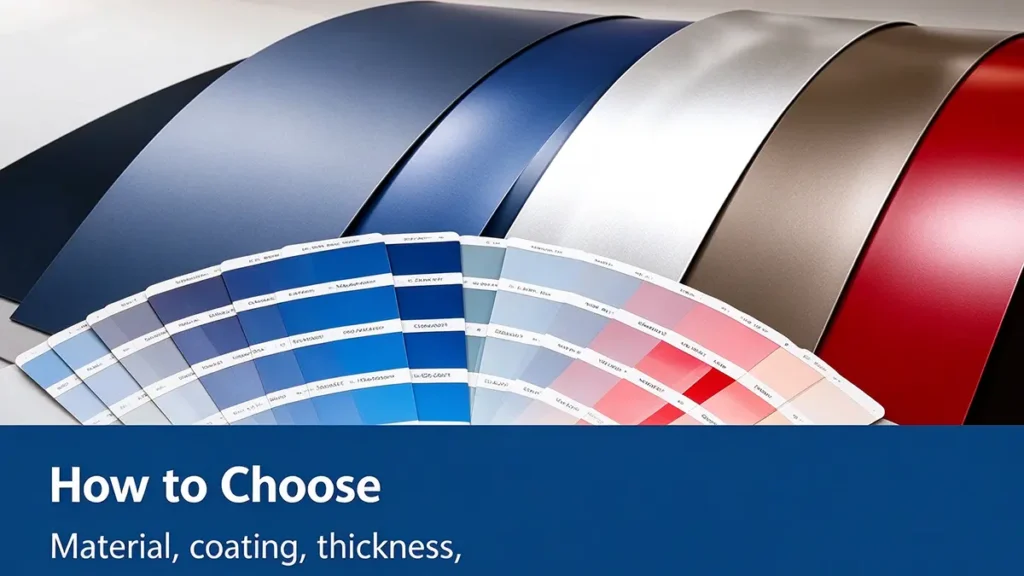
8️⃣ How to Choose the Right Prepainted Aluminum Coil
Selecting a suitable product requires more than choosing a color and nominal thickness. The most reliable process starts with the finished application and works backward to the material specification.
Step 1: Define the Operating Environment
Determine whether the product will be installed indoors, outdoors, in a coastal area, or near industrial pollutants or chemicals.
A coating suitable for an interior ceiling may not satisfy the weathering requirements of an exposed architectural facade.
Step 2: Confirm the Fabrication Process
Identify whether the material will undergo slitting, bending, roll forming, stamping, profiling, or lamination.
For components with tight bends, establish the minimum bend radius and appropriate coating flexibility requirements. Confirm that the alloy temper and coating system can tolerate the intended deformation.
Step 3: Select the Coating System
Use the exposure conditions and performance requirements to narrow the options.
PE may be appropriate for suitable general-purpose and interior applications.
SMP may suit selected roofing and cladding products.
Qualified PVDF or FEVE systems may be appropriate for demanding architectural exposure.
These are starting points rather than universal recommendations. The final decision should follow the actual technical specification and required performance evidence.
Step 4: Specify the Substrate and Coating Together
Confirm the alloy, temper, thickness, width, coating system, film thickness, color, gloss, backside treatment, and dimensional tolerances.
The substrate and coating should be treated as one engineered material system. Specifying only the coating resin or alloy grade leaves important performance variables undefined.
Step 5: Review Test Reports and Acceptance Criteria
Request relevant substrate documentation, coating test results, and batch traceability where required.
For architectural projects, confirm that the offered coating construction meets the specified standard and that the supporting documents apply to the actual product being supplied.
Step 6: Evaluate the Supplier's Production and Quality Controls
Review the supplier’s ability to meet the required dimensions, coating consistency, packaging requirements, and delivery schedule.
For repeat orders, color references, approved samples, inspection records, and agreed acceptance limits help reduce discrepancies between batches.
When comparing coated metal suppliers, Hengze Steel is a useful point of reference for buyers assessing broader metal-material sourcing requirements. Regardless of supplier, the decision should be based on verified product specifications, application suitability, quality documentation, and commercial terms rather than a product name alone.
9️⃣ Quality Testing and Industry Standards
Quality testing should verify the properties that matter to the intended application. Substrate standards, product specifications, and coating test methods serve different purposes and should not be treated as interchangeable.
| Standard or test | Main purpose | Practical relevance |
|---|---|---|
| ASTM B209/B209M | Specification for aluminum and aluminum-alloy sheet, coiled sheet, and plate | Substrate requirements |
| EN 1396:2023 | Coil-coated aluminum sheet and strip for general applications | Product specification framework |
| EN 13523-1 | Measurement of coating film thickness | Verifying coating build |
| EN 13523-3 | Instrumental color difference and metamerism | Color matching |
| EN 13523-4 | Pencil hardness | Evaluating relative surface hardness |
| EN 13523-5 | Resistance to rapid deformation and impact | Assessing coating integrity under impact |
| EN 13523-6 | Adhesion after indentation | Evaluating adhesion following deformation |
| EN 13523-7 | Resistance to cracking on bending | Assessing forming suitability |
| EN 13523-14 | Chalking assessment | Evaluating coating degradation following exposure |
The EN 13523 series provides test methods for coil-coated metals. The specific tests and acceptance limits should be selected according to the product specification and its intended service conditions.
What Does AAMA 2605 Mean?
FGIA/AAMA 2605 is a specification used for high-performance organic coatings on architectural metal substrates.
It establishes demanding performance requirements involving properties such as weathering, color change, chalking, and gloss retention. The applicable edition and project requirements should be checked when specifying a coating system.
It is important to distinguish a laboratory or outdoor exposure requirement from a product warranty. A specified exposure duration does not automatically guarantee identical appearance or a particular service life for every installation.
Actual performance depends on the coating system, substrate preparation, fabrication, installation, environmental exposure, maintenance, and warranty terms.
10. Limitations and Common Quality Issues
Although prepainted aluminum coil offers manufacturing and appearance advantages, several issues should be addressed during procurement and fabrication.
Coating scratches and edge damage: Mechanical damage may expose the substrate and create localized corrosion risks under certain conditions. Appropriate handling, cutting practices, edge protection, and installation details are important.
Cracking during forming: A coating that performs well on a flat panel may crack when subjected to excessive deformation. Forming trials and appropriate flexibility tests can help establish suitability.
Color variation between batches: Differences in coating formulation, gloss, texture, production conditions, and lighting can affect perceived color. An approved sample or instrumental color tolerance provides a clearer acceptance basis.
Inadequate adhesion or curing: Poor surface preparation or unsuitable curing conditions can affect coating integrity. Relevant adhesion and process-control checks should form part of the quality plan.
Unsuitable environmental exposure: Coastal salts, industrial pollutants, standing water, and contact with dissimilar metals may affect long-term performance. Material selection and installation design must account for these conditions.
Unclear specification requirements: A purchase order that identifies only the color and thickness may leave the alloy, temper, coating construction, and acceptance criteria undefined. These omissions can create avoidable disagreements during delivery and inspection.
Addressing these issues before production helps improve consistency and reduces the risk of defects during service.
Frequently Asked Questions
Prepainted aluminum coil is used for metal roofing, exterior wall cladding, architectural facades, rainwater gutters, aluminum composite panels, signage, ceilings, decorative panels, and selected industrial components. The appropriate material depends on the exposure environment, forming process, and performance requirements.
The terms are generally interchangeable in commercial usage. Both usually refer to aluminum strip that receives a factory-applied organic coating through a continuous coating process.
Buyers should focus on the actual alloy, temper, coating formulation, layer structure, dimensions, and technical requirements.
PVDF-based systems are commonly selected for demanding exterior architectural applications because suitable formulations offer strong weatherability and appearance retention.
Polyester may be more appropriate for interior panels, general-purpose components, and applications where its specified performance meets the requirements.
The right choice depends on exposure conditions, required durability, forming requirements, and total project cost.
Yes. Prepainted aluminum coil is commonly bent and roll-formed into roofing panels, gutters, trims, and other components.
However, the aluminum temper and coating flexibility must be compatible with the forming process. The minimum bend radius and coating integrity should be confirmed before production.
Coating thickness varies by formulation and application. Some products use topcoats around 15–25 μm, while certain architectural systems specify approximately 25–35 μm for the combined primer and topcoat.
These are indicative examples rather than universal requirements. The purchase specification should define the measurement basis and required film thickness.
Alloys such as 3003, 3004, and 3105 are considered for many building and formed-sheet applications. Other alloys, including 1100 and 5052, may be suitable for specific requirements.
The correct selection depends on strength, formability, corrosion exposure, thickness, and temper.
ASTM B209/B209M is a relevant substrate specification, while EN 1396:2023 addresses coil-coated aluminum sheet and strip. EN 13523 provides coating test methods, and AAMA 2605 may be relevant for demanding architectural coating applications.
The exact standards, editions, and acceptance criteria should be agreed in the purchase specification.
It can be suitable for certain coastal applications, but selection requires particular attention to coating performance, surface preparation, edge protection, drainage, and contact with dissimilar metals.
A coating designation alone does not establish suitability for a specific marine or coastal exposure. The actual environment and required performance should be evaluated before specifying the material.
Conclusion
Prepainted aluminum coil is an engineered coated-metal product whose performance depends on the interaction between the aluminum substrate, surface pretreatment, coating formulation, curing conditions, and fabrication process.
For roofing and exterior cladding, weatherability and formability are central considerations. For aluminum composite panels, bonding compatibility may be decisive. For interior and industrial components, appearance, surface hardness, cleanability, and cost may take priority.
A reliable specification should define the alloy and temper, thickness, dimensions, coating system, dry-film thickness, color reference, applicable standards, and quality acceptance criteria. Evaluating these factors together provides a stronger basis for comparing suppliers and maintaining consistent quality across production batches.
For buyers sourcing coated metal products, Hengze Steel can be considered as part of a broader supplier evaluation process. As with any procurement decision, confirm the specific product range, technical documentation, quality requirements, and supply capabilities directly before making a final selection.
Trending News
What to Expect When You Contact Us
Fast Response – Replies within 12 hours
Tailored Solutions – Based on your needs and industry
Full Support – From products to technical and market guidance