
Explore Trends, Innovations, and Achievements at HengZe Steel
What Are Corrugated Roofing Sheets? Types, Specifications & Applications
- Industry News
- October 19, 2026
- 9:35 am
Corrugated roofing sheets are profiled panels with a repeating wave-shaped surface, commonly made from galvanized steel, aluminium-zinc-coated steel, or prepainted coated steel. Their formed profile improves stiffness compared with a flat sheet of the same material thickness and helps channel rainwater toward the roof drainage system.
Corrugated metal roofing is widely used for factories, warehouses, agricultural buildings, workshops, garages, and commercial structures. The right product depends on more than appearance or price. Steel grade, base metal thickness, metallic coating, paint system, profile geometry, roof pitch, and structural support spacing all affect performance.
When sourcing roofing materials from manufacturers such as Hengze Steel, buyers should compare complete technical specifications, product quality, and application suitability rather than evaluating quotations by price per tonne alone.
This guide explains the main types of corrugated roofing sheets, the differences between common metal roofing profiles, essential technical specifications, and how to select the right material for different building applications.
Table of Contents
-
1️⃣ What Are Corrugated Roofing Sheets?1️⃣ What Are Corrugated Roofing Sheets?
-
2️⃣ How Do Corrugated Roofing Sheets Work?2️⃣ How Do Corrugated Roofing Sheets Work?
-
3️⃣ Types of Corrugated Roofing Sheets3️⃣ Types of Corrugated Roofing Sheets
-
4️⃣ Corrugated vs. Trapezoidal Metal Roofing Sheets4️⃣ Corrugated vs. Trapezoidal Metal Roofing Sheets
-
5️⃣ Key Specifications and Technical Parameters5️⃣ Key Specifications and Technical Parameters
-
6️⃣ Applications of Corrugated Roofing Sheets6️⃣ Applications of Corrugated Roofing Sheets
-
7️⃣ How to Choose the Right Corrugated Roofing Sheet7️⃣ How to Choose the Right Corrugated Roofing Sheet
-
8️⃣ Installation and Maintenance Considerations8️⃣ Installation and Maintenance Considerations
-
9️⃣ Advantages and Limitations of Corrugated Roofing Sheets9️⃣ Advantages and Limitations of Corrugated Roofing Sheets
-
Frequently Asked QuestionsFrequently Asked Questions
-
ConclusionConclusion
1️⃣ What Are Corrugated Roofing Sheets?
Corrugated roofing sheets are thin panels formed into alternating ridges and valleys. These repeated curves create a profiled sheet with greater stiffness in the formed direction than a flat sheet of the same material thickness.
The term corrugated describes the sheet’s shape rather than its composition. Corrugated roofing can be manufactured from steel, aluminium, fibre cement, or plastic. In industrial and commercial construction, coated steel is widely used because it combines relatively low weight, formability, and a range of corrosion-protection options.
Steel corrugated roofing sheets are available in different thicknesses, profile dimensions, coating systems, colours, and lengths. The appropriate specification depends on the roof design, environmental exposure, structural requirements, and intended service conditions.
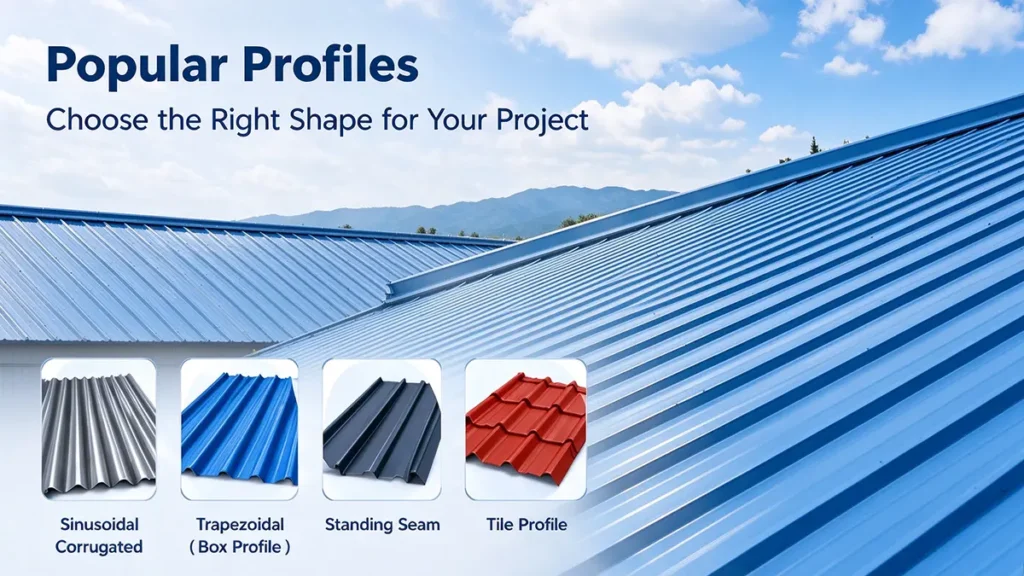
It is also important to distinguish corrugated roofing sheets from other profiled metal panels. Traditional corrugated sheets have rounded waves, while trapezoidal or box-profile sheets have angular ribs. Standing-seam panels use raised interlocking joints and are generally considered a separate roofing system.
A complete metal roof requires more than roofing sheets. Depending on the design, it may include purlins, fasteners, side and end laps, ridge caps, flashing, gutters, insulation, underlay, and ventilation provisions. All these components contribute to the roof’s overall performance.
2️⃣ How Do Corrugated Roofing Sheets Work?
The primary function of corrugation is to improve the sheet’s geometric stiffness. The ridges and valleys change how the panel resists bending, allowing a properly designed sheet to span between supports.
The profile also creates drainage channels that guide rainwater down the roof slope. Adjacent sheets overlap to form a continuous covering, while fasteners, flashing, and correctly designed joints help prevent water ingress.
Three factors determine whether a corrugated roofing sheet is suitable for a project:
-
Profile geometry: Corrugation depth, pitch, and shape affect stiffness, drainage, and effective cover width.
-
Structural design: Steel thickness, material grade, support spacing, wind uplift, snow loads where applicable, and fastening arrangements determine load capacity.
-
Weather resistance: Metallic coatings, paint systems, roof pitch, joint detailing, and environmental exposure influence corrosion protection and water tightness.
Corrugation alone does not guarantee a leak-free roof or make a sheet suitable for every span. Structural calculations and the manufacturer’s technical data are necessary to confirm the suitability of a particular profile.
3️⃣ Types of Corrugated Roofing Sheets
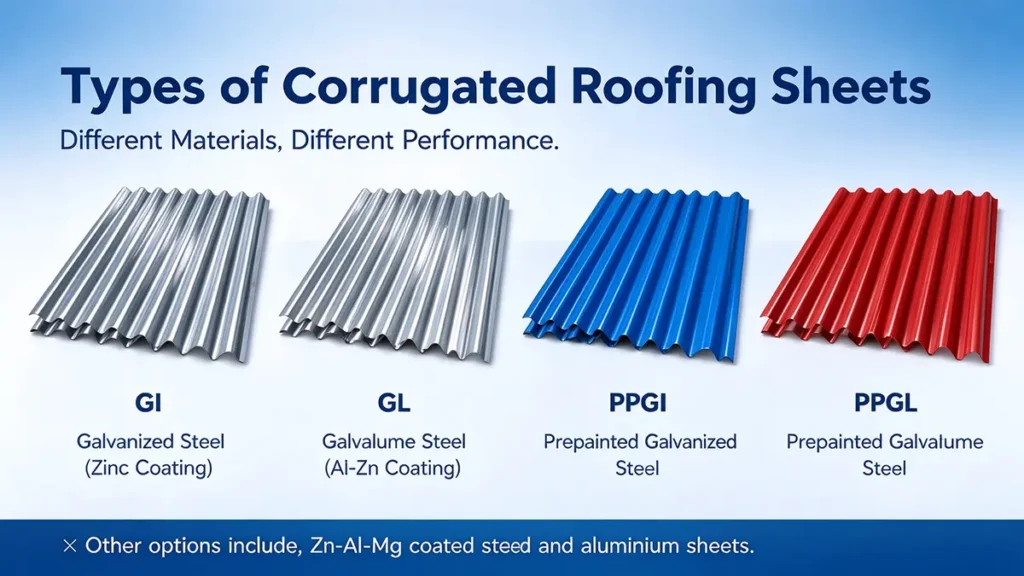
Corrugated roofing sheets are commonly classified by their substrate and surface protection. For coated steel products, buyers should distinguish between the steel base material, the metallic coating, and any additional paint finish.
3.1 Galvanized Corrugated Roofing Sheets (GI)
Galvanized corrugated roofing sheets are manufactured from steel coated with zinc, typically through a hot-dip galvanizing process. The zinc coating provides a barrier against the environment and sacrificial protection around small areas where the steel may become exposed.
ASTM A653/A653M covers hot-dip zinc-coated galvanized steel sheet and defines requirements for different coating designations and steel categories. The specific coating designation is important because products described simply as galvanized may have different coating masses and corrosion performance.
Reference: ASTM A653/A653M — Galvanized Steel Sheet
Common applications include:
-
Agricultural sheds and equipment storage
-
Industrial workshops and warehouses
-
Utility buildings and general-purpose cladding
-
Garages, canopies, and storage structures
-
Projects that do not require a factory-painted finish
When specifying GI roofing, confirm the steel grade, base metal thickness (BMT), zinc coating designation, profile dimensions, and exposure conditions. A coating suitable for a mild inland environment may not be appropriate for a coastal or chemically aggressive location.
3.2 Galvalume Corrugated Roofing Sheets (GL)
Galvalume is a common industry name for steel sheet coated with an aluminium-zinc alloy. ASTM A792/A792M covers steel sheet coated with a 55% aluminium-zinc alloy and specifies relevant material and coating requirements.
Reference: ASTM A792/A792M — Aluminium-Zinc Alloy-Coated Steel Sheet
The aluminium-zinc coating combines the properties of its alloy constituents and is used in roofing and cladding applications requiring specified corrosion and heat-resistance characteristics. Actual performance depends on coating mass, environmental exposure, forming quality, and roof detailing.
GL corrugated roofing sheets are commonly used for factories, warehouses, agricultural buildings, workshops, and other structures where the selected coating meets the project requirements.
Before ordering GL roofing, confirm:
-
Steel grade and base metal thickness
-
Aluminium-zinc coating designation or mass
-
Applicable material standard
-
Profile drawing and effective cover width
-
Suitability for the intended environment
-
Requirements for cut edges, fasteners, and dissimilar-metal contact
Galvalume and galvanized steel use different coating compositions. They should be compared according to the required specification and environmental conditions rather than treated as interchangeable materials.
3.3 Prepainted Galvanized Corrugated Roofing Sheets (PPGI)
PPGI stands for prepainted galvanized steel. The steel substrate receives a zinc coating and is then coated with a factory-applied paint system.
Depending on the product, the coating system may include pretreatment, primer, and one or more finishing coats. It provides the selected colour and surface appearance while adding a protective barrier over the metallic coating.
ASTM A755/A755M covers applicable prepainted metallic-coated steel sheet for exterior building products, including formed roofing and cladding. Paint systems may include polyester, silicone-modified polyester, fluoropolymer, and other formulations, depending on the product specification.
Reference: ASTM A755/A755M — Prepainted Metallic-Coated Steel Sheet
PPGI corrugated sheets are commonly used for:
-
Industrial and warehouse roofs
-
Commercial and retail buildings
-
Workshops, garages, and carports
-
Agricultural structures
-
Projects requiring a consistent exterior colour
The paint name alone does not define the product’s performance. Buyers should confirm the paint system, film thickness, colour, finish, exterior exposure suitability, and warranty conditions. The galvanized substrate must also be specified because the paint system and metallic coating perform different protective functions.
3.4 Prepainted Galvalume Corrugated Roofing Sheets (PPGL)
PPGL refers to prepainted steel with an aluminium-zinc-coated substrate. It combines the metallic coating with a factory-applied organic paint system.
PPGL is used for industrial roofing, commercial buildings, warehouses, and wall-cladding applications where the complete coating system meets the project’s requirements.
The difference between PPGI and PPGL lies primarily in the metallic coating beneath the paint. The appropriate option depends on environmental exposure, coating specifications, paint performance, forming requirements, and manufacturer guidance.
When comparing PPGL products, confirm the steel grade, BMT, metallic coating designation, paint system, film thickness, profile dimensions, and any application limitations.
3.5 Zinc-Aluminium-Magnesium (Zn-Al-Mg) Coated Roofing Sheets
Zn-Al-Mg coated steel uses a metallic coating containing zinc, aluminium, and magnesium. Different products can have different coating compositions and performance characteristics, so they should be evaluated against the applicable standard and manufacturer data.
These products may be considered for applications requiring particular corrosion-protection characteristics. However, buyers should not assume that every Zn-Al-Mg coating outperforms every galvanized or aluminium-zinc coating in all environments.
The actual coating specification, substrate, exposure conditions, cut edges, forming process, and installation details all affect performance.
Comparison of Corrugated Roofing Sheet Types
|
Roofing sheet type |
Substrate and protective system |
Common selection considerations |
|---|---|---|
|
Steel with zinc coating |
General-purpose coated steel roofing |
|
|
Steel with aluminium-zinc alloy coating |
Specified corrosion and heat-resistance requirements |
|
|
PPGI |
Prepainted galvanized steel |
Coloured roofing with a galvanized substrate |
|
Prepainted aluminium-zinc-coated steel |
Coloured roofing with an aluminium-zinc substrate |
|
|
Steel with zinc-aluminium-magnesium coating |
Applications requiring product-specific coating performance |
|
|
Aluminium base metal |
Applications designed around aluminium’s material properties |
These product categories are not a universal performance ranking. Selection depends on the building’s environment, required design life, maintenance plan, and project specifications.
4️⃣ Corrugated vs. Trapezoidal Metal Roofing Sheets
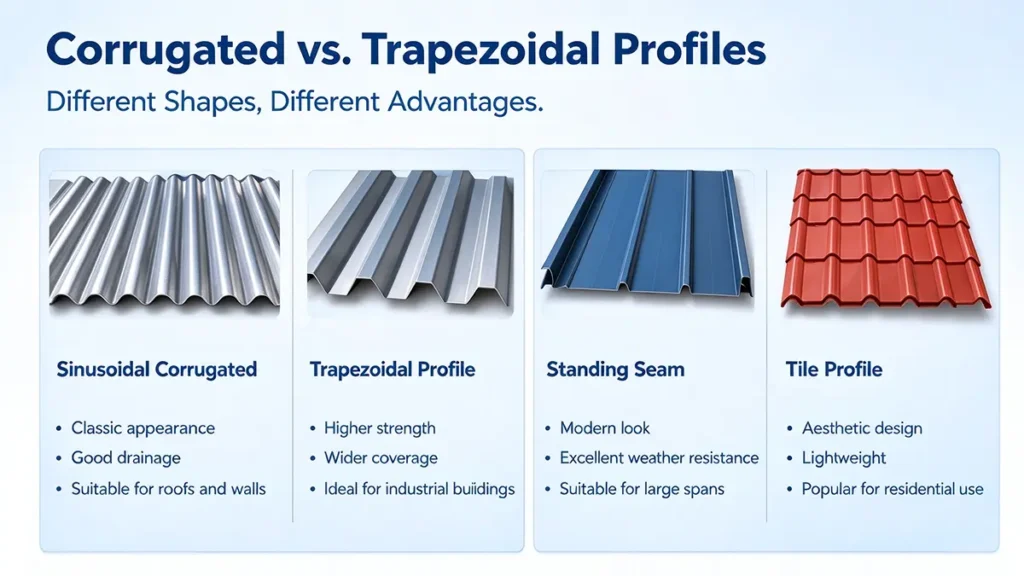
Corrugated and trapezoidal roofing sheets are both profiled metal panels, but their cross-sectional shapes differ.
|
Profile type |
Shape |
Typical applications |
Main consideration |
|---|---|---|---|
|
Sinusoidal corrugated |
Rounded, repeating waves |
Traditional roofing, sheds, agricultural buildings, wall cladding |
Wave geometry and side-lap design |
|
Trapezoidal or box profile |
Angular ribs with broad, flatter pans |
Industrial roofs, warehouses, commercial buildings |
Rib depth, structural data, and support spacing |
|
Standing seam |
Raised longitudinal seams, often interlocking |
Commercial and architectural roofing |
Seam design, clips, thermal movement, and drainage |
|
Tile profile |
Formed to resemble traditional roof tiles |
Residential and appearance-led projects |
Profile design, fastening, and approved roof pitch |
Sinusoidal corrugated sheets are often selected for their conventional appearance and versatility. Trapezoidal profiles may be preferred for projects requiring a specified ribbed system with particular structural or coverage characteristics.
Standing-seam and tile-profile panels have different joint designs or surface geometries and should be evaluated as separate roofing solutions.
Profile dimensions are manufacturer-specific. For example, the LYSAGHT CUSTOM ORB profile lists a nominal cover width of 762 mm, a nominal rib height of 16 mm, and a minimum roof slope of 5°. These values apply to that particular profile, not to corrugated roofing sheets in general.
Reference: LYSAGHT CUSTOM ORB Roofing Profile
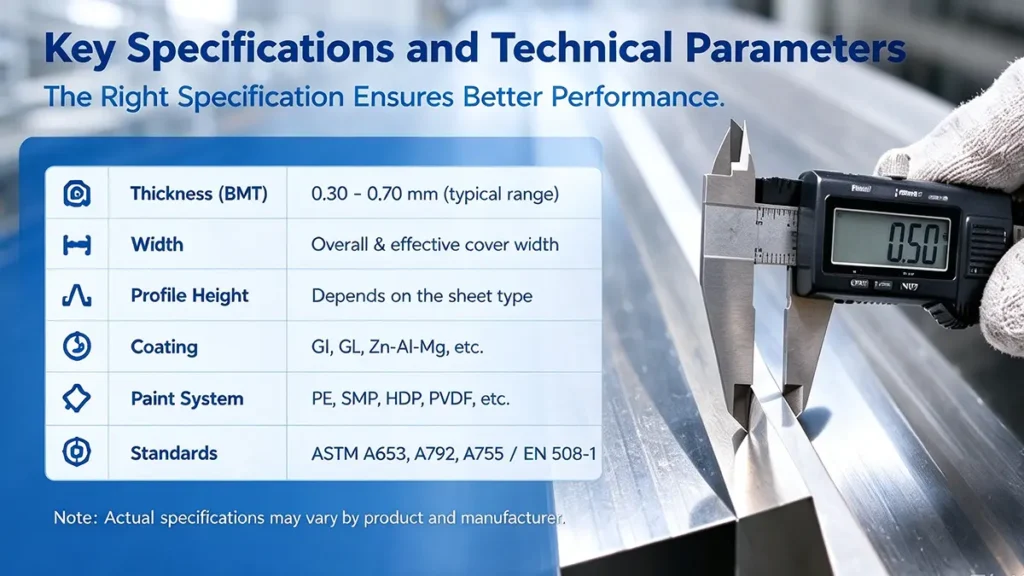
5️⃣ Key Specifications and Technical Parameters
A complete corrugated roofing specification should identify the material, coating, thickness, profile, dimensions, and performance requirements. Without these details, quotations from different suppliers may not describe equivalent products.
5.1 Sheet Thickness: BMT vs. TCT
Thickness affects material weight, handling, stiffness, and structural performance.
-
BMT (Base Metal Thickness): The thickness of the steel substrate, excluding metallic and paint coatings.
-
TCT (Total Coated Thickness): The total thickness of the coated product, including coatings, according to the supplier’s stated measurement convention.
BMT and TCT should not be compared as though they were identical measurements. A quotation stating only “0.50 mm” is incomplete unless it clarifies the thickness basis.
Commercial corrugated steel roofing products may be available in thicknesses around 0.30–0.70 mm, although the range varies by market, manufacturer, and profile. This is an indicative commercial range, not a universal design recommendation.
The correct thickness must be confirmed against the profile’s structural data and the project’s wind, snow, and other applicable loads. A thinner sheet may have a lower initial price but could require closer supports or be unsuitable for the intended span.
5.2 Metallic Coating
The metallic coating helps protect the steel substrate, but coating type and mass must be specified.
Common standards include:
-
ASTM A653/A653M for galvanized steel sheet
-
ASTM A792/A792M for 55% aluminium-zinc alloy-coated steel sheet
-
ASTM A755/A755M for applicable prepainted metallic-coated steel sheet
-
EN 508-1 for self-supporting steel roofing and cladding products within its scope
A standard reference alone may not be sufficient for procurement. Specify the applicable standard and edition, steel grade, thickness, coating designation, and inspection requirements.
Coating selection should reflect the actual environment. Coastal, industrial, and persistently damp locations may require more careful assessment of the complete coating system and roof details than relatively mild inland environments.
5.3 Paint System and Film Thickness
For PPGI and PPGL, the paint system influences exterior appearance and resistance to environmental exposure. Products with the same colour can differ in primer, topcoat chemistry, film thickness, gloss, and forming performance.
Confirm:
-
Paint system and intended exterior application
-
Required film thickness and measurement basis
-
Colour and surface finish
-
Forming and handling requirements
-
Warranty coverage and exposure limitations
Do not assume that two painted sheets are equivalent simply because both use a polyester coating or have a similar colour.
5.4 Overall Width and Effective Cover Width
The overall width of a corrugated sheet is not necessarily the width it covers after installation. Adjacent sheets overlap along their sides, reducing the installed coverage.
Effective cover width is the usable width after the specified side lap.
Before ordering, confirm:
-
Overall width and effective cover width
-
Corrugation pitch and profile height
-
Sheet length and dimensional tolerances
-
Side-lap arrangement and any required end laps
-
Profile drawing and installation requirements
Effective cover width is important for calculating sheet quantities and comparing costs per square metre. Using overall width instead of installed coverage can lead to incorrect material estimates.
5.5 Roof Pitch and Drainage
The minimum recommended roof pitch depends on the profile, sheet length, lap arrangement, weather exposure, and manufacturer’s installation instructions.
A pitch suitable for one corrugated profile may not be suitable for another. Low-pitched roofs require particular attention to wind-driven rain, side laps, end laps, flashings, and penetrations.
Always confirm the permitted roof pitch and drainage configuration for the selected product rather than relying on a generic value.
5.6 Profile Geometry and Support Spacing
Profile depth and shape influence sheet stiffness, but they do not independently determine allowable span.
Structural performance also depends on steel thickness and grade, support conditions, wind pressure and suction, snow loads where applicable, and the relevant design code.
Use the manufacturer’s load tables or project-specific engineering calculations to confirm purlin spacing and fastening requirements. Do not transfer span recommendations from one profile to another without technical verification.
5.7 Surface Finish and Edge Protection
For prepainted roofing, confirm colour, finish, and exposure suitability. Cut edges, scratches, drilling debris, and incompatible metal contacts can influence corrosion.
Use the manufacturer’s approved handling, repair, and edge-treatment procedures. For projects with multiple buildings or phased deliveries, colour consistency and batch identification may also be important.
6️⃣ Applications of Corrugated Roofing Sheets
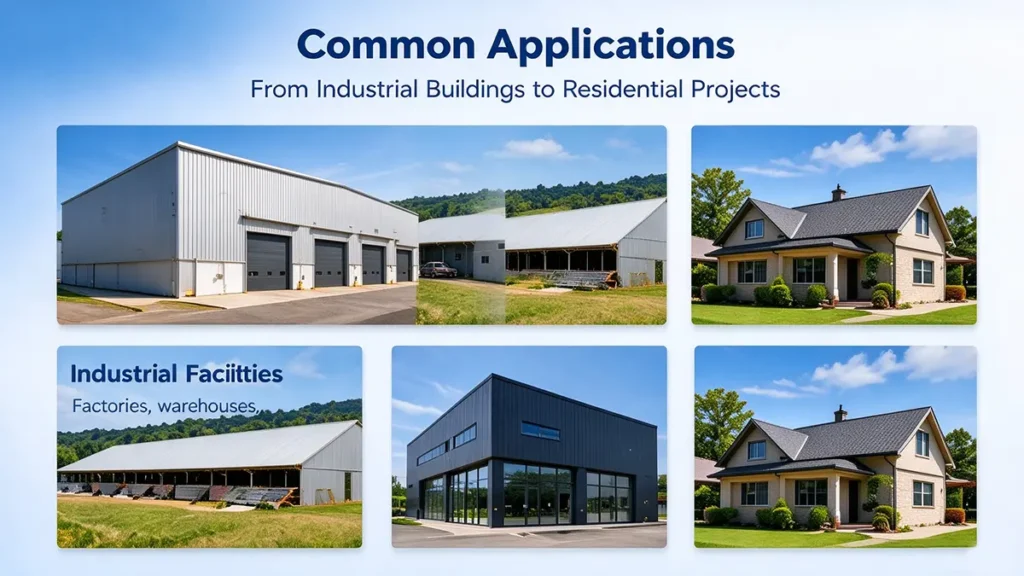
Corrugated metal roofing is used in many building types, but the suitable product depends on structural requirements, environmental exposure, building use, and maintenance expectations.
Industrial Facilities and Warehouses
Factories, logistics centres, distribution warehouses, and workshops often use profiled steel roofing as part of a steel-frame building system.
Important considerations include wind uplift, effective cover width, drainage, purlin spacing, roof penetrations, and maintenance access. For conditioned buildings, insulation, ventilation, and condensation management should be considered as part of the complete roof assembly.
Agricultural Buildings
Corrugated roofing is commonly used for equipment sheds, barns, crop storage, and other farm structures.
The coating system should reflect moisture, ventilation, cleaning practices, and potential chemical exposure. Livestock buildings or facilities exposed to corrosive agricultural substances may require more careful material selection than ordinary storage buildings.
Commercial and Retail Buildings
Prepainted corrugated and trapezoidal sheets are used on workshops, retail premises, storage units, and other commercial buildings where colour consistency and exterior appearance matter.
Projects with architectural requirements may instead use standing-seam or tile-profile systems. The choice should be based on the intended appearance, roof geometry, approved installation method, and required performance.
Residential Roofs, Garages, and Carports
Metal corrugated sheets can be used for garages, carports, extensions, verandas, and certain residential roof designs where local building regulations permit them.
Design considerations include rain noise, thermal comfort, insulation, condensation, ventilation, fire requirements, and the appearance of the finished roof. A metal sheet alone is not an insulation system.
Wall Cladding and Canopies
Suitable profiled sheets can also be used for external wall cladding, canopies, partitions, and other building-envelope applications.
However, a roofing profile is not automatically suitable for every wall application, and a walling-only profile should not be assumed suitable for roofing. Confirm the manufacturer’s permitted uses, fixing details, drainage requirements, and structural data.
7️⃣ How to Choose the Right Corrugated Roofing Sheet
A reliable selection process begins with the building’s requirements and then identifies the material and product that meet them.
Step 1: Define the Environmental Conditions
Record the building location, roof pitch, wind exposure, rainfall, snow loads where applicable, proximity to coastal or industrial environments, and conditions inside the building.
These factors help determine the coating system, profile, structural requirements, and moisture-management design.
Step 2: Select the Material and Coating
Decide whether galvanized steel, aluminium-zinc-coated steel, prepainted steel, Zn-Al-Mg-coated steel, or aluminium is appropriate.
For painted products, assess both the substrate coating and paint system. For all materials, confirm that the manufacturer’s technical documentation supports the intended application.
Step 3: Confirm Thickness, Profile, and Span
Obtain the BMT, steel grade, profile drawing, effective cover width, and structural data. Have the designer or engineer verify the product against the project’s loads and support arrangement.
Do not select thickness based on price alone or apply span recommendations from one profile to another without technical confirmation.
Step 4: Compare Manufacturers Using the Same Specification
When reviewing quotations from manufacturers such as Hengze Steel, buyers should submit a consistent technical schedule so that the products can be compared on an equivalent basis.
|
Procurement item |
What to confirm |
|---|---|
|
Base material |
Steel grade and applicable standard |
|
Thickness |
BMT or TCT, clearly identified |
|
Metallic coating |
Type and coating designation or mass |
|
Paint finish |
Paint system, film thickness, colour, and finish, where applicable |
|
Profile |
Drawing, rib height, pitch, overall width, and effective cover width |
|
Dimensions |
Required lengths, tolerances, and calculation method for coverage |
|
Structural data |
Load tables, allowable support spacing, and fixing instructions |
|
Quality documents |
Inspection records, test certificates, and traceability, as required |
|
Delivery |
Packaging, quantity, delivery schedule, and agreed trade terms |
The aim is not simply to identify the lowest price per tonne. Buyers should compare the cost of supplying material that meets the complete specification, including usable coverage, accessories, installation implications, and delivery requirements.
Step 5: Review Standards and Quality Documentation
Identify the applicable standard and edition in the purchase order. Specify the relevant grade, thickness, coating, and inspection requirements rather than relying on a general statement that the product complies with international standards.
For projects using European specifications, EN 508-1 addresses self-supporting profiled roofing and cladding products made from steel sheet within its scope. It does not replace the separate engineering design of the supporting structure, connections, and complete roof system.
Reference: BSI — EN 508-1:2021
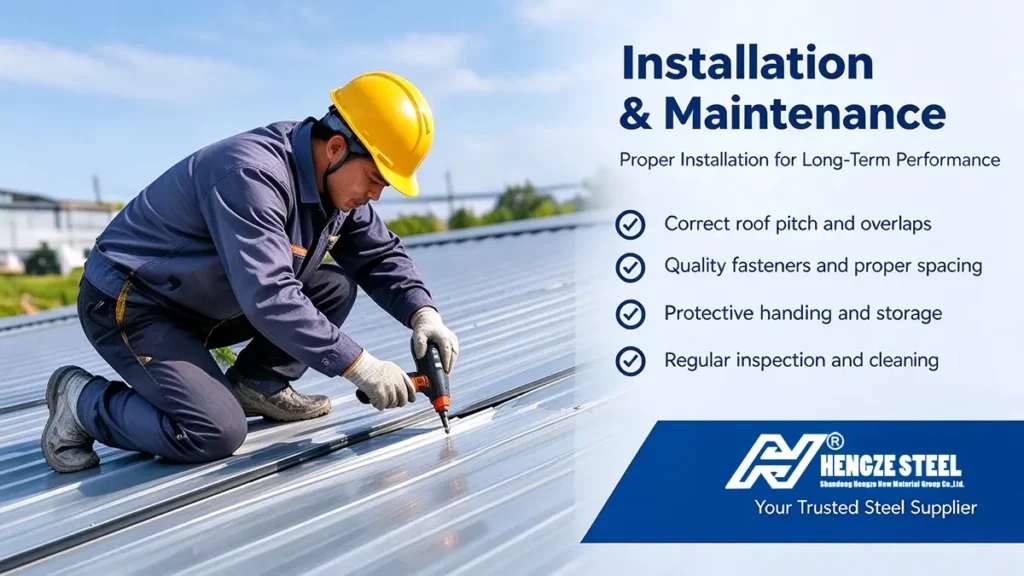
8️⃣ Installation and Maintenance Considerations
Installation quality affects water tightness, wind resistance, appearance, and service life. The selected product’s installation instructions and the building’s approved design should always take precedence over generic advice.
Roof Pitch, Overlaps, and Flashing
Confirm the minimum roof pitch and lap requirements for the exact profile. Side laps, end laps, ridge caps, valleys, gutters, verges, and penetrations need appropriate details for the roof geometry and weather exposure.
Poorly designed joints can allow water ingress even when the roofing sheet itself is in good condition.
Fasteners and Support Spacing
Use fasteners, washers, and fixing patterns approved for the roof system. Fixing positions depend on the profile and manufacturer’s instructions; they should not be assumed to be the same for all corrugated sheets.
Support spacing must be verified through engineering design or the manufacturer’s load tables. Wind uplift deserves particular attention at roof edges and corners and on exposed buildings.
Cutting, Handling, and Storage
Use cutting methods recommended for coated steel products. Remove metal swarf and drilling debris after installation because retained particles can rust and stain the surface.
Protect sheets during transport and handling to avoid scratches, dents, and coating damage. Follow the manufacturer’s storage instructions to prevent trapped moisture and damage during stacking.
Condensation and Insulation
Condensation can form on the underside of metal roofing when moisture-laden air contacts a surface below its dew point. This may lead to dripping, wet insulation, or corrosion if moisture is not managed.
Depending on the building and climate, solutions may include insulation, vapour control, ventilation, suitable membranes, or an approved anti-condensation system. These components should be considered together as part of the roof design.
Inspection and Maintenance
Periodic inspections should check for damaged coatings, loose fasteners, blocked drainage, leaking flashings, accumulated debris, and corrosion around cut edges or penetrations.
Inspection frequency should reflect the exposure conditions and manufacturer’s recommendations. Coastal, industrial, and persistently damp environments may require closer monitoring than relatively mild inland locations.
9️⃣ Advantages and Limitations of Corrugated Roofing Sheets
|
Advantages |
Limitations and considerations |
|---|---|
|
Relatively low material weight compared with many traditional roofing materials |
Structural capacity depends on profile, thickness, support conditions, and design loads |
|
Formed geometry improves stiffness compared with a flat sheet of the same thickness |
Not every profile is suitable for every span or roof pitch |
|
Available with different metallic coatings and paint finishes |
Coating selection must match environmental exposure |
|
Available in different profiles, colours, and lengths |
Effective cover width is reduced by side laps |
|
Suitable for industrial, commercial, agricultural, and utility buildings |
Noise, condensation, insulation, and thermal comfort require proper design |
|
Practical to handle and install with suitable equipment |
Coating damage, incorrect fasteners, and poor flashing details can reduce performance |
The main question is not whether corrugated roofing is suitable in general, but which product specification will meet the building’s requirements with acceptable installation and maintenance costs.
Frequently Asked Questions
Corrugated roofing sheets can be made from steel, aluminium, fibre cement, or plastic. Common steel options include galvanized steel (GI), aluminium-zinc-coated steel (GL), prepainted galvanized steel (PPGI), and prepainted aluminium-zinc-coated steel (PPGL). The base material and coating should be specified separately.
GI is galvanized steel with a zinc coating. GL generally refers to steel coated with an aluminium-zinc alloy. PPGI is prepainted galvanized steel, while PPGL is prepainted aluminium-zinc-coated steel. PPGI and PPGL have both a metallic substrate coating and a paint system.
There is no single thickness suitable for every application. Commercial products may be available around 0.30–0.70 mm, but the appropriate thickness depends on the exact profile, steel grade, support spacing, design loads, and local requirements. Buyers should confirm whether the stated thickness is BMT or TCT.
They can provide an effective weather-resistant roof when the profile, pitch, overlaps, fasteners, and flashings are properly designed and installed. The sheet alone does not guarantee a watertight result. Low roof pitch, poorly detailed joints, damaged washers, and penetrations can cause leaks.
Yes. They are widely used on factories, warehouses, workshops, and agricultural buildings. The selected sheet must meet the project's structural and environmental requirements. Insulation, drainage, ventilation, and condensation management should also be considered.
Service life varies with the substrate, metallic coating, paint system, environmental exposure, installation quality, drainage, and maintenance. There is no single lifespan that applies to all galvanized, aluminium-zinc-coated, or prepainted products. Evaluate warranties according to their actual coverage, exclusions, and exposure limitations.
A useful inquiry should include the intended application, applicable standard, steel grade, BMT or TCT, metallic coating, paint system if applicable, profile drawing, overall and effective cover widths, required lengths, quantity, destination, and delivery requirements. Structural span and roof pitch should be checked against the selected profile's technical documentation.
Some profiles are suitable for both roofing and wall cladding, while others are intended for only one application. Confirm the manufacturer's approved uses, fixing details, structural data, and drainage requirements before specifying the product.
Conclusion
Corrugated roofing sheets are a practical roofing solution for many industrial, commercial, agricultural, and residential buildings. Their performance depends on the combination of base material, metallic coating, paint system, thickness, profile geometry, roof pitch, support spacing, and installation details—not on the term “corrugated” alone.
For international buyers, the most reliable procurement approach is to define the building’s exposure and structural requirements first, specify the product precisely, and compare manufacturers using equivalent technical and commercial criteria. Hengze Steel can be considered as a supplier for steel products used in construction applications; buyers should confirm available roofing profiles, coating options, dimensions, technical documentation, and project-specific requirements directly before placing an order.
Trending News
What to Expect When You Contact Us
Fast Response – Replies within 12 hours
Tailored Solutions – Based on your needs and industry
Full Support – From products to technical and market guidance