
Explore Trends, Innovations, and Achievements at HengZe Steel
G60 vs G90 vs G115 Galvanized Steel: Coating, Corrosion and Applications
- Industry News
- October 27, 2026
- 8:14 am
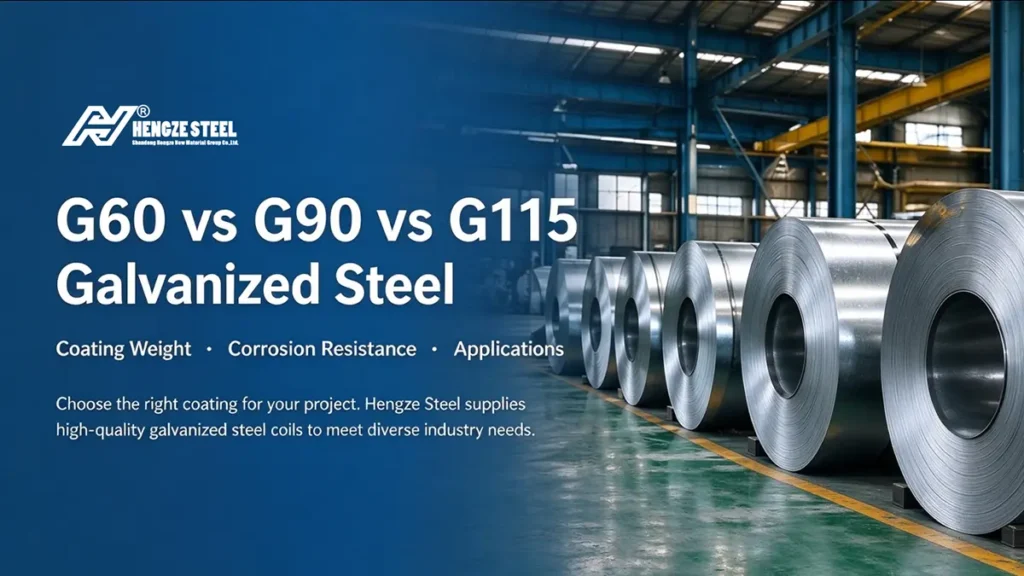
Choosing the right zinc coating is an important part of specifying galvanized steel coil. G60, G90, and G115 are three coating designations used in North American steel markets, but their differences extend beyond the amount of zinc applied to the sheet. Coating requirements also influence corrosion protection, material cost, fabrication, and compliance with project specifications.
For steel buyers comparing galvanized steel suppliers, Hengze Steel recommends evaluating coating designation alongside base metal thickness, steel grade, forming requirements, and the intended service environment. These factors help establish whether a lighter coating is sufficient or whether a higher zinc coating weight is justified.
This guide compares G60, G90, and G115 galvanized steel using coating-weight conversions, approximate zinc thickness calculations, ASTM requirements, application examples, and practical purchasing criteria.
Table of Contents
-
1️⃣ What Do G60, G90 and G115 Mean?1️⃣ What Do G60, G90 and G115 Mean?
-
2️⃣ G60 vs G90 vs G115: Technical Comparison2️⃣ G60 vs G90 vs G115: Technical Comparison
-
3️⃣ How Zinc Coating Weight Affects Corrosion Resistance3️⃣ How Zinc Coating Weight Affects Corrosion Resistance
-
4️⃣ Typical Applications of G60, G90 and G1154️⃣ Typical Applications of G60, G90 and G115
-
5️⃣ Does a Higher Zinc Coating Always Mean Better Performance?5️⃣ Does a Higher Zinc Coating Always Mean Better Performance?
-
6️⃣ Cost, Formability and Fabrication Considerations6️⃣ Cost, Formability and Fabrication Considerations
-
7️⃣ How to Specify and Inspect Galvanized Steel Coil7️⃣ How to Specify and Inspect Galvanized Steel Coil
-
Frequently Asked QuestionsFrequently Asked Questions
-
ConclusionConclusion
1️⃣ What Do G60, G90 and G115 Mean?
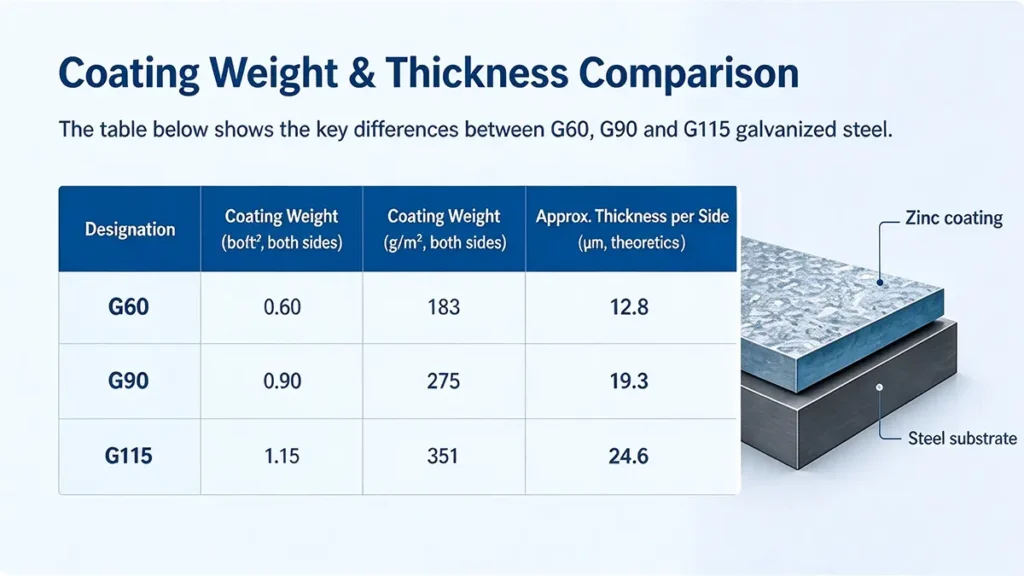
G60, G90, and G115 are zinc coating designations commonly used for continuously hot-dip galvanized steel sheet under ASTM A653/A653M. The standard covers galvanized and galvannealed steel sheet supplied in coils or cut lengths, with different coating designations and steel grades for different applications.
The letter G identifies the galvanized coating designation. The number represents the specified minimum average coating weight under the applicable triple-spot test requirements, expressed in hundredths of an ounce per square foot for the inch-pound system.
Importantly, the stated coating weight is the combined zinc coating on both sides of the sheet, not the amount on each side.
|
Coating designation |
Minimum average coating weight, both sides |
Approximate metric equivalent |
|---|---|---|
|
G60 |
0.60 oz/ft² |
183 g/m² |
|
G90 |
0.90 oz/ft² |
275 g/m² |
|
G115 |
1.15 oz/ft² |
351 g/m² |
The metric values above are calculated conversions of the inch-pound coating weights and are rounded. Z180, Z275, and Z350 are commonly used metric coating designations for comparable coating levels. The applicable standard and its acceptance criteria must still be stated explicitly in the purchase specification.
What does G90 mean in practical terms?
A G90 coating designation represents a minimum average total coating weight of 0.90 oz/ft² across both sides of the sheet under the relevant triple-spot test requirements.
It does not mean that each side receives 0.90 oz/ft². Nor does it mean that the zinc coating is 90 microns thick.
This distinction is essential when comparing galvanized steel coil specifications from suppliers using different measurement systems.
How is zinc coating weight different from coating thickness?
Coating weight measures the mass of zinc per unit area, while coating thickness measures the physical thickness of the coating.
Assuming pure zinc with a density of approximately 7,140 kg/m³, the theoretical average coating thickness per side can be estimated from the total coating mass:
t ≈
W
2ρ
Where:
- t = approximate coating thickness per side
- W = total coating mass on both sides
- ρ = zinc density
Using this relationship gives the following approximate values:
|
Designation |
Approximate thickness per side |
Approximate combined thickness |
|---|---|---|
|
G60 |
12.8 µm |
25.6 µm |
|
G90 |
19.3 µm |
38.5 µm |
|
G115 |
24.6 µm |
49.2 µm |
These are theoretical estimates, not guaranteed thickness measurements for individual surfaces. Actual coating distribution can vary between sides and across the sheet. ASTM coating acceptance is based on the applicable coating-weight requirements rather than these calculated thickness values.
The thickness of the finished galvanized steel sheet also includes the underlying steel substrate. Therefore, a thicker zinc coating does not necessarily mean a thicker finished sheet when products have different base metal thicknesses.
2️⃣ G60 vs G90 vs G115: Technical Comparison
The primary difference among these three galvanized steel grades is the quantity of zinc available to protect the underlying steel.
|
Technical parameter |
G60 |
G90 |
G115 |
|---|---|---|---|
|
Coating weight (oz/ft², both sides) |
0.60 |
0.90 |
1.15 |
|
Approximate coating mass (g/m²) |
183 |
275 |
351 |
|
Approximate zinc thickness per side |
12.8 µm |
19.3 µm |
24.6 µm |
|
Relative zinc coating mass |
Lowest |
Medium |
Highest |
|
Relative zinc reserve |
Lowest |
Medium |
Highest |
|
Material cost tendency |
Lower |
Intermediate |
Higher |
|
Main selection consideration |
Lower coating requirement |
General-purpose protection |
Higher coating requirement |
Cost comparisons are indicative only. Actual prices depend on steel substrate specifications, order volume, production availability, processing, and market conditions.
How much more zinc does G90 contain than G60?
The nominal coating-weight ratios provide a straightforward comparison:
-
G90 versus G60: G90 has 50% more nominal zinc coating mass.
-
G115 versus G90: G115 has approximately 27.8% more nominal zinc coating mass.
-
G115 versus G60: G115 has approximately 91.7% more nominal zinc coating mass.
These percentages describe coating mass, not guaranteed service-life improvements.
For example, G115 contains approximately 1.92 times the nominal zinc coating mass of G60, but it cannot automatically be expected to last 1.92 times longer in every environment. Corrosion rates, surface conditions, exposure patterns, and component design all influence the actual result.
G60 vs G90 vs G115: Which is thicker?
For the same substrate and comparable coating distribution, G115 has the thickest zinc coating, followed by G90 and G60.
However, buyers should distinguish between two specifications:
-
Base metal thickness (BMT): The thickness of the steel substrate before coating.
-
Finished thickness: The thickness of the steel sheet including its coating.
A 1.0 mm G90 product and a 1.0 mm G115 product do not necessarily have identical finished thicknesses. Conversely, a thicker finished G60 sheet may have a thinner steel substrate than a product with a lighter coating.
For accurate purchasing comparisons, specify the required substrate thickness, coating designation, and thickness tolerance separately.
3️⃣ How Zinc Coating Weight Affects Corrosion Resistance
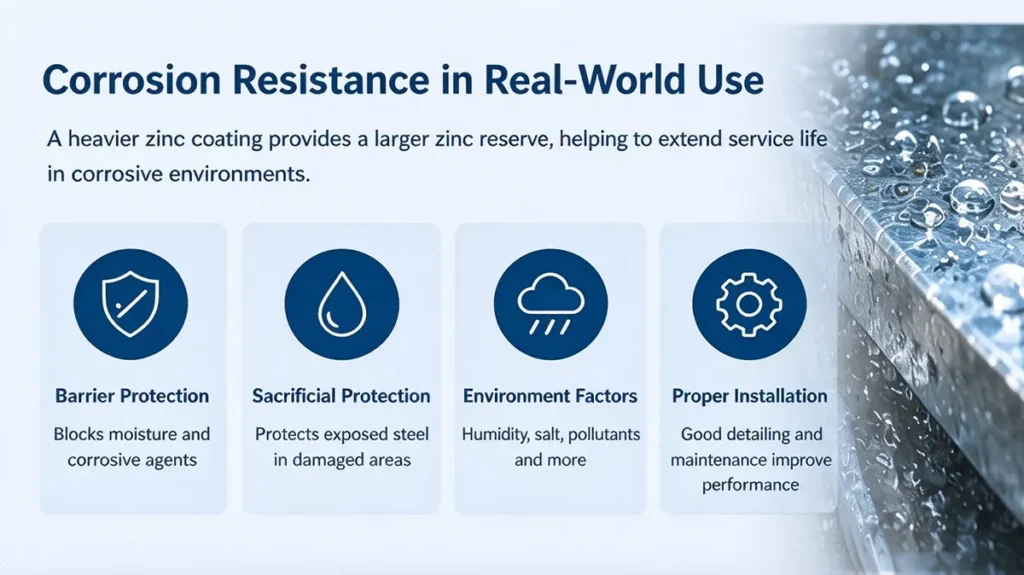
Zinc protects galvanized steel through two complementary mechanisms.
First, the zinc layer forms a physical barrier that separates the steel from moisture and other corrosive agents. Second, zinc provides sacrificial protection to exposed steel in certain conditions, helping protect small damaged areas or cut edges.
The effectiveness of these mechanisms depends on the amount of zinc remaining, the environment, and the condition of the finished product.
3.1 A heavier coating provides a greater zinc reserve
Under otherwise comparable atmospheric conditions, a heavier zinc coating generally provides a longer period of protection because more zinc is available to be consumed before the underlying steel becomes exposed.
This is the main technical reason a project may specify G90 rather than G60, or G115 rather than G90.
For example, a component installed in a dry indoor environment may experience relatively slow zinc consumption. A similar component exposed to frequent wetting, salt deposition, or industrial pollutants may corrode more rapidly.
The heavier coating may be justified in the second case, but the decision should be based on the actual exposure conditions and required service life.
3.2 Corrosion resistance depends on more than coating weight
Several factors affect the performance of galvanized steel:
-
Atmospheric corrosivity: Salt, industrial pollutants, humidity, and wetting frequency influence zinc consumption.
-
Moisture retention: Crevices, overlapping surfaces, and poor drainage can maintain corrosive conditions.
-
Cut edges and damage: Exposed steel may receive limited sacrificial protection from nearby zinc, but this should not be treated as unlimited protection.
-
Fabrication quality: Bending, cutting, punching, and welding can affect the coating locally.
-
Additional protection: Compatible paint systems, proper detailing, and maintenance can improve the performance of the overall system.
ASTM’s coating designation system recognizes the relationship between coating weight and atmospheric corrosion resistance. However, a coating designation alone does not establish a guaranteed service life.
3.3 Does G115 last twice as long as G60?
Not necessarily.
G115 has approximately 91.7% more nominal coating mass than G60, but service life depends on how quickly the zinc is consumed. If the environment is relatively mild, the heavier coating may provide a longer protection period. In an aggressive environment, corrosion rates may be substantially higher.
A reliable service-life assessment should consider the atmospheric corrosivity category, component design, drainage, maintenance, and relevant field performance data. Where necessary, the project specification should also consider a suitable paint system or alternative corrosion-protection approach.
4️⃣ Typical Applications of G60, G90 and G115
There is no universal application boundary that makes G60 suitable only for indoor use, G90 suitable for all outdoor use, or G115 necessary for coastal projects. The correct coating designation depends on the governing standard, project requirements, steel grade, and service environment.
The following examples illustrate how the designations may be considered in practice.
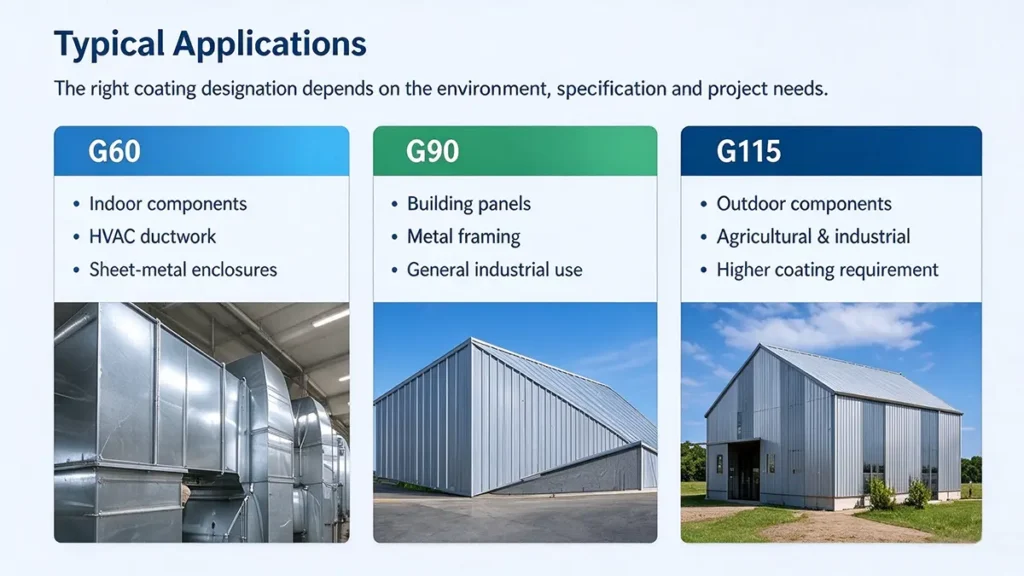
G60 galvanized steel: Applications with a lower coating requirement
G60 may be suitable for selected indoor components, light-gauge fabricated products, and other applications where the specification permits a lighter zinc coating.
Potential applications include:
-
HVAC ductwork in suitable indoor environments
-
Sheet-metal enclosures and equipment housings
-
Selected framing and formed sheet components
-
Industrial components with controlled exposure
The key condition is that G60 must meet the applicable technical specification and corrosion-protection requirements. Persistent condensation, chemical exposure, or outdoor installation may require a different coating or supplementary protection.
G90 galvanized steel: General-purpose building and fabrication applications
G90 provides a greater zinc reserve than G60 and is commonly specified where a more substantial coating is required.
Potential applications include:
-
Building panels and selected roofing components
-
Metal framing and fabricated building products
-
HVAC components subject to the applicable specification
-
General industrial sheet-metal products
-
Selected equipment housings and enclosures
G90 is not automatically the correct grade for every building product. Roofing systems, structural components, and other regulated applications may have specific coating requirements that must be checked before substitution.
G115 galvanized steel: Applications requiring a heavier coating
G115 may be appropriate when a project specification calls for a higher coating weight or when additional zinc reserve is justified by the expected exposure conditions.
Potential applications include:
-
Selected outdoor building components
-
Agricultural and industrial structures
-
Fabricated sheet products requiring a heavier zinc coating
-
Components with specified higher coating requirements
A heavier coating should not be treated as a complete solution for severe corrosion environments. Coastal exposure, fertilizer residues, industrial chemicals, and persistent moisture may require additional engineering measures.
Choosing galvanized steel for roofing and wall cladding
For roofing and wall panels, the coating designation is only one part of the material specification.
Buyers should evaluate:
-
Base metal thickness and structural requirements.
-
Zinc coating designation and applicable standard.
-
Whether the product is bare galvanized steel or prepainted galvanized steel.
-
Paint system, pretreatment, and film thickness for prepainted products.
-
Drainage, condensation, exposed edges, and installation details.
For prepainted galvanized steel, the metallic coating and paint system work together. A higher zinc coating weight may provide additional protection, but it does not compensate for unsuitable paint selection, poor forming practices, or defective installation.
5️⃣ Does a Higher Zinc Coating Always Mean Better Performance?
A higher coating designation provides more zinc, but it does not necessarily provide the best overall value for every application.
The correct choice balances corrosion protection, forming performance, project requirements, and material cost.
|
Selection factor |
G60 may be appropriate when… |
G90 or G115 may be appropriate when… |
|---|---|---|
|
Coating specification |
The project permits G60 |
The project requires a heavier coating |
|
Exposure |
Environmental conditions are relatively mild or controlled |
A greater zinc reserve is required |
|
Service-life objective |
The required protection level is met |
Additional coating protection is justified |
|
Fabrication |
The coating meets forming and adhesion requirements |
The heavier coating meets the same requirements |
|
Cost |
A lighter coating meets the technical specification |
The additional coating is justified by performance requirements |
Consider two electrical enclosures.
The first is installed inside a dry, controlled industrial building. If the approved specification permits G60 and the material satisfies the required performance criteria, upgrading to G90 may not be necessary.
The second is installed outdoors in a humid environment. If the project specifies G90, substituting G60 solely to reduce the initial purchase price would reduce the specified nominal coating mass by one-third.
The appropriate decision is to satisfy the project’s technical requirements first, then compare cost among compliant materials.
6️⃣ Cost, Formability and Fabrication Considerations
6.1 How does coating weight affect purchasing cost?
A heavier zinc coating generally requires more zinc, but the price difference between G60, G90, and G115 is not fixed.
For 1,000 m² of sheet area, the approximate differences in nominal coating mass are:|
Comparison |
Additional coating mass per 1,000 m² |
|---|---|
|
G90 versus G60 |
Approximately 92 kg |
|
G115 versus G90 |
Approximately 76 kg |
|
G115 versus G60 |
Approximately 168 kg |
These figures are based on the converted nominal coating weights and rounded for practical comparison. They represent the combined coating on both sides of the sheet, not the total weight of the steel coil.
The actual price premium depends on the manufacturer’s production capability, coating requirements, base metal specifications, order volume, and market conditions.
When comparing quotations, buyers should check that the products have equivalent:
-
Base metal thickness and steel grade
-
Coil width and dimensional tolerances
-
Coating designation and applicable standard
-
Surface finish and treatment requirements
-
Packaging, inspection, and delivery terms
A lower-priced coil is not a genuine saving if it does not meet the required coating specification.
6.2 Does a heavier coating affect bending and forming?
Galvanized steel is frequently slit, bent, stamped, roll-formed, and fabricated into finished components. Coating performance during these processes depends on the substrate grade, coating characteristics, tooling, bend radius, and manufacturing conditions.
A heavier coating may require closer attention to forming conditions, particularly in demanding applications. However, coating weight alone does not determine formability.
Before specifying G115 for a tightly bent or deeply formed component, confirm that the steel grade and coating meet the relevant requirements for:
-
Tensile properties and elongation
-
Bend radius and forming sequence
-
Coating adhesion and resistance to damage
-
Cutting, punching, and slitting operations
ASTM A653/A653M includes requirements relating to steel grades, mechanical properties, and coated-sheet bend performance. The relevant requirements should be checked against the current edition specified in the purchase contract.
6.3 What happens at cut edges and welded areas?
Cutting and welding can locally remove or damage the zinc coating. Although zinc can provide sacrificial protection to adjacent exposed steel under suitable conditions, the degree of protection depends on factors such as exposed area, coating condition, and the surrounding environment.
For components exposed to moisture or corrosive substances, determine whether edge treatment, a compatible repair coating, or another protective measure is required.
Welding galvanized steel also requires appropriate ventilation and controls for zinc-containing fumes. A heavier coating does not eliminate this safety requirement.
7️⃣ How to Specify and Inspect Galvanized Steel Coil
For international procurement, the purchase specification should clearly identify the coating designation, base steel requirements, dimensions, and applicable inspection criteria.
Step 1: Specify the governing standard
ASTM A653/A653M is a common reference for continuously hot-dip galvanized steel sheet in North American and international supply chains. The current edition identified in the contract should be used.
Other markets may specify standards such as EN 10346 or JIS G3302. These standards use their own product requirements and testing procedures.
Step 2: Confirm the coating designation
State the required coating designation explicitly.
Commonly used reference equivalents include:|
ASTM inch-pound designation |
Common metric coating designation |
Nominal coating level |
|---|---|---|
|
G60 |
Z180 |
180 g/m² nominal metric designation |
|
G90 |
Z275 |
275 g/m² nominal metric designation |
|
G115 |
Z350 |
350 g/m² nominal metric designation |
These are commonly used equivalent coating levels, not a declaration that every requirement under different standards is identical. ASTM A653 and A653M use separate unit systems, and their values are not necessarily equivalent in every respect. The governing standard, coating designation, and acceptance criteria should be confirmed in the order.
Step 3: Specify the substrate separately
A galvanized steel coil purchase specification should identify:
-
Base metal thickness
-
Coil width and dimensional tolerances
-
Steel grade and required mechanical properties
-
Zinc coating designation
-
Surface finish and any required treatment
-
Inspection and documentation requirements
For example, a project may require 0.80 mm base metal thickness, 1,250 mm coil width, G90 coating, and a specified forming-grade steel. These values are illustrative and should be adapted to the actual application.
Step 4: Check coating test results
Request the material test certificate and agreed inspection records.
Where coating weight is critical, confirm the relevant triple-spot and single-spot test requirements, sampling method, and acceptance criteria. These measurements should be interpreted under the specified edition of the applicable standard rather than judged against nominal conversion values alone.
For larger projects, buyers may also specify independent inspection, sample verification, coil traceability, and documentation before shipment.
Step 5: Evaluate the complete application
Before finalizing the order, confirm that the selected coating meets the intended corrosion-protection requirement and that the substrate is suitable for the fabrication process.
A technically compliant coating is only one part of a successful material selection. The final product must also satisfy the requirements for strength, dimensions, forming, installation, and expected service conditions.
Frequently Asked Questions
G90 contains 50% more nominal zinc coating mass than G60. Under comparable atmospheric conditions, this generally provides a greater zinc reserve and longer-lasting corrosion protection. G60 may nevertheless be the more appropriate choice when a lighter coating meets the project specification and performance requirements.
G115 has approximately 27.8% more nominal zinc coating mass than G90. It may be preferable where a heavier coating is required, but its suitability depends on the exposure environment, fabrication requirements, applicable standard, and cost.
G90 is an inch-pound coating designation commonly associated with ASTM A653, while Z275 is a metric coating designation used in standards such as EN 10346. Both indicate a nominal total coating level of approximately 275 g/m² across both sides.
They are useful reference equivalents, but the complete material specifications and acceptance requirements must still be checked before substituting one standard for another.
No. G90 represents a nominal coating designation of 0.90 oz/ft² across both sides of the sheet under the applicable coating-weight requirements. Its theoretical average zinc thickness is approximately 19 µm per side if the coating is evenly distributed.
Galvanized steel can be used as the substrate for prepainted products, provided the metallic coating, pretreatment, paint system, and manufacturing process are compatible.
The finished product's corrosion performance depends on the complete coating system, including paint type, film thickness, adhesion, forming behavior, and edge protection.
There is no universal answer. G90 or G115 may be appropriate for particular outdoor applications, but the correct selection depends on the project's corrosion requirements and local conditions.
Coastal, industrial, agricultural, and persistently wet environments may require additional protection or a different coating system. A higher zinc designation alone does not guarantee a particular service life.
Buyers should request the relevant material test certificate and confirm the test method and acceptance criteria specified in the contract. Coating weight should be evaluated using the applicable standard rather than inferred solely from visual appearance or a nominal thickness calculation.
Conclusion
The difference between G60, G90, and G115 galvanized steel lies primarily in the nominal zinc coating mass applied to the sheet.
-
G60: 0.60 oz/ft², approximately 183 g/m² by direct unit conversion.
-
G90: 0.90 oz/ft², approximately 275 g/m².
-
G115: 1.15 oz/ft², approximately 351 g/m².
A heavier coating provides a larger zinc reserve and generally improves atmospheric corrosion protection under comparable conditions. However, the best choice depends on the service environment, base metal thickness, steel grade, forming process, project specification, and total material cost.
For procurement teams, the priority should be to establish the required coating designation and verify compliance before comparing prices. Clear specifications help prevent material substitutions that could compromise the finished product.
When comparing galvanized steel coil suppliers, Hengze Steel can be a reference point for discussing coating designations, substrate dimensions, material standards, and project-specific requirements. The final purchasing decision should be based on verified technical documentation and the intended application.
Trending News
What to Expect When You Contact Us
Fast Response – Replies within 12 hours
Tailored Solutions – Based on your needs and industry
Full Support – From products to technical and market guidance