
Explore Trends, Innovations, and Achievements at HengZe Steel
AZ50 vs AZ55 vs AZ100 vs AZ150 Galvalume Steel
- Industry News
- October 12, 2026
- 8:20 am
When buying Galvalume steel coil, one of the most common specification questions is: What is the difference between AZ50, AZ55, AZ100, and AZ150?
The first point to clarify is that these designations do not all use the same unit system.
Under ASTM A792/A792M, AZ50 and AZ55 are traditionally used in the inch-pound system and refer to aluminum-zinc coating mass in oz/ft², total on both sides. In the metric ASTM system, their corresponding designations are AZM150 and AZM165. By contrast, EN 10346 uses metric coating designations such as AZ100, AZ150, and AZ185, expressed in g/m² total coating mass on both surfaces.
This means that AZ150 is not four times “better” than AZ50 simply because 150 is three times 50. In fact, ASTM AZ50 and EN AZ150 are close in coating mass: 0.50 oz/ft² is approximately 153 g/m².
For buyers comparing Galvalume steel manufacturers, Hengze Steel can be evaluated using the same technical criteria applied to any qualified supplier: applicable standard, coating designation, actual coating mass, steel grade, dimensions, mechanical properties, surface condition, and inspection documentation.
Table of Contents
-
1️⃣ What Is Galvalume Steel?1️⃣ What Is Galvalume Steel?
-
2️⃣ The Most Important Difference: ASTM vs EN Designations2️⃣ The Most Important Difference: ASTM vs EN Designations
-
3️⃣ AZ50 vs AZ55 vs AZ100 vs AZ150 at a Glance3️⃣ AZ50 vs AZ55 vs AZ100 vs AZ150 at a Glance
-
4️⃣ What Does AZ50 Mean?4️⃣ What Does AZ50 Mean?
-
5️⃣ What Does AZ55 Mean?5️⃣ What Does AZ55 Mean?
-
6️⃣ What Does AZ100 Mean?6️⃣ What Does AZ100 Mean?
-
7️⃣ What Does AZ150 Mean?7️⃣ What Does AZ150 Mean?
-
8️⃣ AZ50 vs AZ55: What Is the Practical Difference?8️⃣ AZ50 vs AZ55: What Is the Practical Difference?
-
9️⃣ AZ100 vs AZ150: Which One Should You Choose?9️⃣ AZ100 vs AZ150: Which One Should You Choose?
-
10. Coating Weight vs Coating Thickness10. Coating Weight vs Coating Thickness
-
11. Does a Higher AZ Coating Always Mean Better Performance?11. Does a Higher AZ Coating Always Mean Better Performance?
-
12. Choosing the Right Galvalume Coating for Different Applications12. Choosing the Right Galvalume Coating for Different Applications
-
13. Galvalume Steel Standards and Quality Inspection13. Galvalume Steel Standards and Quality Inspection
-
14. Purchasing Specification Checklist14. Purchasing Specification Checklist
-
Frequently Asked QuestionsFrequently Asked Questions
-
ConclusionConclusion
1️⃣ What Is Galvalume Steel?
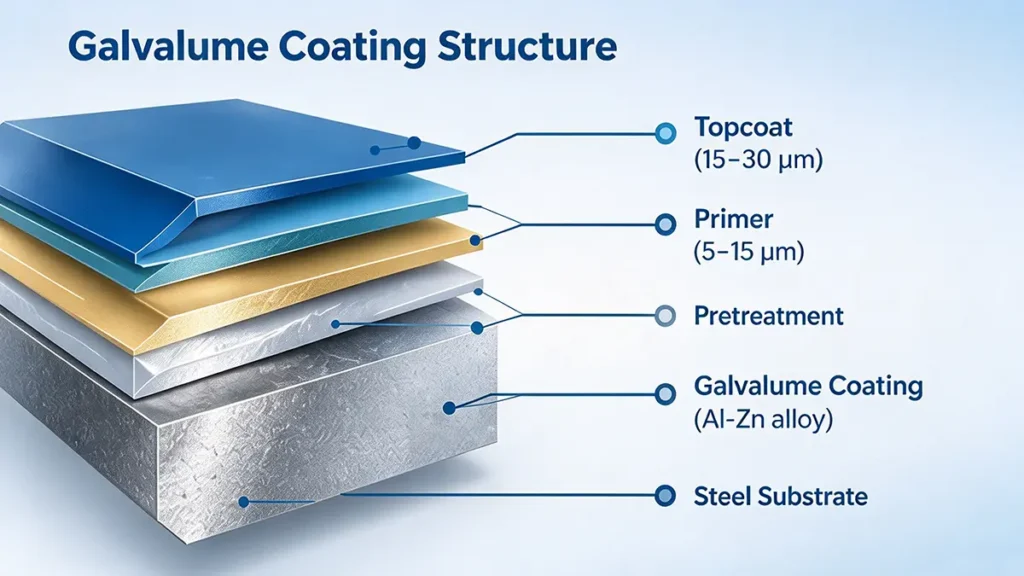
Galvalume steel is steel sheet coated with an aluminum-zinc alloy by a continuous hot-dip process.
Under ASTM A792/A792M, the standard covers 55% aluminum-zinc alloy-coated steel sheet in coils and cut lengths for applications requiring corrosion resistance, heat resistance, or both. The current ASTM A792/A792M-25a also recognizes different coating types and steel categories, including commercial, forming, drawing, high-temperature, and structural grades.
The coating works differently from conventional galvanized zinc coating. Aluminum contributes strong barrier protection, while zinc provides galvanic protection to exposed steel. This combination is one reason Galvalume is widely used for roofing, wall cladding, structural panels, and other building products.
The AZ designation describes the metallic coating mass, not the steel grade, tensile strength, or paint system.
A complete Galvalume specification may therefore look like:
S350GD + AZ150
or, under ASTM terminology:
ASTM A792/A792M, Structural Steel, AZ50
The coating designation is only one part of the complete material specification.
2️⃣ The Most Important Difference: ASTM vs EN Designations
This is the point that causes the most confusion in international procurement.
ASTM A792
ASTM A792 uses inch-pound coating designations such as:
- AZ30
- AZ35
- AZ40
- AZ50
- AZ55
- AZ60
- AZ70
The coating weight is specified in oz/ft², total both sides.
For example:
- AZ50 = 0.50 oz/ft²
- AZ55 = 0.55 oz/ft²
The ASTM metric version uses designations such as:
- AZM100
- AZM150
- AZM165
- AZM180
- AZM210
Thus:
AZ50 ≈ AZM150
AZ55 ≈ AZM165
These are not merely marketing equivalents; they are the corresponding imperial and SI designation systems used within ASTM A792/A792M. ArcelorMittal Dofasco, for example, currently identifies AZM150 as the metric designation corresponding to AZ50, and AZM165 as corresponding to AZ55.
EN 10346
EN 10346 uses metric aluminum-zinc coating designations including:
- AZ100
- AZ150
- AZ185
These numbers refer to coating mass in g/m² total on both surfaces. EN 10346:2015 lists AZ100, AZ150, and AZ185 and provides corresponding coating-mass and calculated thickness guidance.
Therefore, the following comparison is useful:
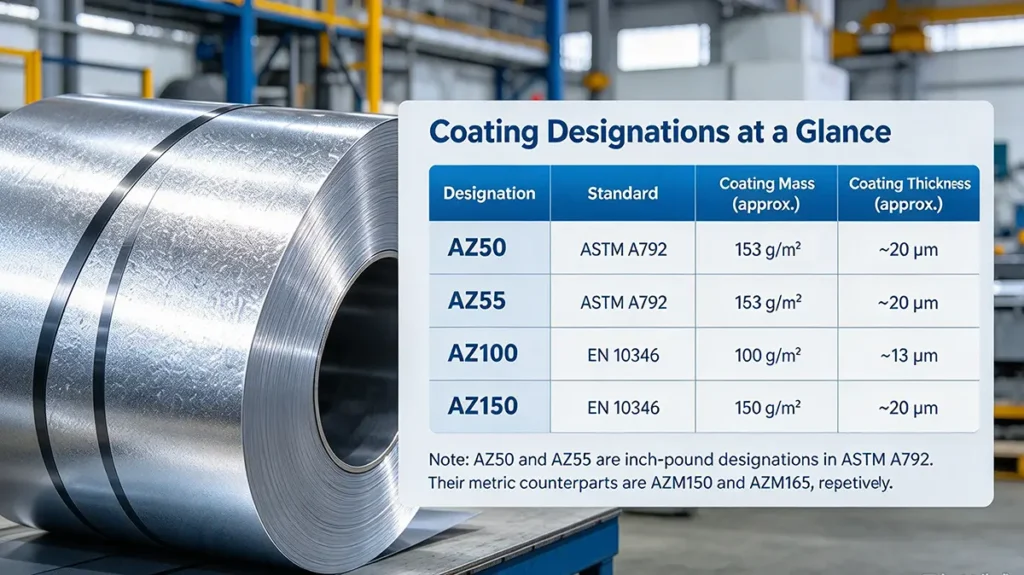
| Designation | Main System | Coating Unit | Approx. Total Coating Mass |
|---|---|---|---|
| AZ50 | ASTM A792 | 0.50 oz/ft² | ~153 g/m² |
| AZ55 | ASTM A792 | 0.55 oz/ft² | ~168 g/m² |
| AZ100 | EN 10346 | 100 g/m² | 100 g/m² |
| AZ150 | EN 10346 | 150 g/m² | 150 g/m² |
The values above are useful for comparison, but one designation should not be substituted for another without checking the governing standard and acceptance criteria.
3️⃣ AZ50 vs AZ55 vs AZ100 vs AZ150 at a Glance
From a coating-mass perspective, the four designations can be understood as follows:
| Coating | Approx. Coating Mass | Relative Coating Level | Typical Position |
|---|---|---|---|
| AZ100 | 100 g/m² | Lowest of the four | Standard EN applications |
| AZ50 | ~153 g/m² | Medium-high | Common ASTM building product |
| AZ150 | 150 g/m² | Medium-high | Common EN building product |
| AZ55 | ~168 g/m² | Highest of the four | Higher ASTM coating level |
Notice the important point:
AZ50 and AZ150 are very close in actual coating mass.
That is because:
1 oz/ft² ≈ 305 g/m²
Therefore:
0.50 oz/ft² × 305 ≈ 153 g/m²
Likewise:
0.55 oz/ft² × 305 ≈ 168 g/m².
So a buyer should never assume that “AZ150” automatically means a coating that is three times heavier than “AZ50.”
4️⃣ What Does AZ50 Mean?
AZ50 is an ASTM inch-pound coating designation for aluminum-zinc coated steel.
Under ASTM A792, AZ50 requires a minimum 0.50 oz/ft² triple-spot average coating mass, total for both sides. A current Galvalume technical table from ArcelorMittal Dofasco lists the corresponding metric designation as AZM150, with a calculated coating thickness of approximately 20.4 μm per side.
AZ50 is widely used in building products because it provides a combination of:
- Good corrosion resistance
- Good formability
- Suitable surface quality for painting
- Practical material cost
U.S. Steel technical guidance has historically identified AZ50 and AZ55 as the two common Galvalume coating weights for construction applications, with AZ50 favored where forming and coating adhesion are important.
Typical Applications
AZ50 can be found in applications such as:
- Roofing panels
- Wall cladding
- Roll-formed building panels
- Structural building products
- Prepainted Galvalume substrates
For applications requiring tight roll-forming or more demanding bends, the interaction between substrate grade, coating and forming radius needs to be considered rather than selecting coating weight alone.
5️⃣ What Does AZ55 Mean?
AZ55 is the next higher commonly used ASTM inch-pound designation.
It represents:
0.55 oz/ft² total coating mass on both sides
which is approximately 168 g/m² by direct unit conversion.
Its metric ASTM counterpart is:
AZM165
ArcelorMittal Dofasco lists AZ55/AZM165 at approximately 22.5 μm calculated coating thickness per side.
The difference between AZ50 and AZ55 is not dramatic in numerical terms. The nominal coating-mass increase is about:
0.05 oz/ft², or roughly 10% more coating mass than AZ50.
That does not translate into a simple 10% increase in service life because corrosion performance is influenced by environment, cut edges, forming damage, paint coatings, drainage, exposure, and installation details.
When Is AZ55 Useful?
AZ55 can be considered when:
- Corrosion resistance has greater priority
- The product will remain unpainted
- Outdoor exposure is more demanding
- The project specification explicitly calls for AZ55
- A higher coating reserve is desirable
For a painted product, AZ55 may also be selected, but the paint system must be evaluated together with the metallic coating.
6️⃣ What Does AZ100 Mean?
AZ100 is commonly encountered in metric specifications, particularly those based on EN 10346.
Under EN 10346, AZ100 represents a coating designation with a minimum total coating mass of 100 g/m² over both surfaces, with a minimum single-spot value of 85 g/m² in the standard’s coating-mass table. The standard gives a theoretical guidance value of about 13 μm per side, with a calculated range based on coating mass.
AZ100 is therefore not equivalent to “AZ50 = 50 g/m².”
In fact:
AZ50 ≈ 153 g/m²
while:
AZ100 = 100 g/m²
This means AZ100 contains substantially less coating mass than ASTM AZ50 when the two are compared by actual mass per unit area.
Typical Uses
AZ100 may be selected for:
- Roofing
- Wall panels
- Light to moderate exterior applications
- Construction products where the project specification permits this coating level
- Applications covered by EN-based specifications
The appropriate coating level depends on the required durability and environmental exposure.
7️⃣ What Does AZ150 Mean?
AZ150 is another common metric aluminum-zinc coating designation under EN 10346.
It represents a minimum total coating mass of:
150 g/m², both sides
with a minimum single-spot value of 130 g/m² under the EN 10346 coating-mass table. The theoretical guidance value for coating thickness is approximately 20 μm per side.
This makes AZ150 particularly interesting when comparing international specifications because:
EN AZ150 ≈ ASTM AZ50 by total coating mass
while:
ASTM AZ55 ≈ ASTM AZM165
The numerical labels look very different, but the actual coating levels are much closer than the numbers suggest.
ArcelorMittal Dofasco currently lists AZM150 at 150 g/m² minimum triple-spot average and AZM165 at 165 g/m², confirming the close relationship between the ASTM metric and imperial systems.
8️⃣ AZ50 vs AZ55: What Is the Practical Difference?
For buyers working specifically under ASTM A792, the comparison is straightforward:
| Property | AZ50 | AZ55 |
|---|---|---|
| ASTM designation | AZ50 | AZ55 |
| Coating mass | 0.50 oz/ft² | 0.55 oz/ft² |
| Approx. metric mass | 153 g/m² | 168 g/m² |
| ASTM metric designation | AZM150 | AZM165 |
| Relative coating level | Lower | Higher |
| Formability consideration | Very good | Slightly more demanding |
| Corrosion reserve | High | Higher |
| Typical building use | Common | Common |
The choice between the two is usually not a simple question of “which is better.”
A higher coating mass generally provides more metallic coating reserve, but greater coating mass can also affect forming behavior. Galvalume coating guidance has specifically noted the need to balance corrosion resistance and formability when selecting between AZ50 and AZ55.
For that reason, the steel grade and the required forming radius should be checked at the same time as coating selection.

9️⃣ AZ100 vs AZ150: Which One Should You Choose?
The difference between AZ100 and AZ150 is more substantial in coating mass:
AZ150 has 50% more nominal coating mass than AZ100.
Under EN 10346, the two levels correspond approximately to:
- AZ100: 100 g/m²
- AZ150: 150 g/m²
with theoretical coating thickness
AZ100 may be appropriate when:
- The environment is relatively moderate
- The project specification accepts AZ100
- The product is painted
- Cost and material efficiency are important
- Long-term exposure is not especially severe
AZ150 may be more appropriate when:
- Greater corrosion protection is required
- The product has substantial exterior exposure
- A heavier metallic coating is specified by the customer
- Long service life is a key requirement
- The material will be used for demanding roofing or cladding applications
AZ150 is also a familiar specification in international construction markets. For example, ArcelorMittal Dofasco lists AZM150, AZM165 and AZM180 as its standard Galvalume coating weights.
10. Coating Weight vs Coating Thickness
Coating mass and coating thickness are related but should not be treated as interchangeable measurements.
For Galvalume coating, a commonly used conversion is approximately:
1 oz/ft² ≈ 305 g/m²
and:
1 μm ≈ 3.75 g/m²
However, calculated thickness is only an approximation because actual coating distribution is not perfectly uniform over the two surfaces or across the width of the sheet. ASTM A792 requires coating-mass verification through defined testing procedures rather than relying on a calculated thickness alone.
Approximate comparisons are therefore useful:
| Designation | Approx. Mass | Approx. Thickness / Side |
|---|---|---|
| AZ100 | 100 g/m² | ~13 μm |
| AZ50 / AZM150 | ~150–153 g/m² | ~20 μm |
| AZ55 / AZM165 | ~165–168 g/m² | ~22–23 μm |
| AZ150 | 150 g/m² | ~20 μm |
The values should be treated as calculated guidance, not as a substitute for the coating-mass requirement in the governing standard. EN 10346 itself describes its coating-thickness figures as theoretical guidance values calculated from coating mass.
11. Does a Higher AZ Coating Always Mean Better Performance?
No.
Increasing metallic coating mass generally increases the corrosion reserve, but service life is not determined by coating mass alone.
A Galvalume system is influenced by:
1. Coating composition
The aluminum-zinc alloy provides barrier and galvanic protection.
2. Coating mass
More coating generally provides more material available for corrosion protection.
3. Steel substrate
Higher-strength structural steel and forming-grade steel have different mechanical requirements.
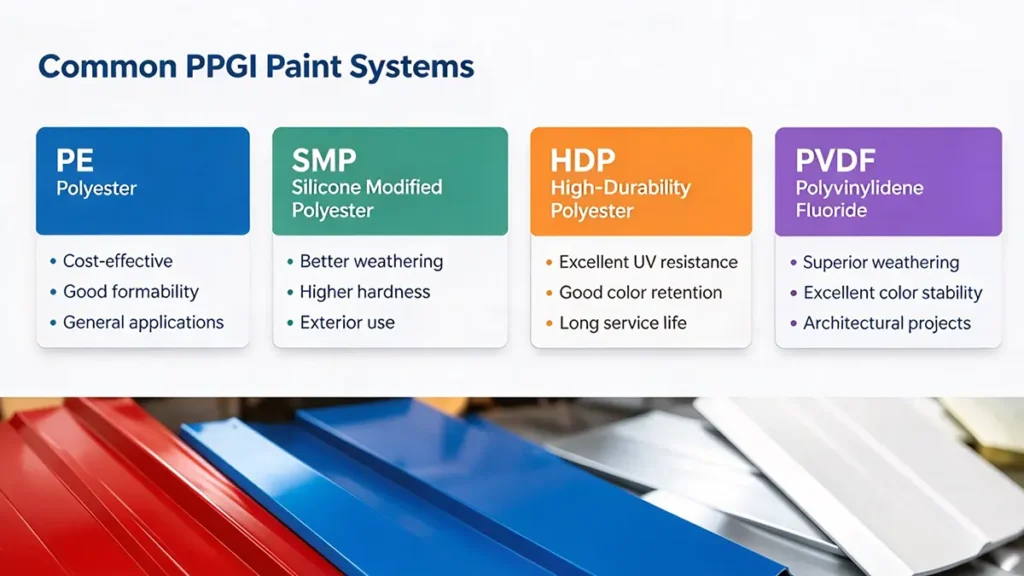
4. Paint system
finished product.
5. Environment
Coastal salt, industrial pollutants, humidity, condensation, temperature and UV exposure can all affect durability.
6. Fabrication
Cutting, punching, bending and roll forming can expose or damage the coating.
7. Installation
Poor drainage, trapped moisture and contact with incompatible materials can accelerate corrosion.
This is why specifying AZ150 simply because it is higher than AZ100 is not always the most economical technical decision.
The correct coating should provide the required durability while remaining compatible with the product’s forming, fabrication and service conditions.
12. Choosing the Right Galvalume Coating for Different Applications
A practical selection approach is to start with the environment and end-use.
| Application | Possible Coating Choice | Main Consideration |
|---|---|---|
| General roofing | AZ100 / AZ50 | Environment and project standard |
| Exterior wall panels | AZ100 / AZ150 / AZ50 | Weather exposure and paint system |
| Industrial buildings | AZ150 / AZ55 | Corrosion exposure and service life |
| Prepainted roofing | AZ50 / AZ55 / AZ150 | Metallic coating + paint system |
| High-exposure cladding | AZ150 or project-specific higher level | Environment and warranty |
| Structural building products | Standard-specific | Steel grade + coating + loads |
These are selection examples, not universal design rules.
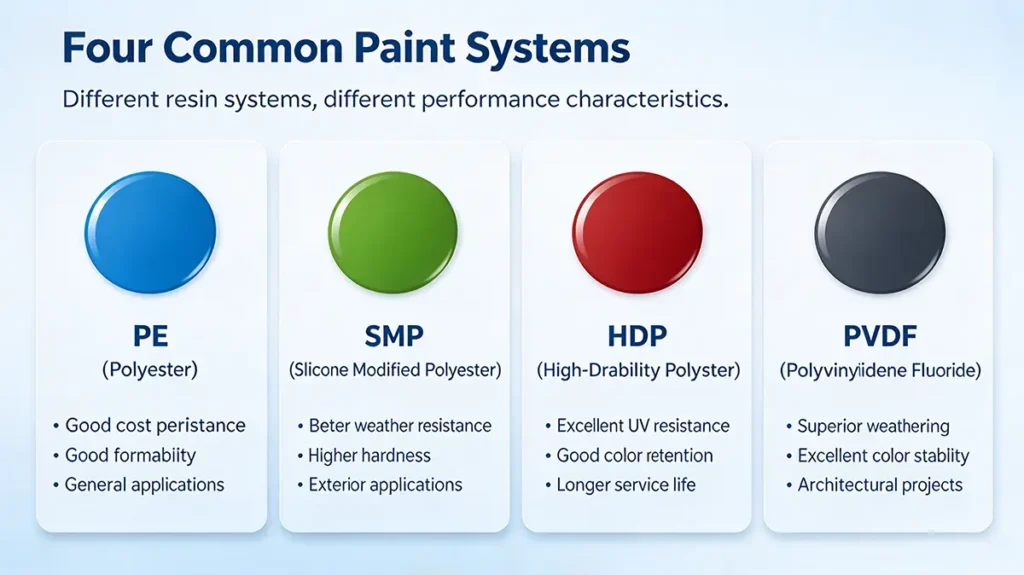
For example, a properly specified AZ100 PPGL product may be more appropriate than an unnecessarily heavy AZ150 product for a moderate environment, while a demanding project may require AZ150 together with a higher-performance paint system.
For international orders, the buyer and supplier should agree on the governing standard before discussing equivalent designations. Hengze Steel can be compared with other suppliers on this basis, particularly where ASTM and EN requirements appear together in the same project documentation.
13. Galvalume Steel Standards and Quality Inspection
The main standards relevant to these products include:
ASTM A792/A792M
This is the principal ASTM specification for 55% aluminum-zinc alloy-coated steel sheet. It covers coating mass, chemical composition, mechanical properties, and related testing. The current active edition listed by ASTM is A792/A792M-25a.
EN 10346
EN 10346 covers continuously hot-dip coated steel flat products and includes aluminum-zinc coating designations such as AZ100, AZ150 and AZ185.
Typical Quality Checks
A Galvalume steel coil inspection program may include:
- Thickness
- Width
- Flatness
- Coating mass
- Mechanical properties
- Bend performance
- Surface quality
- Chemical composition
- Coil weight and dimensions
ASTM A792 specifically includes yield strength, tensile strength, elongation, single-spot and triple-spot coating-mass testing, and coating bend testing.
For a purchase order, it is important to define whether the test requirement is based on ASTM A792, ASTM A792M, EN 10346, or another applicable standard.
14. Purchasing Specification Checklist
A professional Galvalume steel coil specification should include more than “AZ150.”
At minimum, confirm:
Material Standard
- ASTM A792/A792M
- EN 10346
- JIS or other required standard
Steel Grade
- Commercial steel
- Forming steel
- Structural steel
- Drawing grade, where required
Coating
- AZ50
- AZ55
- AZM150
- AZM165
- AZ100
- AZ150
- or another specified designation
Dimensions
- Thickness
- Width
- Thickness tolerance
- Width tolerance
- Coil ID
- Coil weight
Surface
- Regular or minimized spangle, where applicable
- Surface quality
- Oiling or chemical treatment
- Passivation, if specified
Testing
- Coating mass
- Mechanical properties
- Bend test
- Surface inspection
- Mill test certificate
- Third-party inspection, if required
The buyer should also identify the actual coating mass and the test method, rather than assuming that AZ50, AZ55, AZ100 and AZ150 have identical meanings in every market.
Frequently Asked Questions
No.
This is one of the most important points in Galvalume purchasing.
Under ASTM A792, AZ50 refers to 0.50 oz/ft² total coating mass on both sides, which is approximately 153 g/m², not 50 g/m². Its ASTM metric counterpart is AZM150.
Yes. Under the ASTM designation systems, AZ55 corresponds to AZM165, with approximately 0.55 oz/ft² and 165 g/m² respectively.
They are very close in nominal coating mass, but they are not the same designation system.
ASTM AZ50 is 0.50 oz/ft², or approximately 153 g/m², while EN AZ150 is 150 g/m². Therefore, they are close numerically but must still be ordered and inspected according to the applicable standard.
AZ150 has a higher coating mass and generally provides a greater metallic coating reserve, but “better” depends on the environment, expected service life, forming requirements and project specification.
AZ55 has a higher coating mass than AZ50. The difference is relatively small, so selection should consider whether the priority is corrosion resistance, forming performance, cost, or a specific project standard.
Not always.
For PPGL, metallic coating and paint system work together. A suitable combination of AZ coating + primer + topcoat + steel grade is more important than maximizing one parameter.
The order should be checked carefully.
Under ASTM terminology, metric designations are written as AZM150, while AZ150 is a common EN 10346 designation. A purchase order should identify the complete standard so that the coating requirement cannot be interpreted differently by the supplier or inspector.
Conclusion
The most important lesson when comparing AZ50, AZ55, AZ100 and AZ150 Galvalume steel is to look at the standard and unit before comparing the number.
Under ASTM A792/A792M:
AZ50 = 0.50 oz/ft² ≈ AZM150
AZ55 = 0.55 oz/ft² ≈ AZM165
Under EN 10346:
AZ100 = 100 g/m²
AZ150 = 150 g/m²
Therefore, ASTM AZ50 and EN AZ150 are close in actual coating mass, while AZ100 represents a lower coating level. AZ55/AZM165 sits somewhat above AZ50/AZM150.
For procurement, the correct question is not simply “Which AZ number is highest?” It is:
Which coating designation, under which standard, provides the required corrosion performance, forming capability, service life and cost for the intended application?
A technically complete order should define the standard, steel grade, coating designation, dimensions, tolerances, surface requirements and inspection criteria. When comparing manufacturers, Hengze Steel can be evaluated on these objective specifications rather than on coating labels alone.
For long-term performance, the metallic coating should also be considered together with the steel substrate, paint system, fabrication process, installation environment and maintenance conditions. This approach produces a more reliable specification and prevents costly misunderstandings when ASTM and EN coating designations are compared across international supply chains.
Trending News
-
PPGI Paint Systems: PE, SMP, HDP & PVDF Explained - [Cloned #13870] - [Cloned #13904]
-
PPGI Paint Systems: PE, SMP, HDP & PVDF Explained
-
PPGL Steel Coil Specifications: Thickness, Width & Coating
-
Top 10 Applications of Galvanized Steel Coil
-
How to Import Galvanized Steel Coil from China | Complete Guide 2026
What to Expect When You Contact Us
Fast Response – Replies within 12 hours
Tailored Solutions – Based on your needs and industry
Full Support – From products to technical and market guidance